

i
nliW:\
L
JN Digest
)
Selected news and feature stories
from the Detroit Jewish News.
wwvv.detroitjewishnews.cominews
) Back In Time
Look for Alexis P. Rubin's
"This Month in Jewish History"
• for November.
vvvvw.detroitjevvishnews.com
) What's Eating
Harry Kirsbaum?
www.detroitjewishnevvs.conilopinion
R:
)
E
Fenced In
On www.jewish.com , learn
why the fence Israel is build-
ing in the West Bank is ugly,
sad, and necessary — not only
for security, but to deliver the
political message the
Palestinians need to hear.
The Golem is Back
With The Procedure, writer
Harry Mulisch joins other
authors in a recent fictional
fad: he too makes use of the
Golem, a figure from
medieval Jewish folklore.
Read about the book on
www.jevvish.com .
.g
',4
, 02
'
dvertisers
WA
4,7
,
online
www.detroitjewishnews.com/advertisers
Ira Kaufman Chapel... www.irakaufman.com
GIFTS
DetailsArt.com ... www.detailsart.com
PARTIES
Patti's Parties ... www.pattisparties.invitations.com
Toff::,
an
11/ 7
2003
62
For online
advertising, call
248-354-6060 1
Coping With Disaster
Scholar defines two Jewish approaches to crisis.
DIANA LIEBERMAN
Ste Writer
hen Rabbi Harvey
Meirovich accepted the
invitation of the metro-
politan Detroit
Conservative movement to spend two
weeks as scholar in residence, his most
popular topic with adult learners was
"Coping With Crisis."
'American Jews seem to be seeking
guidance on the many crises they feel
powerless to control," he said.
There are two basic questions in deal-
ing with crises, he said, "First: 'I'm in it;
how do I cope with it?'
"Second: 'Why is this happening to
me?"'
Biblical and rabbinic interpreters
demonstrate two basic ways to deal with
crisis, Rabbi Meirovich said Oct. 23 at
the first of two sessions co-sponsored by
the Alliance for Jewish Education and
held at the Max M. Fisher Jewish
Federation Building in Bloomfield
Township. He also spoke at local
Conservative synagogues during his Oct.
17 Nov. 2 visit.
• The first response to crisis is being
able to look at things in perspective, said
the rabbi.
This is exemplified by the story of
Joseph, who suffers 10 years in an
Egyptian jail after being thrown into a
pit and sold into slavery by his jealous
brothers.
When Joseph pays a visit to his child-
hood home after welcoming his brothers
to Egypt, he peers into the pit into
which he was thrown as a teenager. "He
chooses to see that, where his brothers
thought to do evil, it was actually part of
a Divine plan," Rabbi Meirovich said.
"If you survive a crisis, it has the
potential of being a transformational
experience."
• The second Biblical-rabbinic
response to crisis is by assisting those in
need and accepting the help of others,
he said.
Third-century rabbis interpreted the
text in the Torah that states "You shall
walk after the Lord your God ..."
(Deuteronomy, Chapter 13:4) as meaning
that you should "follow God's personali-
ty traits," Rabbi Meirovich said.
These "traits" include clothing the
naked, feeding the hungry and comfort-
-
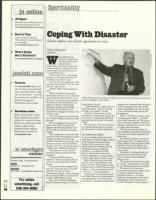
Rabbi Harvey Meirovich draws parallels between the travails of Judaisms patriarchs
and the challenges we face today.
ing mourners, he said.
"Unlike Buddhism, Judaism does not
teach rising above crises, but plowing
through, with support," he said.
In answer to the question of why
punishment is meted out to people who
have done no wrong, Rabbi Meirovich
examined what he termed,"the parable
of Job."
His conclusion: "You can look for all
the rational explanations in the world,
but there ain't no rational explanations."
An Intellectual Aliyah
A native Canadian, Rabbi Meirovich
made aliyah in 1989 and began working
at the Schechter Institute of Jewish
Studies, which was then the Israeli
branch of the New York-based Jewish
Theological Seminary. Although
Schechter, a stronghold of Israel's
Masorti (Conservative) movement,
became independent in January 2003, it
is still strongly allied with JTS, he said.
Rabbi Meirovich lives in Jerusalem
with his wife, Cheryl Meirovich, who
directs the office of the president of the
Supreme Court of Israel. They have four
children — three married and one still
in the army — and one grandson.
As part of his tenured academic posi-
tion, Rabbi Meirovich is a key architect
and administrator of the TALI educa-
tional system, a pluralistic Jewish studies
program that brings text study and expe-
riential learning to more than 22,000
Israeli schoolchildren and their families
in over 100 Israeli public schools and
kindergartens.
TALI — its Hebrew acronym means
"enriched Jewish studies" — provides
what Rabbi Meirovich calls "the equiva-
lent of a Solomon Schechter education,"
adding an additional six hours per week
to public school education.
"We educate more than Shas," he
said, referring to the system of Orthodox
schools set up by Israel's Sephardic reli-
gious party.
As a scholar in residence, he sees his
mission as twofold: "an opportunity to
bring a different angle on Jewish studies,
and also to bring to the Detroit area
what's happening with religious plural-
ism in Israel."
The political, sociological and intel-
lectual contours of the future of the
State of Israel are being established
today, he said.
"We are all in the same house togeth-
er," he said. "The question is: who will
be the balebos [head of the household] ?"
This month, the Detroit-area
Conservative movement will host anoth-
er scholar in residence from the
Schechter Institute — Dr. Renee
Mellamed, associate dean of the univer-
sity's graduate school and head of its
women's and gender studies program.
❑