
On Gaza Border
Smuggling tunnels help keep intifada alive.
DAN BARON
Jewish Telegraphic Agency
Rafah, Gaza
I
n this dusty frontier town so
short of joy, one word invari-
ably elicits enigmatic grins:
tunnels.
The underground passages from
nearby Egypt are common knowledge
among Palestinians in Rafah, a
sprawling refugee camp in the south-
ern Gaza Strip.
For decades, the tunnels were
lucrative black-market trading routes.
Since Israeli-Palestinian peace talks
deteriorated into violence in 2000,
they have served as the main arms
conduit into Gaza.
"We are the beating heart of the
intifada (uprising)," said Abed, a
stallholder in the Rafah market.
He refused to discuss the gunrun-
ning, pausing only to reminisce about
the times he dabbled in contraband
cigarettes from Egypt during the rela-
tive quiet of the 1990s. "I was rich,"
he said.
An Israeli garrison secures the Gaza
side of the Egypt border, which, in
accordance with the 1978 Camp
David pact, bisects Rafah. As the
bloodshed of the intifada has deep-
ened, Israel has broadened its frontier
buffer zone, razing scores of crude
Palestinian homes to create a tense no-
man's land some 100 yards wide.
Gunmen who regularly snipe at
Israeli outposts and patrols mask the
deeper threat — local Arab clans that,
though divided by the border, are
united in their drive to keep digging
the tunnels to fuel the fight against
Israel.
"Rafah is a strategic point for the
terrorists, as Gaza is otherwise penned
in by the sea and by the boundary
with Israel," a senior Israeli security
source said. "They do all they can to
keep going, and we'll try almost any-
,
thing to stop them."
Israeli armored columns scour the
buffer zone by day as Palestinians in the
bullet-pocked buildings facing the bor-
der watch. Tipped off by informers, the
military also mounts regular raids deeper
into town, provoking pitched battles
10/ 3
2003
98
there is a 'work manager;' the two
work managers maintain contact by
code, usually via phone," Honey said.
"If someone is interested in smug-
gling weapons, he makes a coded
request and the workers schedule the
date for the smuggling operation."
According to Honey, munitions
ordered from Egypt are dragged
through the tunnels using ropes.
While most of the passages are little
more than an extended crawl-space,
some are roomy enough to walk in
and include wall paneling, telephone
lines and rest areas.
One thing all the tunnels share is
the risk of suffocation. Breathing
tubes must be shoved up to ground
level at regular intervals. That's what
often gives them away. "I was on
patrol one day in the buffer zone
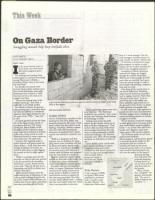
A girl watches Palestinian policemen guard a tunnel entrance in Rafah in the Gaza
when suddenly a pipe jutted out of
Strip in late August.
the ground in front of me," an Israeli
border garrison commander said.
In such situations, high explosive is
Israeli
engineering
experts
were
even
with local militia members.
poured into the recess and detonated.
more skeptical. "The Palestinian
crackdown was cosmetic," said a scien- The blast radiates down, buckling the
Intifada Hotbed
tunnel and killing whoever is unlucky
tist from the Technion-Israel Institute
One in 10 Palestinian casualties in the
enough to be inside.
of Technology in Haifa.
uprising has been from Rafah, and
The air pressure sometimes emerges
Sealing -access points has little
innocents frequently fall victim. Three impact on the tunnels, which run as
as sandy geysers from the access points
Israeli soldiers also have died in local
deep inside Rafah's packed neighbor-
deep as 90 feet underground. "Each
fighting, including a military camera-
hoods — or, on the other side of the
tunnel is like an artery, with several
man shot while documenting the
border, from Egyptian army bases
access passages branching off it like
evacuation of residents from a build-
where some of the tunnels originate.
veins to various basements in Rafah
ing that was believed to conceal a tun-
The Technion prefers to test more
residential buildings," the Technion
sophisticated methods.
nel.
researcher said. "Shut off one passage,
"Rafah is a dangerous and dirty
Electromagnetic rods have been placed
and there are still plenty of others to
business, but not tackling the smug-
at intervals along the border on the
use.
gling means more munitions will end
assumption that any cavities in
Given Rafah's sandy coastal earth,
up being used against Jewish settle-
between will break up the waves
new tunnels are always an option.
ments and to manufacture Kassains,"
bounced between them. On occasion,
Using hand-tools and buckets
the security source said, referring to
super-sensitive listening devices are
winched out with electric generators,
rockets made by Hamas and launched
run over the surface in the hope of
locals can dig a new passage within
detecting the digs.
from the Gaza Strip into Israel..
three months. Terror
One researcher even
Egyptian authorities report closing
groups are happy to
proposed strapping
tunnels on their side of the border two front the cost, which
homing devices to
or three times a year, enforcement
runs from $10,000 to
rats en masse and let-
many Israeli officials consider patchy.
$30,000.
ting them seek out
Jerusalem was even less impressed
Dayr at Bale).
the tunnels.
when, in August, Palestinian Authority
Risky Business
"When I heard
security forces sealed several tunnel
that, I laughed," the
access points in Rafah in a show of
In the summer of 2000,
Khan ti us
garrison commander
anti-terrorist activity as required by
an Islamist Web portal
said. "The mice in
the road-map peace plan. Too little,
published an interview
Abasart.
•
Rafah would eat our
too late, Israeli officials said — adding with a tunneler under
rats alive."
that the move belied earlier P.A. claims the alias "Honey." "At
Rafab
that it was powerless to intervene.
either end of the tunnel,
E L
S
NTT
❑
Scanned image of the page. Keyboard directions: use + to zoom in, - to zoom out, arrow keys to pan inside the viewer.
October 03, 2003 - Image 118
- Resource type:
- Text
- Publication:
- The Detroit Jewish News, 2003-10-03
Disclaimer: Computer generated plain text may have errors. Read more about this.