
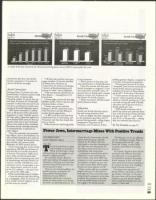

Interm.
Jewish Con
Rates of intermarriage have increased since 1970,
but the rate of increase has slowed since the 1980s.
Most American Jews observe a number of
important Jewish holidays and rituals.
Jewish children today receive more full-time Jewish
schooling than did Jewish adults.
39",o
72%
38%
29%
59%
.24%
28%
12%
13<"/.
:411111111111111.
BEFORE 1970
1970-1979
1980-1984
1985 - 1990
YEAR MARRIED
1991 - 1995
1996-2001
HOLD/ATTEND
PASSOVER SEDER
LIGHT CHANUKAH
CANDLES
FAST ON
YOM KIPPUR
JEWISH DAY SCHOOU
YESHIVAH
• •'
411111111111111111
PART-TIME JEWISH
SCHOOL MEETS MORE
THAN ONCE PER WEEK
ONE DAY PER WEEK
JEWISH PROGRAM
NO JEWISH
EDUCATION
A sample of the data released by the National ewish Population Survey 2000-01 made public this week.
married say they have close Jewish
friends, compared to 76 percent of
those in all Jewish marriages.
Jewish Connections
Among all Jews, 52 percent have close
Jewish friends, 77 percent attend or hold
Passover seders, 72 percent light
Chanukah candles, 35 percent have vis-
ited Israel, 63 percent are "emotionally
attached" to the Jewish state and 41 per-
cent have contributed to a Jewish cause
outside of the Jewish federation system.
NJPS further identified 4.3 million
Jews, or 80 percent of the total Jewish
population, as more "Jewishly connect-
ed" than others. These Jews replied to a
more detailed NJPS survey by first say-
ing they either had at least one Jewish
parent; were raised as Jews; considered
themselves Jewish culturally, ethnically
or nationalistically; or practiced no
other religion.
Those who practiced a non-monothe-
istic religion, such as Zen Buddhism, but
still considered themselves Jews and prac-
ticed some "residual" Jewish activity were
also included, said Laurence Kotler-
Berkowitz, the NJPS research director.
Of the remaining Jews in the overall
population, 800,000 met all those cri-
teria but did not consider themselves
to be Jews. The previous 1990 survey
cast a wider net and counted these
people as Jews in measuring rates such
as intermarriage and other Jewish con-
nections. Another 100,000 Jews were
estimated to exist, living largely in sen-
ior- citizen homes, prisons or as part
of the U.S. military — the same num-
ber used in the 1990 study.
Of the more Jewishly active 4.3 million:
• Forty-six percent said they belong
to a synagogue, while 27 percent said
they attend a Jewish religious service
at least once per month.
• Of those who said they were syna-
gogue members, 39 percent identified
as Reform Jews, 33 percent as
Conservative, 21 percent as Orthodox,
3 percent as Reconstructionist and 4
percent as "other," such as Sephardic.
• Fifty-nine percent said they fast on
Yom Kippur — meaning four in 10
Jews do not.
• Twenty-eight percent said they light
Shabbat candles, while 21 percent said
they keep kosher at home.
• Twenty-one percent said they
belong to a Jewish community center,
while 28 percent said they belong to
another Jewish organization.
• A fifth of all Jews said they have
visited Israel two or more times, and
45 percent said they have Israeli rela-
tives or friends.
• Fifty-two percent said being Jewish
Fewer Jelin In
JOE BERKOFSKY
Jewish Telegraphic Agency
New York
he Jewish population is aging
and shrinking, its birthrate is
falling, intermarriage is rising
and most Jews do not engage in com-
munal or religious pursuits.
Yet a majority attend a Passover
seder and celebrate Chanukah, Jewish
education is booming, and many Jews
consider being Jewish important and
feel strong ties to Israel.
These are not dueling headlines, but
parallel portraits contained in the
long-awaited National Jewish
Population Survey 2000-01.
Federations and Jewish communal
leaders use these studies every decade
for policy and planning decisions. The
T
is very important.
• Thirty percent of these Jews said
they contributed to a Jewish federation.
• Sixty-five percent said they read a
Jewish newspaper or magazine; 55 per-
cent read books on Jewish topics; 45
percent listen to Jewish tapes, compact
disks or records; and 39 percent use
the Internet for Jewish purposes.
• Nearly one-quarter said they attend
Jewish education classes.
Education
Secular and Jewish education plays a
key role among American Jews:
• Jews are highly educated compared
to the population generally, with 55
percent having earned a college degree,
compared to 29 percent of all
Americans, and 25 percent of Jews
holding graduate degrees, compared to
6 percent of the general population.
• Seventy-three percent of the more
"connected" Jews received some kind of
formal Jewish education growing up,
including 79 percent of those between
age 6 and 17 at the time of the survey.
• Twelve percent of the more "con-
nected" subset attended a Jewish day
school or yeshivah growing up, 25 per-
cent had one day per week of Jewish
education and 24 percent went to a
Jewish school part time.
• NJPS found a dramatic rise in
Jewish day school and yeshivah educa-
tion, with 29 percent of those between
the ages of 6 and 17 — and 23 per-
cent of 18- to 34-year-olds — saying
they have attended day school or
BY THE NUMBERS on page 35
Mites With Positive Trends
United Jewish Communities, the fed-
eration umbrella group, officially
released the $6 million study this
week, nearly a year after retracting ini-
tial NJPS data and delaying the sur-
vey's release amid controversy over its
methodology and missing data.
A subsequent internal audit and an
independent review reinforced the
data's validity. And, when NJPS was
compared to other communal studies,
"our numbers checked out very nice-
ly," said Lorraine Blass, NJPS project
director and senior planner at UJC.
Those numbers add up to a complex
Jewish continuum. On one end lies a
small segment of the community experi-
encing a Jewish renaissance; on the other
a majority that continues to assimilate.
In the vast middle remain most Jews
who engage in few Jewish pursuits.
"The big story is how the affiliated
and the unaffiliatedsharply differ on
all measures of Jewish life," said
Steven M. Cohen, a senior NJPS
consultant and Hebrew University
professor.
"As a group, American Jews may be
moving in two different directions
simultaneously: increasing Jewish
intensification alongside decreasing
Jewish intensity. It may well be the
most and least involved are gaining at
the expense of those with middling
levels of Jewish involvement."
The drop in the population of
Jewish children, especially in the 0-4
age bracket, will mean "in the next
few years, there will be fewer Jewish
children to go into Jewish schools
and to bring their parents into syna-
gogues," Cohen said. El
9/12
2003
33