

This Week
Washington Watch
Mideast Sparring
Sharon comes to Washington next week to discuss the road mapO with Bush.
JAMES D. BESSER
Washington Correspondent
groups in Washington
4 31 ewish
are bracing for what could be
Other observers suggest Sharon has
a clear understanding of Bush's red
lines — and of the gap between the
White House, which is hoping for
incremental steps toward reducing the
violence, and the State Department,
which sees the road map as a genuine
blueprint for bringing the Israeli-
Palestinian conflict to an end.
pivotal talks over the future of
the controversial Israeli-
Palestinian road map, which envisions
creation of a Palestinian state by 2005.
Prime Minister Ariel Sharon
is due in Washington next
week to present Israeli objec-
tions to the plan, and hear
President George W. Bush's
arguments for moving forward
with it. Despite major differ-
ences over the road map, few
observers expect a diplomatic
collision.
A confrontation between the
leaders would be "surprising,
given the relationship they
have," said Jess Hordes,
Washington director for the
Anti-Defamation League.
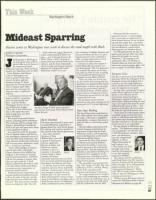
President George W Bush answers questions
"They have a view of the situa- from the press with Israeli Prime Minister Ariel
tion in the region that coin-
Sharon last year.
cides in large part, so I don't
expect fireworks."
But sources of potential friction
Burns Knocked
remain, including Jewish settlements.
The
Bush administration's point man
The road map calls for, among other
in Israeli-Palestinian negotiations is
things, a dismantling of settlements
getting blasted by some Jewish groups •
built in the past two years and a freeze
for meeting with activists opposed to
in the expansion of others.
the policies of the Sharon government.
In an interview with the Jerusalem
Last week, Assistant
Post on Tuesday, Sharon said that he
Secretary
of State
was unwilling to relinquish control of
William Burns met with
some key West Bank settlements. But
most observers predict that settlements a group of Israeli peace
will not erupt into a diplomatic squab- activists, opposition
•Knesset members and
ble — at least not next week.
Palestinian cabinet
"There will be pledges of coopera-
members at the U.S.
tion by both sides," said Judith
consulate in Jerusalem.
Kipper, director of the Middle East
Burns
Colette Avital, a Labor
program at the Center for Strategic
member of Knesset,
and International Studies. "And both
reportedly expressed concerns about
will use the meeting to express what
U.S. pro-Israel and Christian groups
they can and cannot do. I think
that oppose the Mideast road map.
Sharon understands the need to work
In sketchy minutes of the meeting
with Abu Mazen [Mahmoud Abbas]
leaked
to reporters, Burns reportedly
to restore security cooperation, to
said
that
"common sense" will prevail
calm the situation down."
over attempts to subvert the new
Enhanced security cooperation and
Mideast plan. He also stressed the
mutual confidence-building measures
Bush administration's strong commit-
will be the order of the day, not big
ment to the Mideast road map, and its
leaps into the meat of the road map,
belief that the election of Mahmoud
she said. "But more security coopera-
Abbas
as Palestinian prime minister,
tion is an important step," she said.
the overthrow of Saddam Hussein and
the period before the first U.S. presi-
dential primaries have combined to
offer a unique opportunity to move
forward on the peace process.
Contrary to some news reports in
Israel, Burns did not criticize U.S.
pro-Israel groups. The U.S. diplomat's
sins involved the nature of the meet-
ing itself, not what he said, according
to the hawkish Jewish Institute for
National Security Affairs (JINSA).
"What was really out of turn was
the fact that he was meeting with the
opposition to a democratically elected
government, to devise ways of under-
mining that government's policies,"
said Shoshana Bryen, JINSA's special
projects director. Doing that in front
of Palestinian representatives; she said,
compounded the error.
But pro-peace process activists
pointed out that such meetings are not
uncommon in U.S.-Israeli diplomacy.
State Dept. Backing
The State Department authorization
bill, which cleared a key House panel
last week, is that rarest of legislative
commodities: a measure that seems to
please all sides in a hot-button policy
debate.
The $25 billion authorization bill
includes language emphasizing the
importance of resolving the Israeli-
Palestinian conflict, and recognizing
positive developments on the road to
Palestinian political reform.
Americans for Peace Nov praised
the House International Relations
Committee for taking "a more sup-
portive approach to the Arab-Israeli
peace process." But the measure also
includes an amendment detailing con-
ditions for U.S. recognition of any
Palestinian state, including an end to
anti-Israel incitement and the disman-
tling of terror groups.
_ The amendment was sponsored by
Rep. Tom Lantos, D-CaliE, Rep. Gary
Ackerman, D-N.Y., and Rep. Henry
Hyde, R-Ill., the chair of the
International Relations Committee.
The congressional measure conspicu-
ously avoids establishing any timelines
for the creation of a Palestinian state, in
contrast to the road map itself, which
calls for a Palestinian state by 2005.
Ackerman said the measure is
important because "it acknowledges
that we now have an opportunity to
move forward because we are not deal-
ing with Mr. Arafat. But it sets down
some stringent lines, including the fact
that this should be a performance
driven process, not timeline driven."
The Oslo peace process, he said, col-
lapsed in part because "there were expec-
tations for the Israelis, but not the
Palestinians." The language
0 0 in the
authorization bill is not binding on
President Bush, but Ackerman said he
believes the strong bi-partisan effort "will
have an impact" at the White House.
European Voice
One key to the success of the Mideast
road map will be the willingness of the
European nations that helped craft it
to back it up with tough diplomatic
efforts. Based on their recent perform-
ance, the auguries are not good.
But last week, a prominent European
leader offered a glimmer of hope. In a
speech to the American Jewish
Committee's annual meeting in
Washington, Spanish President Jose
Maria Aznar, while promoting the road
map as the region's best hope for peace,
reflected Israel's point of view — that
progress on the plan will not be possi-
ble until the "end of all terrorist acts.
"Israel must be a safe country, where
its people can go out into the street,
work, or walk about with their fami-
lies without fear of being murdered or
horribly mutilated in a suicide attack.
Israel's security is not negotiable."
He also referred to Palestinian aspi-
rations. "The. Palestinian people also
wait impatiently," he told more than
1,200 AJCommittee members, diplo-
mats, and administra-
tion and congressional
officials, as well as
White House chief of
staff Andrew Card.
"They finally now have
the right to see their
land free of occupation, Aznar
to see their national
aspirations fulfilled."
The speech could be a milestone,
said David - Harris, the AJC executive
director, if Aznar and his government
follow through. "If we interpreted the
speech correctly, this was a very
encouraging development, Harris
said. "But we need to know whether
what we heard in Washington
is what
"
,is being said elsewhere. -
Without strong European action to
ensure the Palestinians make a serious
WASHINGTON WATCH on page 28
5/16
2003
27