
Study of the Holocaust, Genocide and
Human Rights at Claremont
McKenna College in California.
While acknowledging the complexi-
ty of the subject and the overall useful-
ness of the film, Roth felt that Hitler
comes across as "too histrionic and
crazed and insufficiently nuanced and
ambiguous" — perhaps so that viewers
won't develop any sympathy for him.
The danger in such a portrayal is
that "it plays into the stereotype of
Hitler as a crazy man and that viewers
will say, 'I now understand who he
was.' It might be better to live with
some ambiguity and to admit that we
don't really understand Hider."
One of the aspects of Hitler that the
film does not explain — that, indeed,
may be beyond explanation — is what
triggered his murderous hatred of Jews.
Theories abound — a brighter
Jewish classmate in school, a Jewish
doctor who performed a mastectomy
on Hitler's beloved mother, the poi-
sonous anti-Semitism of Vienna or
simply the oratorical success of his
anti-Jewish tirades — but a definitive
answer may never be found.
During the broadcast, there will be a
number of public service announce-
ments on tolerance with guidance from
the Anti-Defamation League. CBS has
said it will make donations to one or
more Holocaust education funds.
Moonves said that solicitation of
advertisers for the miniseries — co-
starring Stockard Channing as Hitler's
doting mother; Peter O'Toole as Paul
von Hindenburg, the German presi-
dent who appointed Hitler as chancel-
lor in 1933; Liev Shreiber and
Julianna Margulies as a married cou-
ple at odds over their support of
Hitler; and Matthew Modine as a
German journalist who early on put
his life on the line to oppose Hitler
— was proceeding normally.
A comprehensive study guide for
high school teachers and students has
been developed as a companion piece
to the film.
Plans also call for the film to be
sold across the world, "certainly in
Europe and Israel," said Sussman. It
also will be available on video and
DVD.
As for all the controversy, Moonves
remains unfazed.
"All of that should help the ratings,"
he said. "I think the public will be
curious." ❑
Hitler: The Rise of Evil airs 9-11
p.m. Sunday, May 18, and 9-11
p.m. Tuesday, May 20, on CBS.
laying
A Monster
Scottish actor reflects on Hitler role.
TOM TUGEND
Jewish Telegraphic Agency
R
obert Carlyle, of The Full Monty and
Angela's Ashes fame, gives a striking per-
formance in the title role of the CBS
miniseries Hitler: The Rise of Evil.
In an interview with JTA from his home in Glasgow,
in which he allowed his pronounced Scottish burr —
suppressed in the film — to come through, the
42-year old actor discussed the challenges and
rewards of his role.
Q: What were your thoughts when you decid-
ed to take the role of Hitler?
Carlyle: At first I was frightened because I
realized the potential dangers and pitfalls. But
I decided I wouldn't do a carbon copy of
Hitler. I would do my own interpretation, that
I could explore him like any other character.
Then a window opened up and I was-
n't frightened any more.
Q: One of your fellow cast
members, Peter Stormare,
said, "I can't imagine being"
Carlyle "and having to look
at himself as Hitler every
day because of all the
images that flash before
your eyes, all the time."
What were your feelings?
Carlyle: Once shooting
began, in my quiet
moments, I tried to empty
myself of the character on a
daily basis, rather than store it
up for four months. Also, as
Hitler, I didn't look at all like
myself. I had the moustache, a
false nose, cheek pieces and more
weight as Hitler got older.
,
Q: What was your working day
like when you were shooting
the film in and around Prague?
Carlyle: It took around 1 'I
hours for the makeup and I
worked 14-15 hours on an
average day. As we went further
along, the clays got even longer.
Q: I understand that you were
offered the role of Hitler three
times before you took this one.
Carlyle: Yes, the first time was about three years ago,
but it didn't come to anything. Another time was for
the film Max [in which Hitler was played by Noah
Taylor]. Five months before I started the CBS job, I
worked for three months on a BBC television produc-
tion that started with Hitler in the bunker, and we
flashed back to his earlier life. So I had already learned
a good deal about the character.
Q: I believe the BBC project was canceled, partly due
to strong Jewish protests.
Carlyle: I'm not sure. I heard that there were funding
problems because the American studio partner backed
out. I don't know about Jewish protests, but if there
were any, I would understand that.
Q: One of the concerns raised when CBS announced
the project was that any good actor would try to find
the human elements in Hitler and therefore make him
more sympathetic.
Carlyle: It wasn't a question of searching for
the human traits. I didn't have to find that
to get close to the character. I thought
Hitler was very cunning and had a belief
of you're-either-for-me-or-against-me. I
tried to focus on these things.
Q: Were you aware of the objections
raised by some Jewish spokesmen and
organizations in the early stages of the
CBS project?
Carlyle: Not at all. I didn't know
what was going on behind the
scenes. But I knew from the
beginning that if I gave as
honest a portrayal as I
could, it would be all right.
I didn't want to upset any-
one.
Q: After you finished
shooting, did you go
through a decompres-
sion stage?
Carlyle: Yes, I took off
and spent a month in the
country. A few weeks ago, I
went back to London for
some final dubbing and sud-
denly saw "my" Hitler on the
monitor. And I said to myself,
"Jesus, what a pompous little
prick" — and then, "You've
done your job." ❑
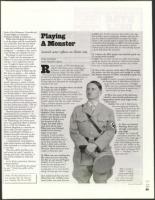
Robert Carlyle as
Hitler: "I tried to
empty myself of the
character on a daily
bath, rather than store
it p f r lbw. months."
Photo by Cliff Lipson/CBS
5/16
2003
99
Scanned image of the page. Keyboard directions: use + to zoom in, - to zoom out, arrow keys to pan inside the viewer.
May 16, 2003 - Image 119
- Resource type:
- Text
- Publication:
- The Detroit Jewish News, 2003-05-16
Disclaimer: Computer generated plain text may have errors. Read more about this.