
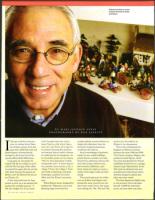

Collector Irwin Elson is at home
among his thousands of antique
metal figures.
f.
BY MARJ JACKSON LEVIN
PHOTOGRAPHY BY DAN LIPPITT
I
f the guy with the most toys
wins, we declare Irwin Elson
the all-time champ. Irwin has
more than 4,000 little lead and
plastic figures, all meticulously
arranged in the lower level of his
spacious Bloomfield Hills home.
Long gone are the battles he
staged with his toy soldiers as an 8-
year-old. But the grip of the collec-
tor seized him again after he and his
wife, Judy, became the parents of
Robyn, now 36, followed by her sis-
ter, Denise, 34.
A tiny lead polar bear he hap-
pened to pick up at an antique fair
ignited his youthful passion. "I
felt the weight of it in my hand
18 •
MAY 2003 • STYLE AT THE JN
and it brought back the excite-
ment I had as a kid when I got a
new toy," says Irwin. So at age 33,
he started haunting flea markets
and antique fairs to build a domes-
tic collection for his daughters. As
he invariably points out to visitors,
"they're all in peacetime civilian
occupations now." A three-ring cir-
cus, parades, farm scenes, a zoo, a
village ("I love the village," Irwin
can't help exclaiming.) and park
landscapes, populate his home
office and the Elsons' recreation
area.
When Elson's house, designed by
architect Iry Tobocman, was in the
planning stage, Irwin had him
include lighted, recessed shelves to
display his collections. Soon his
intricately designed panoramas
overflowed the shelves.
Irwin's assemblages of predomi-
nately 54 mm. scaled buildings,
ponds, flowers, animals, cars, kids,
housewives, policemen, fences, fire-
men, beer trucks, delivery men,
lawn mowers, ballerinas, a jazz
band, whatever it takes to create a
replica of the larger world, are fasci-
nating.
The prized pieces in his collec-
tion are hollow lead figures cast
during the same years his toy sol-
diers were made. Irwin, like many
boys during the '30s, '40s and '50s,
used to buy his soldiers in
Hudson's toy department.
They were manufactured in
England, by Britains Limited,
between the years 1900 and 1960.
The French company, Mignot, also
produced similar figures, which
were then handpainted by French
and British housewives in a cottage-
industry type of production. In the
'60s, lead was declared toxic and
manufacturers both abroad and in
America changed to plastic and
other non-toxic metals.
The later figures are slightly larg-
er, not as pricey. Irwin has spent
from $1 to 5400 for individual
pieces, and sets often cost more.