

SRAEL AT
5 5
Israel's Greatest Generation
1948 veterans fight a final battle 55 years later
AYELET BECHAR
Jewish Renaissance Media
Jerusalem
0
relative military strength of the two sides in the war —
was it really David vs. Goliath? — and the origins of
the Palestinian refugee problem. In doing so, they are
challenging the basic premises surrounding not just the
war but also the moral ground on which Israel stands.
No wonder that Zahik Yavne, 79, is furious.
"They are stealing our history. These so-called New
Historians are saying things that can't be true," he tells
an interviewer.
"How could anyone deny we were few against
many," complains Yavne, who fought in the air force
in 1948 and clearly remembers being attacked by a
n a recent spring day in Tel Aviv, the lobby
of the lecture hall is filled with a lively crowd
— about 300 people, mostly men, all older
than 75. They greet each other with pats on
the shoulder, hands waving across the room
and warm hugs.
They are the regulars. They devoutly attend monthly
seminars sponsored by the Israeli Society for Military
History on the Jewish state's security issues.
Today's subject is titled simply "The War
Moves," but it's clear to everyone which war will
be discussed.
At the podium, historian Mordecai Bar-On
addresses the familiar faces: "I see a lot of gray
hair here, and I'm thinking: How many of you
took part in the War of Independence? Well, the
question should be the opposite: How many of
you didn't?"
A wave of agreement rises from the audience.
Almost all fought 55 years ago in Israel's most sto-
ried conflict, the War of Independence. To most
Israelis and to Jews in the diaspora who will gath-
er to celebrate Yom HaAtzmaut on May 7, these
men and women are their country's greatest gen-
eration, warriors who fought me'atim mul rabim
(the few against the many) to gain an amazing
victory.
Now mostly retired, their numbers dwindling
by the day, they come here to meet their peers
and to relive and recount the history of the 1948
war.
But Bar-On is about to touch a raw nerve. He
is going to talk about "New History," the work of
scholars and journalists who are writing revision-
ist, and sometimes radical, accounts of the 1948
war.
For many Israelis — veterans and younger peo-
ple alike — these histories, based on documents
from archives opened over the last 10 to 15 years,
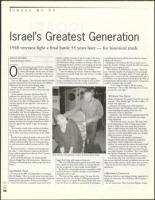
Sara and Zvi Novoplansky in their Jerusalem home today
are hard to. accept.
Such revisionist histories, the Israeli novelist
Aharon Megged has told interviewers, "deprive our
larger Arab force with superior firepower.
children of everything that makes people proud of
"We were 600,000 people against seven Arab coun-
Israel."
tries. Maybe we had more soldiers in a particular bat-
tle, but in general, we were totally outnumbered."
But Bar-On, who fought and was wounded in 1948
TESS HEROIC TALES'
and later became a Knesset member and an historical
"The story of the War of Independence is amazing,"
researcher, isn't so sure.
Bar-On begins. "[But] in recent years, more and more
"We were not few against many," he says after the
books have come out telling less heroic tales and giving seminar. But the Dor Tashach (1948) generation will
more specific descriptions of success and failure."
never accept it, no matter how many books will come
These new histories re-examine issues such as the
out. For them, it's offensive and hurtful. It contradicts
5/ 2
2003
54
for historical truth.
everything they know, all the stories they have been
telling over the years."
Speaking at the seminar, Bar-On is careful not to
hurt the veterans' feelings. Instead, he tells them some-
thing they are longing to hear.
"Your memory is problematic," he says. "How can
you remember exactly what happened one particular
night on a hill in the Judean desert 55 years ago? But
despite this, I want to tell the young researchers that it
would be a very big mistake to write about the War of
Independence relying only on documents. Documents
could be mistaken and one-sided.
"I am using this stage to tell the young
researchers: 'Use us, take advantage of us, so you
can get the story right."'
`WE KNOW THE TRUTH'
Ya'akov Nachmias, 81, stayed home the day of the
seminar. "Why should I go?" he asks a visitor. "It
would only upset me."
Sitting in the living room of his spacious
Rishon Lezion villa, Nachmias shows a book he
wrote detailing the battles of his unit, the
renowned Givati 52 Battalion.
Nachmias, who still lectures regularly about the
1948 war, says he wants to tell the way things
really happened.
"We know the truth," he says. "We know that
in the beginning we had to bring empty bullet
shells in order to get new ones, that we had to
fight at night because the Arabs had long-range
weapons and we didn't, that the entire army had
only two or three dependable tanks; one of them
didn't even have a reverse gear
"We had very old cannons, nicknamed
Napoleonchiks (because Napoleon could have
used them). And we didn't have the heavy
artillery, the tanks and the planes the enemy had."
Nachmias served in the army for 27 years but
refuses to say where he fought or to have his pic-
ture taken because, he explains, "this is not about
me, Ya'akov Nachmias. I was no big hero.
"I don't want the future generations to look at
us as heroes. But I do want them to remember
that we survived only because we believed that we were
right and morally superior. And I want them to know .
.. that we can survive only if we keep our military
superiority."
.
A HISTORIAN'S CHALLENGE
Nachmias' belief in maintaining military superiority is
exactly the point that New Historian Moti Golani is
challenging.
In his recent book, Wars Dont fitst Happen, Golani