

Entertainnte
iwi
At The Movies
Solomon's Choice
Writer-director wrestles with God in his new film, "Levity."
NAOMI PFEFFERMAN
Jewish Journal of Greater Los Angeles
T
he first images of Ed
Solomon's thought-provok-
ing film, Levity, came to -
the writer-director while
tutoring in a maximum-security
youth prison in Calabasa, Calif., two
decades ago.
"One inmate kept a photograph of
the boy he had shot, and he kept
touching it, fingering it," he said. "He
was struggling to understand that it
was a human life he had taken, but he
was only 17 and serving the first year
of a life sentence.
"And that haunted me. I began
wondering, 'What would he be like as
an adult? Where would he go if he
were let out of prison and what would
he do with the photograph?"'
One of the first images in Levity is a
yellowed newspaper photograph of a
convenience store clerk on the graffi-
tied wall of a prison cell. The cell
belongs to Manual Jordan (Billy Bob
Thornton), who is doing life since
murdering the clerk but is suddenly
released on parole.
Subsequently, he wanders through
his old neighborhood, hungry for
atonement, tenuously befriending his
victim's sister (Holly Hunter) and an
enigmatic preacher (Morgan
Freeman).
"Read a book once on redemption,
was written in the [12th] century" he
says in voice-over while riding the
subway, looking out of place with his
battered suitcase and long, gray hair.
"Man said there was five steps toward
making amends."
Solomon said the "man" in
Thornton's remark is actually the
Jewish sage Maimonides; he says he
learned about the "steps" when he and
his wife-to-be, Cynthia, took a
Judaism class with Rabbi Naomi Levy
at Temple Mishkon Tefilo in Venice,
Calif., seven years ago.
"That was crucial for the film," said
Solomon, 42, a self-described "lapsed
atheist."
"Manual doesn't believe in [some]
of the steps, and he says he doesn't
believe in God, yet he's so desperate
for redemption he acts in a way that
contradicts his beliefs. As the preacher
4/25
2003
74
says to him, 'Why be afraid of a God
you don't believe •n?'
"I wanted the boundaries within the
film to be at least as unclear as they
seemed to me in my real life."
Grappling With Faith
Solomon has been grappling with
spiritual questions since growing up
in a Reform Jewish home in Saratoga
in California's Bay Area, where he felt,
"tradition was a big part of Jewish
communal life but without the con-
viction of faith."
Meanwhile, his Christian friends
attended fervent high school fellow-
ship meetings where, they said, they
prayed for him. "I started to feel, 'I'm
so different from these people,'" said
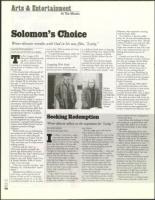
Morgan
Freeman as
Miles Evans
and Billy Bob
Thornton as
Manual
Jordan in Ed
Solomon's
"Levity"
Seeking Redemption
ED SOLOMON
Special to the Jewish News
I
n college, I tutored in a maxi-
mum-security prison for kids
who had committed violent
crimes. I met a 17-year-old boy
there who had killed a 16-year-old
boy earlier that year He had been
tried as an adult and sentenced to life.
Though we were only together for a
couple sessions, he left an impression
that to this day still haunts me.
The sentencing judge not only
made the boy finger his victim's per-
sonal effects, he also made him wear
the dead boy's clothes. The boy told
me he even had to put on his victim's
jacket, and it made him feel
"spooked."
"Like I didn't know that this kid
was, like, a human being or some-
thing," the boy said. It was the judge,
in fact, who told him to keep the
boy's photo.
But the judge never told him he
had to look at it forever.
And yet he couldn't let it go. It was
as if by staring at this two-dimension-
al image he was trying to reconstruct
Some three-dimensional persona, as if
a kind of understanding would
emerge, a way of grappling with the
magnitude of his actions.
It was this relationship — these two
boys, total strangers now bound for-
ever by one horrible deed — that was
the initial inspiration for Levity.
In researching the movie, I spent
time with a lot of people who had
committed murder when they were
kids. I met some through youth
groups, others through church and
community programs. -
Some I interviewed extensively; oth-
ers I just followed. around for a while.
They were all different ages, yet each
had in common that he was trying to
Solomon, who requested a meeting
with his family rabbi.
Over drinks at a San Jose coffee
shop, the 16-year-old revealed that he
was struggling with his faith. "But the
rabbi just looked at me and said, 'Me,
too,'" Solomon recalled. "Today, I
might take comfort in that, but at the
time, it just underscored my sense of
feeling disconnected and out of
place.
Comedy was one of the ways
Solomon learned to connect with peo-
ple, first by bonding with his father
over Mel Brooks films and later by
creating funny sketches for high
school shows. By his senior year at
UCLA, he was writing jokes for
comics such as Garry Shandling; by
age 21, he was a staff writer on TV's
Laverne and Shirley and the youngest
person ever admitted to the Writers
Guild of America.
After co-authoring 1989's Bill &
Ted's Excellent Adventure with Chris
Matheson, he went on to earn screen-
writing credits for films such as
"
.
Leaving Normal (1992), Men in Black
(1997) and Charlie's Angels- (2000).
But when he. tried to sell Levity, his
most personal project and directorial
debut, he says he "literally got hun-
dreds of rejections." In a business
where artists are often pigeonholed,
people wondered why Solomon wasn't
come to terms with the consequences
of what he'd done.
Some (those who believed in God)
were trying on a spiritual level, oth-
ers (those who didn't) on a secular
level. For all of them, it was a kind
of obsession. -
The other thing they had in com-
mon was a sense of futility,. At the end
of the day, none actually thought he
could ever make up for his mistakes.
When I sat down to write the script,
I called a friend, Naomi Levy, who
was a rabbi at a Conservative temple
in Venice, Calif. I told her I wanted to
tell a story that questions whether any
number of so-called "good" acts may
outweigh one very bad one.
And I told her I wanted the central
character to not believe in God. (It
seemed to me . that if he believed in
God, there would be more of a pro-
scribed path for him to follow, and
that was too easy.) I asked her what
my protagonist might have read that
would underscore his belief that he
would never be redeemed.
Naomi pointed me to Maimonides,
a 12th-century talmudic scholar who