

siness Outlook
Bumpy
Road
AFTER THE
1990s,
INVESTORS HAVE
TO RE-ADOPT TRIED-AND-TRUE
INVESTMENT TECHNIQUES.
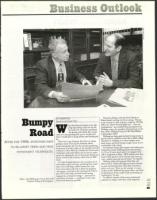
Above: Lyle Wolberg goes over a plan with
Michael Serling of Birmingham.
ED NAKFOOR
Special to the Jewish News
hen the financial markets were clip-
ping right along in the not too dis-
tant past, few could have predicted
the severity with which they would
come to a near-grinding halt, not to mention the
time it would take to shrug off the now familiar pal-
lor.
That's not to say, however, that those on whose
guidance many of us rely for monetary advice
weren't doing their job. On the contrary, predicting
the ferocity of a bear market or the strength of a bull
is sketchy at best. After all, consider the current state
of domestic and world affairs and it's easy to under-
stand why playing the role of clairvoyant should stay
firmly rooted on the midway, rather than on Wall
Street.
So while financial planners cast a cautious eye to
the headlines each morning,. wondering how yester-
day's events will shape today's bottom line, they
know their clients will look to them for guidance
and support, even before the opening bell. They've
got to be at the ready, and that means having
mapped out a financial strategy — particular to
each client, of course — avoiding as many road-
blocks and detours as possible.
"Someone taking a road trip from Detroit to
Miami doesn't just hop in the car and go. They go
to the Internet or AAA and get a roadmap. We help
define our clients' financial goals and ... map out
contingencies," says certified financial planner Lyle
Wolberg, senior vice president of investments in the
Ran, Stone, Wolberg Group at UBS PaineWebber
in Farmington Hills.
Wolberg says these goals include having money to
pay for once-in-a-lifetime events like a child's college
education or wedding, or a warm-weather retire-
ment home, and then having enough money to live
comfortably while retired.
And because clients often express a fear about out-
living their money, Wolberg advises them to look
10, 20 or 30 years ahead and try to imagine what
will be important to them. "We'll outline what they
think they'll spend in 10 or 20 years and come up
with a realistic goal and rate of return," he explains.
Wolberg, along with partners Gary Ran and
Robert Stone, works with high-net-worth individu-
als and recommends they revisit their investment
policy each year. "Early on, the strategy is to accu-
mulate wealth, [followed by] preservation, and final-
ly distribution of that wealth while minimizing tax
implications," he says.
In addition, because of the many unanswered
questions in today's world that could negatively
JS
4/25
2003
65