
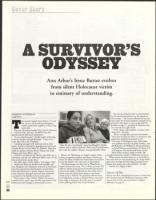

A SURVIVOR'S
ODYSSEY
Ann Arbor's Irene Butter evolves
from silent Holocaust victim
to emissary of understanding.
SHARON LUCKERMAN
Staff Writer
T
heir hands clasped, Irene Butter, 72, and
her 15-year old Israeli granddaughter,
Amelie, press close together on the living
room sofa.
They are discussing Amelie's first visit to Germany
— the first time, she says, she delved into her
grandmother's Holocaust experience.
"It was a hard journey," Amelie recalls of the trip
with her mother and grandmother. "I was 12-13
years old. I felt a lot of sadness."
A striking teenager with dark eyes and a warm
smile, Amelie is visiting her grandparents Irene and
Charlie Butter in Ann Arbor for Passover. She's here
with her parents, Pamela Butter Nassar and Sadik
Nassar, and sister, Shirin, age 11.
Curled in her father's lap, Shirin, who didn't go to
Germany, says she was afraid and didn't want to visit
the concentration camps there.
But older sister Amelie replies, "I'm happy I did."
Amelie and Shirin are familiar with prejudice and
war. Daughters of a Palestinian Arab and an Israeli Jew,
they have experienced discrimination toward them-
selves and loved ones in school, airports, towns and
cities. However, these girls also have been embraced
and loved by the families in both communities.
Their savta, as they call her, Hebrew for grand-
mother, had a much more horrific experience in the
• Holocaust and emerged a determined survivor.
.
4/25
2003
52
The course of Butter's life was determined
by the emotional extremes in the concentra-
tion camps — the horror inflicted by her cap-
tors versus the human-kindness retained by the
prisoners. She knew as soon as she had her
freedom at age 15, penniless in America, that
her survival was a gift of life.
"I felt I had a responsibility to make some-
thing of it," she says.
"Irene's a tough lady and very determined.
That's how she got her Ph.D. in economics and
gained her professional position at the
University of Michigan in Ann Arbor [she's
now professor emeritus of public health]," says
"Hope for me is my fizmily," says granddaughter Amelie
Sid Bolkosky, the William E. Stirton professor
Nassar, who is close to both her Arab and Jewish family es; in Social Sciences and professor of history at U-
here with her mother, Pamela, and grandmother Irene.
M Dearborn. He interviewed Butter for his
Voice-Vision project, which includes 180
recorded interviews, mostly of Holocaust survivors.
Butter, nee Hasenberg, an elegant woman with a
"What struck me most about her is her brilliant
strong, yet gentle presence, was almost Shirin's age
when the Nazis invaded the Netherlands and round- blue eyes that are very penetrating, her sharp intelli-
gence, her strength and her deep commitment to
ed up her family with other Jews in Ainsterdam.
justice she's passed on to her children," he said.
The Hasenbergs were first sent to Westerbork, a
"I think very highly of her.
Dutch internment camp. Then a fluke occurred. The
efficient Dutch postal system forwarded special pass-
ports to her father in Westerbork from their home,
Horrors Of War
which saved the family from going to Auschwitz
Butter says she's worked hard to come to terms with
death camp in Poland. The passports allowed them
the Germans and her Holocaust experience. She
to be deported, instead, to Bergen-Belsen concentra-
knows
that to heal, one must learn to forgive.
tion camp in Germany. But there was to be much
more suffering before they found freedom.
ODYSSEY on page 54