

Cover Story
f A evolution
Founders of Synagogue 2000 recall
the start of the organization.
DIANA LIEBERMAN
StaffWriter/Copy Editor
wo highly respected
Jewish educators, one
Reform and one
Conservative, founded
the national synagogue renewal
program known as Synagogue
2000 in 1995.
The idea of making synagogue
life more meaningful was one
that had intrigued both Rabbi
Lawrence Hoffman and Dr.
Ronald Wolfson for decades. But
it took a third party who knew
them both to finally say, "You
guys are on the same page."
`Why is davening so great at
camp and at USY, and so stale
and uninviting at home?'" Dr.
Wolfson remembers.
Meanwhile, Rabbi Hoffman, 60,
was making his way from his
hometown of Kitchener, Ontario,
to Hebrew Union College Jewish
Institute of Religion in New York
City, the educational and intellectu-
al center of Reform Judaism, where
he is now a professor of liturgy.
From 1984-1987, he also directed
the college's school of sacred music.
Ordained at HUC-JIR in
1969, he earned a Ph.D. from
the university's Cincinnati cam-
pus in 1973.
"In Kitchener, there was only
one congregation — Orthodox,"
which elements of each service they might
want to keep.
Another S2K innovation at the Reform tem-
ple is holding a Shabbat service at 6 p.m.
Friday nights.
Getting Together
Personal Growth
As part of his work at the Whizin
Center, Dr. Wolfson started a
family life institute, which,
beginning in 1990, brought
teams of Jewish educators and
community members to the
University of Judaism campus
each summer.
Among the program's strongest
supporters was Harlene
ApPelinan, director of the Jewish
Federation of Metropolitan
Detroit's Alliance for Jewish
Education, who, as Dr. Wolfson
says, "brought dozens and dozens
of folks."
By 1995, the summer institute
Dynamic Duo
had ballooned from 25
Dr. Wolfson, the
participants to 150. Its
Conservative half of
success caught the atten-
the S2K founding
tion of Rabbi Rachel
team, is vice president
Cowan, director of the
of the University of
Jewish Life Program for
Judaism in Los
the New York-based
Angeles and director
Nathan Cummings .
of the university's
Foundation, who oversees
Whizin Center for the
development and imple-
Jewish Future. Author
mentation of grants total-
of The Art ofJewish
ing approximately $5 mil-
Living series (Jewish
lion per year.
Lights Publishing), he
When Dr. Wolfson out
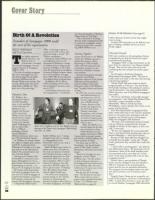
Rabbi Larry Hoffman and Dr. Ron Wolfson lead the
also co-edited First
lined his plans for the insti-
dancing at the Detroit-area Synagogue 2000 kickoff
Fruit: A Whizin
tute to branch out from
held Nov. 19, 2000.
Anthology ofJewish
family education to syna-
Family Education
gogue improvement, Rabbi
(Whizin Institute), which won
Rabbi Hoffman says. "I always
Cowans said he sounded remark-
thought I'd go back to Canada,
the 1999 Jewish Book Award.
ably similar to Rabbi Hoffman, her
to congregational work.
Dr. Wolfson, 53, earned a bache-
former professor at HUC.
lor's degree in religion and a masters Eventually I did, but in a way I
The three met in 1995 at
never dreamed of."
and Ph.D. in education from
Grossinger's, the famed Jewish
Washington University in St. Louis,
Rabbi Hoffman has written or
resort in New York's Catskill
edited more than 20 books on
and went on to the University of
Mountains, which has since been
the roots and practice of Jewish
Judaism for a second masters, this
closed.
time in Jewish Studies.
and Christian liturgy as well as a
"Both of us thought we were
syndicated column for the New
Growing up in Omaha, Neb.,
doing her a favor," Rabbi
York Jewish Week. His introduc-
he attended a Conservative syna-
Hoffman says. "On the surface
tion to Judaism, What is a Jew?
gogue. Although he was "not a
we had nothing in common —
(Simon & Schuster), has sold
great Hebrew School student," he
his background was Conservative;
enjoyed going to services — as
more than 400,000 copies. He
I was a Reform rabbi. He was a
long as he was singing in the choir. also is general editor of Minhag
Californian; I'd spent most of my
Aini: My People's Prayer Boo k
He became regional president
career in New York.
(Jewish Lights Publishing.)
of United Synagogue Youth, the
But the pair hit it off right
One of his most-frequently
teen arm of United Synagogue of
away. "We decided on the spot,
quoted sayings on the need for
Conservative Judaism, and loved
`What a great idea to create a
constant re-evaluation and
USY summer camp and the
project across interdenomination-
retreats held throughout the year.
renewal of religious life is that, in
al lines,'" Dr. Wolfson says.
"I frequently asked myself,
too many synagogues, the words
REVOLUTION on page 68
"
4/ 4
2003
66
DARING To BE DIFFERENT from page 65
over the ark should be "We Have
Always Done It This Way."
This is the kind of thinking
that has made congregational life
in numerous synagogues unwel-
coming and spiritually uninspir-
ing, Rabbi Hoffman says.
S2K team members at all metropolitan Detroit
congregations say they have found the experi-
ence personally enriching.
"Synagogue 2000 is a big commitment on the
part of the lay volunteers," says Shaarey Zedek's
Krugel. "But we have each come away with
something that has enriched our Jewish experi-
ence."
Says Krugel's co-facilitator, Marianne
Bloomberg of Farmington Hills: "We find we
really enjoy each other in the team, like learning
and growing together."
Temple Israel's S2K team closes its special
onegs promptly at 9:30 p.m., "but you always
find people standing in the parking lot continu-
ing the discussion," says team member Rabbi
Marla Hornsten, one of the Reform synagogue's
four rabbis.
"For me as a facilitator, it has really changed
my perspective," says Temple Shir Shalom's Pam
Kornfeld, a recent transplant to West
Bloomfield. "When I moved here from
Philadelphia, I knew nobody. Now I have a core
group of close friends."
Even West Bloomfield's Congregation Beth
Ahm, whose S2K team is now inactive, benefited
from its 18-month active association with the
program, says Naomi Levine of Farmington
Hills, the synagogue's S2K facilitator.
"We were a very enthusiastic group of people,
and we still have a committed core who get
together as friends. In that respect, it was a suc-
cess," Levine says.
"We met very regularly for a year and a half.
Then it was hard to find meeting times. But we
haven't disbanded -- we're just on hiatus."
Because of S2K, Beth Ahm has changed "not
outwardly but inwardly," Levine says. "People
made connections they wouldn't have made oth-
erwise."
"I think S2K is working great," says Detroit-
area S2K liaison Posen. "It's generated a lot of
excitement. Some of the team members were
not previously active; now they are. In fact,
some of the team members left to be on their
synagogue boards."
Norton Stern, a past president of Temple
Israel, says the changes he has seen thanks to
S2K are "dramatic as far as participation,
music and the way we approach spirituality.
The program has encouraged many new plan-
ners and innovators, not to mention atten-
dees."
Temple's Super Onegs are an unusually suc-
cessful S2K program, said Stern of Farmington
Hills. "I think there has been a pent-up need
to extend Shabbat. Synagogue 2000 identified