

Surviving And Thriving
Though not an experience anyone
wants to repeat, Horwitz found that
the fire, which fire investigators traced
to an electrical malfunction in the
computer room, became an impetus
to move the paper forward, rather
than holding it back.
"The fire enabled all of us to recog-
nize and understand our core purpose
of publishing a newspaper every week
that links a very diverse community,"
Horwitz says. "It allowed managers
and staff to understand in very stark
terms what was important in their
work and what was superfluous."
Editor Robert A. Sklar says the abil-
ity to survive the fire and not miss
even one issue in the paper's publish-
ing cycle affected staffers in an unusu-
al way.
"The fire didn't slow us down, but
energized us," he says. "Corporately
and individually, people rallied
together, not just trying to recapture
the past, but many projects in the
works were jumpstarted and moved to
the front burner."
For example, editorial content was
changed. The Scene section of the
paper was resurrected, the Food sec-
tion was expanded and the Readers'
Choice Awards first appeared in the
JN SourceBook.
One area that really took off was
the Web site, Jewish.com . "The fire
was like the launching pad for
Jewish.com,” says Kevin Browett,
general manager for Jewish.com and
director of interactive media for
Jewish Renaissance Media, parent
company of the Jewish News.
"It's not just a Web site, but a place
for the Jewish community to gather
and interact," Browett says. "We use
the Web to gather and disseminate
information across multi-media —
TV, radio, services and products."
Jewish.com just completed an
agreement with the National
Foundation for Jewish Culture in
New York, he says, that will make it
possible for the Web site to carry a
cultural link of art, music and enter-
tainment provided by the foundation.
Weaving Community Together
While the Jewish News looks forward
to the future, it hasn't lost sight of its
past, including the compassion the
community showed to it right after
the fire.
Horwitz remembers moving into "a
vacant second-floor space overnight"
MOVING FORWARD
on page 40
Lessons Learned
Jewish News fire drives home to sta
the meaning of its core purpose.
ARTHUR M. HORWITZ
Publisher
A
s we settle into permanent office space, one year
after a fire destroyed the building and much of
the contents of the Jewish News, it is easy to
reflect on a difficult chapter in our 61-year histo-
Watching flames engulf our "second home" the evening of
Jan. 27, 2002, a temporary sense of helplessness among the
assembled staff yielded to a determination to continue pub-
lishing — without missing a single issue.
When the champagne bottles were uncorked four days
later as the last components of a 116-page issue were shipped
to our printer in Port Huron, there was a sense of relief and
elation at overcoming what had seemed to be an insur-
mountable challenge. With no computers, no phones, no
furniture, no files, no routines, but with off-site backup of
key information, we had continued the Jewish News' record of
more than 3,100 consecutive weeks of uninterrupted service.
The passage of time allows for renewed appreciation of our
achievement and reflection on what has been learned from
the ordeal. Here is a summary:
It's All About People: Too many cornpanies have wor-
shipped at the altar of technology and view their staff as
extras in the "New Economy" While all businesses need to
look for efficiencies to remain competitive, a disaster reminds
you that the resourcefulness, resiliency and institutional
memory of your people are irreplaceable assets.
Facing nothing but the barren walls of a hotel conference
room, the Jewish News staff rallied to produce that week's
issue because they knew their role in our core purpose—
publishing a newspaper of quality, every week, for our com-
munity.
A Disaster Plan Looks Good Only On Paper: Nothing
looks more impressive than a thick, detail-oriented disaster
plan sitting on the shelf of the president's office. It was proba-
bly constructed at an off site retreat by a management team
mixing business with pleasure.
Did we have a disaster plan? Yes and no We had our key
bases covered (off-site backup, etc.) but the rest was improvi-
sation — which is why we were able to publish. Most disas-
ter plans are about process and technology, not about leverag-
ing people.
My suggestion for those who don't have a disaster plan is to
simulate a disaster. Rent an empty hotel ballroom, bring all
of your people together and tell them, Our building just
burned down and everything is lost. Come back to me in
two hours with your plan for moving forward."
We Don't Always Know Why We Do The Things We
Do: A fire wipes out all accumulated habits, good and bad.
Perhaps the greatest victim (and opportunity) is the "well,
we've always done it this way" mindset. From the way we
answer phones to the number of type fonts we offer classified
advertisers, a disaster is an opportunity to evaluate and
enhance our way of doing business.
Be Ready To Learn About Yourself: Watching the building
burn, the questions in my mind flowed: "Was anyone in the
building?" "Could it have been deliberately set?" "How
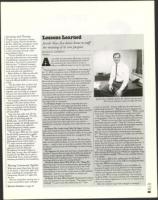
Jewish News Publisher Arthur M. Horwitz says last years
fire was an impetus to move the paper forward.
would we recover?" 'Did we really have all of the essential
stuff backed up off site?" Was our insurance adequate and
did we really understand all of the fine print?" "Where would
we go next?" "Do I have the stamina to endure all of this?"
Less than 12 hours later, I found myself asking a different
set of questions: "How do I keep the staff focused and moti-
vated?" 'Where can we move that meets immediate and
potentially long-term needs?" "How do I secure an advance
from my insurance carrier to handle the immediate expenses
and offset anticipated interruption in cash flow?"
"How will vve handle this story in our own publication ...
after all we are accustomed to covering news, not making
it?" "How do we communicate to our readers and advertisers
that we are still open for business?"
As I watched our managers and staff rally around my state-
ment that we haven't missed publishing an issue of the
Jewish News for 60 years, and we're not about to miss now," I
realized that in addition to their own deeply held commit-
ment to the Jewish News, they were taking their cue from m,
If I were wringing my hands in self-pity, would they have
still overcome all of the obstacles} Words are important. They
have to be chosen carefully. What you say, and how you say
it, is critical.
It has been a difficult but uplifting year for the Jewish
News. I am grateful to our entire staff for enduring and thriv-
ing under diffiailt circumstances.
Also, I continue to be humbled by the remarkable out-
pouring of support and caring directed our way by people
inside and outside of the Jewish community. Many of our
vendors and suppliers went above and beyond the call of
duty in their efforts to keep us publishing. Our temporary
landlord, JARC, was accommodating and professional. I can
think of no better organization to write my rent check to for
the past 12 months.
May we continue to go from strength to strength. ❑
1/24
2003
39