
gutertamment
At, The Movies
`Metropolis'
Detroit Film Theatre screens Fritz Lang's visionary science-fiction opus
with a new 75th-anniversary restoration.
ERIN PODOLSKY
Special to the Jewish News
F
1,0J44
11/22
2002
70
ritz Lang's Metropolis makes its annual
appearance at the Detroit Film Theatre
next weekend. But it may very well be the
first Motor City screening of the film in a
form that at least approaches what its director meant
for his audience to experience.
The 1927 silent sci-fi film tells the story of a
future that has yet to completely arrive but can be
seen in bits and pieces in today's society. The world
is divided into workers and thinkers, and machines
have become the master race. The film put Lang on
the American map some seven years after directing
his first movie.
Often screened in the past at the DFT with live
accompaniment by the Alloy Orchestra, this season's
presentation of Metropolis features an extensively
restored and reworked print four years in the making.
Each of the film's shots was digitally scanned and
cleaned to revive Metropolis' original photographic
quality, and- the original Gottfried Huppertz score
has been re-recorded with a 65-piece orchestra.
The original film, which was subject to major cuts
and other so-called restorations — including those
from its German studio, UFA; its American distrib-
utor, Paramount; and others — has had what can
only be called "nine lives."
Eventually whittled down to just 87 minutes, the
film had undergone extensive edits just three weeks
after its original release; reordering of scenes on low-
quality tapes and DVDs; muddy prints lacking visu-
al clarity; and even a 1984 Giorgio Moroder remake
of the score featuring singers Pat Benatar and
Freddie Mercury.
The digitally remastered version to be shown at the
DFT Nov. 29-Dec. 1 runs 124 minutes and includes
newly located negative material. Music cue sheets and
a German censorship card enumerating cuts made for
content helped to completely reassemble the film to
its original scene order. The German intertitles were
also rewritten and recently translated into English.
post eventually assumed by controversial filmmaker
Leni Riefenstahl).
Goebbels assured the director that his Jewish her-
itage was not a problem, and that Hider, who had
come to power in 1933, was a fan of his films, par-
ticularly Metropolis. The general consensus is that
Lang, a political liberal, was suspicious of the offer
and thought it best not to get involved. He left on a
train for Paris the same night.
It should be noted, however, that there are varying
accounts of Lang's dealings with Goebbels and the
Tangling With The Nazis
circumstances and timing surrounding his flight
Born in Vienna in 1890, Lang was the son of a
from Germany — some accounts saying he smug-
Jewish mother and a Catholic father. He was bap-
gled out his fortune, others that he took practically
tized and raised in his father's faith._
nothing with him.
But when the Nazis rose to power in 1933, Lang's
In any case, he landed in America the next year.
Jewish blood made him a marked man in
Lang and von Harbou were soon divorced,
the eyes of the Reich, as well as those of his
and she went on to write for films pro-
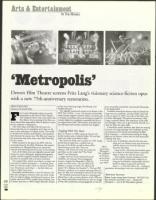
Above:
Nazi-leaning second wife, Thea von
duced by the Nazis.
•
Scenes
from
Harbou, with whom he wrote the scripts for
Lang, in fact, often has been looked upon
"Metropolis':
such films as Der made Tod ("The Tired
as a master at revisionist history, especially
The
`kodfather"
Death") and Metropolis.
when it had to do with his own past.
of cinematic
Lang's work was much admired by Josef
This includes a bizarre incident in which
science
fiction
Goebbels, the German Nazi propaganda
his first wife, Lisa Rosenthal, walked in on
is set in the
minister, despite the filmmaker's 1933 fer-
Lang and von Harbou unexpectedly and shot
year
2026
vently anti-Nazi work, The Last Will of Dr.
herself in despair. Lang never said much
Mabuse. A sequel to 1922's Dr. Mabuse der
about it — or his first wife at all — leading to
Spieler ("Dr. Mabuse the Gambler"), The Last Will
speculation that perhaps it was not a suicide after all.
featured a madman in an asylum spouting Nazi slo-
gans; the film was immediately banned by the Nazis.
American Successes
Yet Goebbels summoned Lang to a meeting and
offered him a job as artistic director of the UFA stu-
Before Lang's escape from Germany, M (1931), his
dio, which essentially would have put him in charge
first German sound film, was — along with
of Nazi film production and propaganda (it was the
Metropolis—. one of the filmmaker's greatest
.
Scanned image of the page. Keyboard directions: use + to zoom in, - to zoom out, arrow keys to pan inside the viewer.
November 22, 2002 - Image 102
- Resource type:
- Text
- Publication:
- The Detroit Jewish News, 2002-11-22
Disclaimer: Computer generated plain text may have errors. Read more about this.