
DESIGNING WOMAN
page 75
came to America in 1939 to escape Hitler,
graduated from Cass Technical High School
in 1942. She earned a bachelor of fine arts
degree from the Rhode Island School of
Design in 1945 and a master of fine arts
degree in architectural design from the
Cranbrook Academy of Art in 1946.
"At the time I graduated, architectural offices
were not taking on women for professional
jobs — certainly not Jewish women — so I
asked Eliel Saarinen for advice," Schnee recalls.
"This well-known architect was very clear in
telling me to apply to competitions — and win
),
them. I did my best to follow his suggestion.
After working as an instructor and visiting
lecturer for Michigan State University,
Schnee was employed as an assistant to the
chief architectural designer for Raymond
Design "is the visual response to an environment and can shape
Loewy Associates in New York City. One year behavior and mood," says Schnee.
later, she opened her own studio, designing
and completing custom silk-screening for
Fruitful Partnership
contemporary textiles and entering her projects for
"I've thought of design as the great communication
established prizes.
tool
for the environment," 'says Schnee, who main-
While earning a number of honors, including one
from the American Institute of Decorators, she came tains the principle as her professional philosophy.
As we choose words carefully, we must convey the
to a career turning point when chosen a design win-
correct
message by design. It is the visual response to
ner by the Chicago Tribune. The honor brought cus-
an
environment
and can shape behavior and mood."
tomers to her door.
While Schnee was applying her artistic
talents and outlook, she looked to her
late husband of more than 50 years,
Edward, a Yale University economics
graduate, to manage finances. The two,
married in 1948, opened the
Adler/Schnee furnishings center in 1949
and continued in business through 1977.
The downtown Detroit shop, located
in Harmonie Park, offered fine designs
in artifacts for the home and pioneered
functional creations of artists and design-
ers. It provided local craftspeople an out-
let for weaving, soft sculpture, glass,
metal and acrylics.
"While we were working in Detroit,
we became involved in boosting the city
and its cultural life," says Schnee, who
helped establish the Greektown Festival
in the Central Business District and rec-
ommended a unifying exterior color to
improve the appearance of Monroe
Street buildings. •
"With my husband handling the
finances, I realized the importance of an
artist's having a businessperson as a part-
ner. That makes it much easier to earn a
living."
Designers' Designer
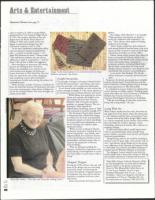
Ruth Adler Schnee: "I love color, and I have
11/8
2002
80
n working with it. '
During the 1950s, Schnee came up with
some of the designs that are now being
reissued by Anzea and International
Contract Furnishing. Originally patterns
for draperies, they now will be used for
upholstery completed with new colors
and weaves.
Schnee can provide the history of each
pattern.
One design, titled "Banners" is an example:
"Flags, pennants and banners are always a
source for celebration and inspiration," she
says. "Their vibrant colors speak of heraldry,
authority and triumph.
"These simple motifs have been enhanced
with strong blocks of boucled yarns, crisp color
sequences and a mixture of soft and hard edges
reminiscent of modern art of the 1960s."
Schnee, whose public projects have taken her
from a restoration of Orchestra Hall to the
beginnings of the World Trade Center, has had
many commissions from a long list of
acclaimed architects, in c - luding Albert Kahn.
She has been a consultant for Frank Lloyd
Wright, Minoru Yamasaki, Louis Redstone and
Bloomfield Hills architect Louis DesRosiers.
A new book, Paul Rudolph: The Florida'
Houses, showcases a mansion that features her
ideas.
Projects in the Jewish community have included
work for Temple Israel, Temple Kol Ami and the
Jewish Federation of Metropolitan Detroit through
the senior apartments in West Bloomfield.
As a Modernist pioneer, Schnee has explained her
artistic leanings to college students. Teaching assign-
ments have taken her to the University of California
Berkeley-San Francisco Extension as well as
Lawrence Technological University in Southfield.
"I like the interchange of ideas that comes from
being with young people," she says.
Living With Art
When Schnee breaks from her work, she moves to
the upper level of her home, where the artistry also
is very striking amid the clean, contemporary lines.
A bronze bust of her father, Joseph Adler, stands
as a tribute completed by her mother. Chair embroi-
dery also holds her mother's signature. A pre-
Columbian collection of statuary fills a cabinet as a
longtime holding.
A coffee-table photo album recalls happy times
with her extended family, which includes three
grown children, attorneys Anita, Jeremy and Daniel,
and seven grandchildren.
"Design brings order to the world by creating an
aesthetic unity of space, light, color, pattern and tex-
ture," says Schnee, whose designs are in the perma-
nent collections of the Museum of American Crafts
in New York City, Victoria and Albert Museum in
London and the Whitney Museum in Louisville.
"As a designer, I never wanted to see what the
market would bear. I have tried, instead, to find the
best possible expressions of beauty and function." ❑
"Ruth Adler Schnee: A Detroit Treasure" will be
on view through Dec. 22 at the Janice Charach
Epstein Gallery in the Jewish Community
Center in West Bloomfield. Gallery hours are
11 a.m.-4 p.m. Sundays, 10 a.m.-5 p.m.
Mondays-Wednesdays and 10 a.m.- 7 p.m.
Thursdays. There is no charge for the Schnee
presentation at 7:30 p.m. Thursday, Nov. 21,
but reservations are required. (248) 432-5579.
Scanned image of the page. Keyboard directions: use + to zoom in, - to zoom out, arrow keys to pan inside the viewer.
November 08, 2002 - Image 112
- Resource type:
- Text
- Publication:
- The Detroit Jewish News, 2002-11-08
Disclaimer: Computer generated plain text may have errors. Read more about this.