

Jewish Detroit is part of the "Images of America"
series of regional and local history books published
by Arcadia, all of which conform to a specific for-
mat. The history of a particular city or community
is told solely through the captions of its chronologi-
cally ordered black and white photographs. In addi-
tion, the size of the book, its cover style and even
the number of pages — 128 to be exact — are iden-
tical in each book of the series.
Delving Deeper
Although Cohen adhered to Arcadia's format to
complete this book, in the end he found it too con-
straining to tell the complete story of Detroit's
Jewish community.
So, he is using Jewish Detroit as a jumping-off
point for his next project, a far more comprehensive
history book he plans to title Echoes of Detroit's
Jewish Communities: 1762-2003.
He jokes it will be. "the grandmother of all books
on Detroit's Jewish history," with a much larger text,
many more photographs and a plethora of stories
about the growth of the community and the lives of
famous Jewish Detroiters.
To accomplish this ambitious project, Cohen has
been combing the archives and reading every page of
the Detroit Jewish News and its predecessors, the
Jewish American (1900-1910) and the Jewish
Chronicle (1916-1951). He hopes to complete the
book by next year.
Cohen, who lives in Oak Park, also is the author
of Echoes of Detroit: A 300 Year History, published in
2000 to celebrate Detroit's 300th anniversary, and
So You Love Tiger Stadium, Too (co-authored with
Joe Falls). The author, a longtime former employee
of the Detroit Tigers' front office, also is working on
a history of Tiger Stadium for Arcadia Publishing.
A member of the Jewish Historical Society of
Michigan, Cohen frequently lectures and presents
slide shows about Detroit history, Detroit baseball
and the history of Detroit's Jewish community.
❑
Jewish Detroit is available at Barnes & Noble,
Borders and WaldenBooks, as well as at
Borenstein's and Spitzer's Hebrew bookstores
and at Miriam's Place kosher restaurant in the
Oak Park Jewish Community Center.
Those who would like to share historical
information or archival quality photographs
(street scenes, etc.) relating to Detroit's Jewish
history for Cohen's upcoming book should
contact him at (248) 968-5314.
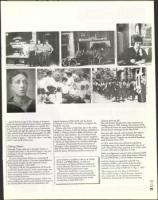
Clockwise from top left:
The Lash brothers founded their dairy restaurant on
Hastings Street in 1900. Hastings Sreet between Kirby
and Frederick became the main shopping deStination for
Detroit's Jewish community by the early 1920s.
Four years after taxicabs with automatic fare registers
made their Detroit debut, Abe Hertzberg's growing
Messenger Taxicab Company was located at Broadway
south of Grand Circus Park.
In 1931, about 20 percent of Detroit's population,
including many in the Jewish community, were out of
work. Gertrude Wineman, pictured, was a tireless work-
er in the 1931 drive to help those in need.
Rabbis and dignitaries were part of the estimated 10,000
Jews who participated in ajoyous demonstration celebrating
the end of World War I and the Balfour Declaration.
Fresh Air Society was organized to provide - new
immigrant children with summer programs offim
and 12011rishment. Here, volunteers accompanied
youngsters on an outing to Belle Isle on Aug. 2, 1905.
After serving in the U.S. Navy in World War I,
Louis Raskin became a Detroit fireman. A quarter
of a century later, his son Danny would become a
well-known columnist for the Detroit Jewish News.
k • AN,
9/27
2002