

Food
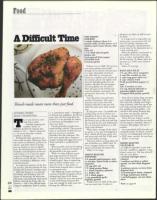
A Difficult Time
Shivah meals mean more than just food.
T
ANNABEL COHEN
Special to the Jewish News
he word shivah is never
said with a smile.
Literally meaning the
number "seven" in
Hebrew, Jewish law requires that
shivah is "sat" — that is, observed
— for seven days after a family
member is buried.
During this time, mourners nei-
ther work nor play. Observant fami-
lies watch no television, perform no
chores, and don't- shave or primp.
Just as clothes are torn to signify
loss, the shivah period is a time for
humility and disruption of the nor-
mal routine. It is a time for explo-
ration of feelings and a time for
reflection on the life lost. For one
week, everything is different, with-
out distractions.
An important element of the shiv-
ah journey, and the mitzvah of corn-
forting the bereaved, includes meals.
After the funeral, it is a mitzvah
for family and friends to visit the
house of mourning. All who enter
the home ceremoniously wash hands
before entering the home after the
'TN funeral — this is the official begin-
8/ 9 ning of condolence. Food is served
2002
82
— a consolation meal — brought in
by friends and neighbors. Jewish law
states that the first meal after the
funeral is to be provided by others,
as mourners are forbidden to eat
their own food.
Friends generally provide most
meals during a shivah. This nourish-
ment is not merely to feed the hun-
gry, but serves as a sensitive
reminder that life continues. The
first meal served after a funeral is
usually milchig with eggs and round
foods included to symbolize life
cycles.
When possible, the act of cooking
and serving a meal for the family of
the bereaved is the best course.
While it's often difficult to pre-
pare large amounts of food for
many, for those visitors who share in
a family's grief, there is something
about a home-cooked meal — or
part of a meal — that seems so
much more personal than a catered
or restaurant meal.
The following recipes to bring to
a house of shivah are quick, uncom-
plicated and; best of all, home-
cooked. They'll be your own person-
al way of showing mourners that
you care enough to make your own
during this difficult time.
•
THE EASIEST
CHICKEN
3 whole chickens (about 3-4
pounds each) cut into pieces, or 2
chickens and 4 more breasts, with
skin
Olive oil
1-2 T. fresh minced garlic
Kosher salt
Fresh ground black pepper
Dried dill weed
Ground paprika
Preheat oven to 400F. (If you have
two ovens, preheat them both).
Arrange all non-breast chicken parts
in a large, disposable aluminum
pan, skin side up. Arrange the
breasts in a separate pan. Drizzle all
the chicken pieces very lightly with
olive oil. Sprinkle garlic over the
chicken. Sprinkle the salt, pepper,
dill and paprika over the pieces.
Place the pans in the oven(s) and
roast the chicken, uncovered, 40
minutes for dark meat, 30 minutes
for white.
Turn the pieces over and roast
another 20 minutes. This step is
essential, since juices from the
chicken collected in the pan will
make the meat juicy when turned
over.
If using one oven, it's possible the
chicken may not be as brown as it
should be. If this is the case, change
the positions of the pans, placing
the bottom pan on the top rack and
the top pan on the rack underneath.
Do not overcook chicken as it will
need to be reheated.
When done, arrange all the chick-
en pieces in one pan (overlapping is
fine), drizzle all the pan juices over
and cover well with foil. Chill until
one hour before serving.
One hour before serving, place the
pan of chicken in a 300E oven. To
serve, arrange chicken on a large
platter and drizzle the juices over.
Makes 12 servings.
SIMPLY ROASTED
POTATOES
5-6 pounds small potatoes, such
as red skin, Yukon Gold or white,
unpeeled
1/4 cup olive oil
2 T. dried parsley flakes
1 t. dried rosemary, optional
2 t. kosher salt
1/2 t. black pepper
2 tsp. granulated garlic
Paprika, garnish
Preheat oven to 425F. If the pota-
toes are more than 2 inches in
diameter, cut them in half or quar-
ter them.
In a large bowl or disposable alu-
minum pan, toss potatoes with the
olive oil, parsley, rosemary, salt,
pepper and garlic. Spread potatoes
in one layer in the aluminum pan or
a large roasting pan.
Roast the potatoes, uncovered, in
the middle of the oven, turning
once or twice, until golden, about
40-50 minutes. To reheat, place the
potatoes in a 250F. oven, covered,
for 1 hour.
Makes 12 servings.
BASIC RICE PILAF
1/3 cup olive oil or margarine
2 cups fine noodles or orzo
3 cups long-grain white rice
6 cups chicken broth
Fresh ground black pepper, to
taste
Salt, if needed, to taste
1/2 cup slivered almonds or
pinenuts, lightly toasted
Chopped fresh parsley, garnish
Heat oil in a heavy, large saucepan
over medium-high heat. Add noo-
dles and cook, stirring until begin-
ning to brown. Add one cup of rice
and cook, stirring constantly until
the noodles are very golden — be
careful at this point, because they
can burn very quickly. Add the
remaining rice and broth.
Cover the pan, bring to a boil,
reduce heat and cook the rice until
all the liquid is absorbed, about 15
minutes. Add pepper and salt, if
needed.
Serve garnished with almonds and
chopped parsley. To reheat, transfer
the rice to a baking dish and heat in
a 250F. oven, covered, for one hour.
Makes 12 servings.
MIXED ROASTED
VEGETABLES
Use different vegetables as you wish:
broccoli, cauliflower, eggplant, celery,
fennel, onions, etc. You may also grill
these for more flavor.
2 pounds asparagus spears,
trimmed
3 medium zucchini or yellow
squash, cut into thick diagonal
slices
4 medium carrots, cut into thick
diagonal slices
1/2 pound green beans, trimmed
12 large mushrooms, halved
1 red bell pepper, cut into thick
slices
FOOD
on page 84