

Editorials are posted and archived on JN Online:
www.detroitjewishnews.com
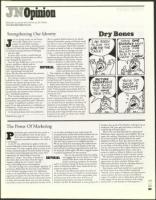
Dry Bones
Strengthening Our Identity
Jr
ews are facing attacks on two fronts
that could reshape who we are as a
people. So said Rabbi Avraham
Jacobovitz last week at the 22nd annu-
al dinner of Oak Park-based Machon ETorah,
the Jewish Learning Network of Michigan.
And he's right.
In many ways, we face a world" infected
with the collapse of moral values as well as
utter disregard for human life.
Over the past 4,000 years, we've survived
slavery, expulsion, ridicule and the
Holocaust. Now, we face the daunt-
ing challenges of apathy, assimila-
tion, intermarriage and spiritual
decay. We also must stare down the terrorists
who seek to destroy us.
The terrorist attacks on America by Islamic
radicals on Sept. 11 wrote a new chapter in
how far our enemies will go to hurt our
friends and allies. Sadly, this chapter is still
being written. "We've only seen a little bit of
the capacity of the enemies of humanity and,
in particular, the enemies of the Jewish peo-
ple," said Rabbi Jacobovitz.
That warning rings true in the increased
police presence marking Jewish events in our
community and around the world. Wherever
we gather in significant numbers, we're tar-
gets. To not take precautions is to fall prey to
indifference. Divine mercy alone won't spare
us from those who hate us.
As for spiritual decay, that's more subjective.
But we applaud Rabbi Jacobovitz for bluntly
asking if materialism, gossip and lifestyle trends
are what we want as the defining parameters of
the Jewish community. The Jewish continuity
we aspire to should be built on a foundation of
reverence for our history, heritage and tradi-
tions — and Israel, our beloved homeland.
Clearly, we must provide more places to
experience the joy of Jewish life, from the
beauty of Shabbat.to what family relation-
ships are all about, to what loyalty, ethics,
respect and love mean. We must
inspire Jews who have lost their
religious identity — and give them
reason and excitement to go find it.
The numbers are telling. According to
Machon, 59 percent of American Jews don't
belong to a synagogue, 70 percent have never
visited Israel and 52 percent of those married
in the last five years married a non-Jew.
Rabbi Aaron Eisenman of Machon's
Jewish Resource Center in Ann Arbor put it
well: "Unfortunately, many people don't see
the beauty of Judaism because they've cut so
much out of it."
Whether it's regular Torah study, visiting
Israel, enjoying traditional Shabbat din-
ners or doing more to help or enrich oth-
ers, the best way to showcase the beauty of
Judaism is by example. We can help reju-
venate the continuity that once thrived by
making it our business to pass the torch of
learning and living Jewishly from one gen-
eration to the next, no matter how Torah
observant we are.
r NAme °NE C F1
cAcRince
I 14Av& rimy,
NA A 'DE- FOK-
PALE - S'n t ■ -)E
ADD - I.
t-AAKE IT OUP
EDIT ORIAL
Related story: page 51
❑
The Power Of Marketing
ro
alestinians were treated late last month to
two very different views of the future.
Both came in advertisements, one on gov-
ernment-controlled television, the other in
a newspaper.
In the TV one, which had no spoken words, the
camera followed an Arab couple who encounter Israel
army troops. The man, angered, plans an attack on the
troops; simultaneously, he envisions dozens of young,
beautiful women beckoning him from a mist. He is
captured by the Israel Defense Forces, but
allowed to "escape." As he does ; an Israeli sol-
dier shoots him in the back. Then the virgins
reappear, pulling the new "martyr" into the •
mist, surrounding him and caressing him.
The other message was a communique, signed by 55
prominent Palestinians the first time it was published
in the Al-Quds newspaper and by 315 Palestinians
when it was republished two days later. The core mes-
sage from the signers was that they hoped "that those
behind the military actions aimed at [harming] citizens
in Israel will reconsider [their acts] and cease pushing
our youth to carry out these operations, because we do
not see them as leading to any results except for
increased hatred, enmity and hostility between the two
peoples, deepening the chasm between them, and
destroying the possibility of both peoples living along-
side each other in peace in two neighboring states ...
We do not think that encouraging the reciprocal exis-
tential fighting between the two peoples in the holy
land will lead to anything except destruction and ruin
for all people of this region. We find no logical, human
or political justification for this outcome."
The two ads captured clearly the pulling
and tugging that must be going on in Gaza
and the West Bank under the pressure of
Israel's continuing crackdown on terrorism
and U.S. President George W. Bush's strong condem-
nation of Palestinian leader Yasser Arafat and the ter-
rorism his regime has allowed.
Obviously, most Westerners prefer the vision of
the newspaper ad, but we should not underestimate
the power of the television call to martyrdom. Our
common sense tells us that there will be no 72
beautiful handmaidens awaiting the homicide
bomber and that his destination is never going to be
EDIT ORIAL
Paradise. But much of the Muslim world gave up on
modernity 500 years ago and yearns to recreate a
vanished age of Islamic glory.
That is why the Bush demand for a democratic
Palestinian entity cannot be easily fulfilled. We may
expect the ordinary Palestinian to realize that his or
her society would be greatly aided by the rapid
adoption of Western ways. But that isn't -the case,
and we need to be prepared for the disappointment
we are likely to feel when Arafat is "re-elected" next
year by a process more like a tribal selection of king
than like our polling process. This is, after all, a
society in which an infant in Hebron was dressed
up as a suicide bomber as a joke to amuse a party.
We should be somewhat heartened that the adver-
tisement was published at all and that, so far, its
signers have not been attacked. Perhaps when
Palestinians develop a taste for tolerating dissent a
little more democracy will be kindled.
But America and Israel should have a game plan
for what comes next, when Arafat's announced
"reforms" prove empty of substance and his elections
return to power the same corrupt and inefficient
regime. It would be wise to think about advertising
some images of our own in which an Arab couple
doesn't have to seek Paradise to find happiness.
7/ 5
2002
33