

Estate of the Artist/SODRAC (Montreal) 2002
of the Surrealist movement. Man Ray pays tribute to
him in this sculpture.
By Another Name
In the book Complex Identities: Jewish Consciousness
and Modern Art, co-edited by Matthew Baigell and
Milly Heyd, Heyd draws a compelling parallel
between Man Ray's art and his hidden Jewish identi-
ty. Just as the object is covered up in The Engima
so has the artist, she writes, covered up his life.
By not revealing his real name, Heyd
argues, Man Ray contrived to conceal
his Jewish origin, the story of his
family's immigration and his emer-
gence from the sweatshop experi-
ence (his father was a tailor) that
affected an entire generation of
American Jewish artists.
Humor played an important
role in both movements,
described by exhibition curator
Tamar Manor-Friedman in the
catalogue, which she also edited,
as "the prankish humor of Dada
and the black humor of Surrealism."
Man Ray's Indestructible Object, which
consists of a working metronome with a
photograph of an eye at the end of its pen-
dulum, is simultaneously playful and dark.
Meret Oppenheim's use of a real squirrel's
tail in The Squirrel is both amusing and
perhaps, repulsive, suggests the curator.
(The squirrel is the national animal of
Canada.)
Oppenheim, of Jewish descent, is best known for
her sculpture Fur Lined Teacup, Sauce and Spoon,
now at the Museum of Modern Art in New York.
She was a model for Man Ray in Paris, posing for the
erotic photographs included in the Toronto exhibit.
Marcel Janco was a Romanian Israeli painter,
printmaker, architect and writer who studied archi-
tecture in Zurich, where he joined Tzara's Dada
group and became active in the movement.
© Estate of the Artist/SODRAC (Montreal) 2002
Janco is one of the more important figures in the
Dada movement, illustrating Dadaist manifestos and
designing costumes and masks for soirees. The
mask-like visage in his oil and collage Le Poilu
(Hairy/The Front Line Soldier) is a reference to
World War I and its aftermath. It was Schwarz who
gave Janco his first post-war exhibition in Europe.
In 1940, Janco made aliyah to Tel Aviv. The move
marked a renewal in his art, away from the abstrac-
tion, with which he was never comfortable, to vigor-
ous interpretations of the colorful local life.
Famed fashion photographer Erwin
Blumenfeld was born in turn-of-the-century
Berlin-and was part of an avant-garde cir-
cle of artists that included members of
the Dada movement between the wars.
In his complex collage Marquis de
Sade, Blumenfeld delivers a sting-
ing indictment of bourgeois socie-
ty, including his own Jewish socie-
ty. Among its many fragmented
images, a newspaper ad
announces that a nobleman with
money and no debts is looking to
marry a woman of means — wid-
ows or Jewesses might also apply.
In Arturo Schwarz's vision,
Surrealism is not simply a movement
of a time, but timeless — a way of
life and state of mind which has
always existed and will continue.
Art Gallery of Ontario curator
Michael Parke-Taylor would concur.
Surrealism has made many inroads into
the way we think and talk, Parke-Taylor says, citing
people's oft-quoted description of the cataclysmic
Sept. 11 as "surreal."
What happened on Sept. 11 was so far beyond
one's comprehension that when it actually hap-
pened, it seemed unreal to so many people. Yet we
know it's all too real, he says.
"Surreal is a hyper-realism, informing advertising,
music, pop art and the whole conceptual art move-
ment of the '70s right up to the present."
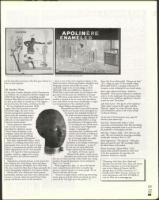
Above left: Erwin Blumenfeld: "Marquis de Sade,"
1921, collage on paper. In this complex collage,
Blumenfeld delivers a stinging indictment of
bourgeois society, including his own Jewish society.
Above right: Marcel DuChamp: Mpolinere
Enameled," 1916, pencil and paint on cardboard
and tin. In this readymade, the artist pays tribute
to French writer Guillarme Apollinaire, who first
coined the word "Surrealism."
Left: Marcel Jean: "The Specter of the Gardenia,"
1936, plaster covered in felt, zipper and film.
With eyes "zipped" in a state of reverie, humor
and romanticism coalesce in the artist's takeoff
on classical statuary.
On the Arts 6 Entertainment cover, page 65,
clockwise from bottom left:
Man Ray: "Indestructible Object," 1923,
metronome and photograph. Man Ray's assemblage
of a working metronome with an eye at the end of
the pendulum is both playful and dark.
Man Ray: "Cadeau (Gift)," 1921, flat-iron and
nails. The artist created this menacing assemblage
shortly after moving to Paris in 1921.
Meret Oppenheim: "The Squirrel," 1960, glass,
foam and squirrel's tail. This assemblage reflects
the black humor of Surrealism.
Marcel Duchamp: "Bicycle Wheel," 1913,
bicycle wheel and fork mounted on white stool.
In his first readymade, the artist blurs the
distinction between art and life.
"Dreaming with Open Eyes: Dada and
Surrealist Art from the Vera, Silvia and Arturo
Schwarz Collection in the Israel Museum"
runs at Art Gallery of Ontario (AGO)
through Sept. 8. AGO is located at 317
Dundas Street West, Toronto, Ontario. For
more information, call (416) 979-6648 or
visit the Web site at www.ago.net .
❑
6/28
2002
69