

Insight
Remember
When • • •
Shades Of Green
From the Jewish News pages this week
10, 20, 30, 40, 50 and 60 years ago.
The ever-winding Green Line, Israel s pre-1967 eastern border,
is the focus of renewed political debate.
GIL SEDAN
Jewish Telegraphic Agency
The Anti-Defamation League of
B'nai B'rith will sponsor a tutoring
program for students in two
Detroit Public Schools to foster
better relations between local
Jewish and black communities.
IV
1982
VID As
Just south of Afula, the line bends southwest, separating the
Arab towns and villages of Wadi Ara — under Israeli control
since 1949 — from their Palestinian sister villages in the east.
Jerusalem
At times, the line divided villages down the middle, like
hen the guns from Israel's War of
the village of -Barta'a in the Wadi Ara region and two
Arab villages further south.
Independence finally fell silent in 1949,
Israel signed a series of armistice agreements
Just east of Hadera, the line cuts south all the way down
with its Arab neighbors.
to Rosh Ha'ayin, creating the soft belly of the state. At
With Egypt, Syria and Lebanon, the armistice lines more or
some points, for example near Tulkarm and Kalkilya, it is
less matched the international borders of Mandatory Palestine.
less than 6 miles from the Green Line to Israel's heavily
The situation was more complex with Jordan,
populated coastal plain.
which during the war had occupied the West
In other words, in the absence of any nat-
Bank of the Jordan River.
ural territorial barriers along the line,
With no previous border to go by, the whole
Palestinian terrorists coming from any of
length of the dividing line between the two
those towns can reach coastal cities such as
armies had to be negotiated. Official negotiations
Netanya, Herzliya and Kfar Sava in less than
in Rhodes were stuck, so Israel secretly complet-
two hours on foot, or within minutes by car.
ed the negotiations direcdy with King Abdullah.
Moreover, at this point the Green Line
A line was drawn on the map, depicting
also lies just a few miles from strategic loca-
more or less the armies' deployment lines at
tions such as the electric power plant in
the end of the war.
Hadera, the fuel tanks of Pi Glilot — the
There was one exception: Under Israeli mili-
site of a recent terrorist attack, which, but
tary pressure, Abdullah ceded certain strips in
for a technical malfunction, could have
501poi
I
the coastal plan and in the Wadi Ara hills that
been of catastrophic scale — and Ben-
were not actually held by the Israelis. .
Gurion International Airport.
The lines were marked green on the maps,
From near Ben-Gurion, the Green Line
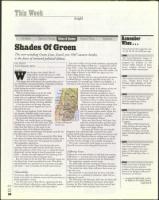
giving birth to the term the Green Line. That A map outlining the
pulls east toward Jerusalem and then once
winding line, which ran approximately 215
Green Line.
again southward, along the Hebron Hills
miles from Beit She'an in the north to the
down to the Negev Desert.
southern slopes of the Hebron Mountains in
For years, the Green Line was virtually
the south, marked Israel's border with Jordan until the Six-
forgotten. Jews and Arabs alike crossed the line undis-
Day War began on June 5, 1967.
turbed, Jewish settlers going to and from their homes in the
In that war, of course, Israel conquered the West Bank
West Bank and Palestinian laborers seeking work in Israel.
and eastern Jerusalem after being attacked by Jordan. Since
Here and there, the army placed roadblocks on the for-
then, the term "Green Line" has acquired more political
mer line, but by and large it was virtually nonexistent.
than geographic significance.
This week, construction work began on a security fence
Israel's return to the Green Line became the main
that will run more or less along the Green Line.
demand of the Arab world and the Israeli left. For the
right, the contours of the Green Line — which left Israel
Differing Views
dangerously narrow along its heavily populated coastal
plain — became the main argument for retaining settle-
Proponents of the fence believe it will help stop terrorist
ments and an Israeli military presence there.
infiltrations — and may revive the old border, possibly
But the results of the Six-Day War essentially wiped out galvanizing a political settlement with the Palestinians.
the Green Line. Israel controlled the entire West Bank,
The opponents comprise several camps.
and the border was opened for free movement of people
The Israeli right fears that reviving the Green Line may
and trade — and, eventually, for bombs and terrorists.
accelerate demands for evacuation of West Bank settlements.
The settlers' fear that a fence will leave them more iso-
lated than ever.
Vulnerability
The Israeli left is concerned that the fence will defer
Two factors make the Green Line nearly impossible for
negotiations on a permanent settlement, while still not
Israel to live with: its arbitrary nature and its proximity to stopping all attacks.
Israeli population centers.
The Palestinians, for their part, claim that the fence will
The line runs west of Beit She'an, separating the Beit
further curtail their freedom of movement, particularly
She'an and Jezreel valleys from major Palestinian popula-
between the West Bank and the Gaza Strip, and will pre-
tion centers such as the Nablus and Jenin regions.
vent illegal laborers from finding work in Israel.
❑
6/28
2002
26
After exterior and interior renova-
tions, Temple B'nai Israel of
Petoskey will rededicate its facili-
ties as it celebrates its 85th anniver-
sary.
A bequest from the Detroit estate
of the late Harry Glassman will
fund the auditorium of Beit
Nehama Culture Center.
1962
The Young Israel Organization
announces at its jubilee conven-
tion in New York City that it has
left the American Jewish
Congress.
The Detroit Police Department
solicits aid from the city's clergy for
the Police & Religious Leaders
Conference on Crime, one of the
largest interfaith gatherings held in
Detroit.
1902:
The Northwest Israel Synagogue
and Center organization has
begun construction of its syna-
gogue on Wyoming, between
Santa Maria and Santa Clara, in
Detroit.
Rabbi Leon Fram of Temple Israel
in Detroit has been elected a
member of the national governing
board of the Religious Education
Association of America.
— Compiled by Holly Teasdle, airhivist,
the Rabbi Leo M Franklinhrhives,
Temple Beth El