

Healthy Eating
92
Beginning Fitness . . . 94
Painful Remedy
-
ISSUES
96
•Z
Women's
health has
RUTHAN BRODSKY
Special to the Jewish News
moved up
the research
ladder over
the last
12 years.
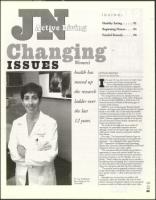
Dr. Lisa Finkelstein:
Some things are not
"inevitable. "
I
n the past 10 years, the interest in health issues
for women over 50 has increased greatly.
From a physiological perspective, women's
health now refers to the prevention, diagnosis
and management of conditions or diseases that may be
unique to women, be more prevalent in women, or
manifest differently in women than men.
This change from a focus on reproductive issues
came with the establishment of the Office of Research
in Women's Health (ORWH) in 1990 by the U.S.
National Institutes of Health to fill serious gaps in
women's health research.
ORWH is now conducting the Women's Health
Initiative, the largest, most ambitious study of women's
health in the world. The 15-year study has enrolled
164,500 postmenopausal women in the U.S. It will
answer questions about hormone replacement therapy
(HRT), calcium supplements, and diet in the preven-
tion and treatment of heart disease, osteoporosis, and
breast and colorectal cancer.
The results of this study and recent studies of
menopause are particularly important because,
although women live 6.4 years longer than men, they
suffer poorer health outcomes and greater disability
from disease.
One study, "The International Position Paper on
Women's Health and Menopause: A Comprehensive
Approach," was published in May Susan Hendrix,
D.O., Department of Obstetrics and Gynecology,
Wayne State University School of Medicine and Hutzel
Hospital in Detroit, was a major author.
"The menopause offers the health care provider an
opportunity to assess each woman's health, her con-
cerns, and the need for health promotion and disease
prevention measures," says Dr. Hendrix, who is not
Jewish. "Today's health care provider has to consider a
bewildering array of changing 'facts' and sees increasing-
ly informed patients with strong personal convictions
about the menopause and their need for medication.
"The provider must be prepared to discuss a variety
of age-related topics, and decide what to recommend
for a specific woman — often in less time than ever
before."
Although some women have no problem with
menopause, others are miserable, and most fit some-
where in between. Symptoms related to the menopause
transition include hot flashes and night sweats, sleep-
6/21
2002