

The Big Story
"I liked to stop by and see Granny
after school, before going home," he
says. She always had a snack — maybe
an egg cream or creamed herring on rye
bread or something with garlic (she
always smelled of garlic, onion and
vanilla, he says).
Whatever she made, it was delicious.
"She was a good cook — much better
than my mother," Dr. Sonenshein says.
"And yes, I did tell that to my mother."
In his book, Dr. Sonenshein writes:
"In my memory Granny still stands in
the window of her apartment, watching
for me[after school], standing on stoc ky,
short legs waving fleshy arms; dressed in a
fresh house dress printed with flowers and a
starched white baker's apron; her face shin-
ing in the late afternoon sun, framed by
black hair streaked with silver"
Dr. Sonenshein describes his grand-
mother as a woman who "didn't know
she was funny' saying "things in a funny
way," like calling her cousin, a dwarf,
"the big lawyer."
She was a generous woman with a
kind heart, "a person who knew love
and who could give love and could take
it," Dr. Sonenshein says. 'But if some-
thing went wrong, she could take that,
too."
Oi*A040MW404.10g!Ak s
Granny loved her family — those liv-
ing nearby as well as the more distant
relatives back in Minsk. Like Cousin
Moshe.
Moshe and his wife, Rifka, were in
terrible shape, according to a letter that
arrived one day at Granny's house. In his
book, Dr. Sonenshein tells how his
grandmother cried as she learned of
Moshe and Rifka's poor son Shimmon,
just 6, and already so. thin that "to keep
the wind from blowing him over, we
have to stuff his pockets with rocks."
And the anti-Semites — they were on
every corner. No food! No safety! So
much disease!
"Please," Cousin Moshe wrote, "we
beg you to send us the money to come
to America where the streets are paved
with gold."
Granny started to save and save and
save. She took on extra work; she tight-
ened her budget at every corner. Finally,
she had the extraordinary sum of $500,
which she mailed to Moshe for the tick-
ets. Abe and Sarah waited, but their rela-
tives never arrived.
At last, though, a letter came: "Dear
Sarah and Abe: The money arrived as
you promised. Thank you. We have
decided not to come to the USA
,
because with $500 we can live like kings
here."
Silverware Grew in Her Garden (a ref-
erence to how Granny would kasher sil-
verware after she had, perhaps, inadver-
tently stuck a dairy fork into a pot of
chicken soup) also recounts how women
cooked long ago, with a pinch of this
and a pinch of that, and how children
looked forward each week to matinee
-
films like Bambi.
Life back then really was different, Dr.
Sonenshein says. The neighborhood was
diverse, he says, but everybody liked
everybody and "everybody was responsi-
ble for everybody."
When Rolf the policeman reprimand-
ed a boy caught playing hooky, the boy's
parents didn't complain; they were grate-
ful. And when Mrs. Cohen told a girl it
was late and time for her to get on
home, "it was no crime" to interfere.
In the evenings, no one watched tele-
vision or played on the computer .or
went to the mall. Instead, family and
friends would gather around the piano
and sing. And on free afternoons, the
neighborhood kids would play ball —
"every corner lot had a baseball team" —
so they got to know everybody.
Recently, a childhood friend of Dr.
Sonenshein's, an Italian, went back to
the old neighborhood to visit. He
brought his camcorder and took pictures
of the schoolyard where they used to
play and of Henry's parents' store. Dr.
Sonenshein saw that much had changed
— but not too much.
"Everything was familiar, though now
the open lots are filled with houses.
There used to be a Jewish neighborhood
and an Italian neighborhood, and today
it's more mixed."
All the memories might have
remained nothing more than that had
Franklin Concerts
Brighten Summer
Fun With Science
41N
6/14
2002
96
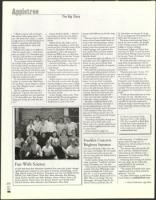
At Oak Park-based Bais Menachem Academy's first science fair, fourth- through
eighth-grade girls competed in such subjects as anatomy and physiology, meteor-
ology, physical science and chemistry. Participants were (top row) Malky Pershin,
Miriam Leaf Aidel Finman, Chaya Beck, Alona Aharonav, Esty Weinberg,
Hindy Finman; (middle row) Esther Babayou, Minna O'Brien, Esther Leaf
Devora Bennish, Penina Forta, Suri Bennett; (bottom row) Mushky Polter,
Mari ashi Bennett, Alona Aharanov, Etty Mishulovin, Elana Kasle.
Four-year-old Sarah Cohen loves her
new house in Franklin. But she misses
the summertime park concerts she
- used to enjoy when the family lived in
Huntington Woods.
So her mother, Karen Couf-Cohen,
made a promise. "I told her we'd have
music in Franklin, too," she said...
This summer, that promise becomes
a reality with three Wednesday night
concerts scheduled for 7-8:30 p.m.,
July 10, 17 and 24 at the Franklin
Green on Franklin Road, north of 13
Mile. There is no charge. The Sun
Messengers, the house band for the
Detroit Pistons, performs July 10,
Dr. Sonenshein not become ill. At age
59, he was diagnosed with leukemia and
told he had 18 months to live.
The doctor retired and soon found "I
had all this time to think." He decided
to take writing courses at Schoolcraft
College in Livonia, Oakland
Community College and Wayne State
University. At WSU, he won the Senior
Personal Essay Writing Contest last year
for his story "Scent of a Granny," which
is included in his book.
He would think often of the past, and
speak about his grandmother with his
mother and sister — and the past would
come back to him quickly, sweetly, like a
little breeze.
"Memories just came," he says. "If I
sat and thought, it came back to me,
like I was there."
As he wrote down his stories, Dr.
Sonenshein went through chemothera-
py. Miraculously — literally (physicians
were astonished) — his cancer now has
vanished. More than nine years after the
dire diagnosis, - Dr. Sonenshein is in great
health.
"It took me about three years to write
the book," he says. "My idea was to
write the least and say the most. Cutting
was difficult, but if the words aren't
telling me much, I learned to get rid of
them. I don't like taking too long to get
to the point."
❑
Dr. Henry Sonenshein's book,
Silverware Grew in Her Garden
($11.95), is available at Book Beat
in Oak Park, Esther's Judaica
Gift World in West Bloomfield,
or by e-mail to the author at:
sunsheinh@aol.com
while Immunity, a Caribbean-style
group, takes the stage July 24.
Negotiations still are going on for the
July 17 performance.
The concerts also will include chil-
dren's activities. Oakland County's
inline-skating tent will put in an
appearance; ice cream trucks will be
on hand at every concert.
Producing three evenings of summer
fun isn't cheap. So far, Cohen has
raised $6,000 of the estimated
$10,000 she'll need.
"The people of Franklin have come
together and they've been extremely
generous," she said.
For more information, e-mail Karen
Couf-Cohen at couflinks@aol.com
— Diana Lieberman, copy editor