

Entertainment
understand as much as I could before putting pen to
paper," says Rigg, who includes personal photos and
copies of documents to provide a deeper sense of the
people behind the numbers.
"Readers will have to step back from any polarized
view of this history and see that not every German
soldier was a Nazi as we use the term today and not
everybody who was of Jewish descent was a victim
of the death camps.
"They also will see that there were probably hun-
dreds of thousands of people who were persecuted
by the Nazis not because they called themselves
Jewish but because the Nazis called them Jewish and
treated them accordingly."
In Pursuit Of Racial Purity
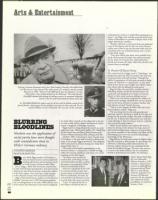
A former German lieutenant and a Jew, Paul-Ludwig (Pinchas) Hirschfeld holds
his War Service Cross Second Class with swords in a military cemetery outside
Hanover in 1996 "Service in the Wehrmacht was my salvation," he said.
"My brother, sister, family all died in the Holocaust. The whole family"
Hirschfeld claimed that during his military service, he remained religiously
Jewish as best he could and recited the Shema evay day.
Lt. Hirschfeld falsified his papers and cut all ties with his family, except for his
Jewish fiancee, whose papers he also falsified and whom he later married. For his
tactical abilities, he was nicknamed "the wise Jew" by his comrades.
BLURRING
BLOODLINES
Nowhere was the application of
racial purity laws more fraught
with contradiction than in
Hitler's German military.
SUZANNE CHESSLER
Special to the Jewish News
B
ryan Mark Rigg traveled to Germany to
trace his family ancestry and returned with
startling information about ancestry search-
es of the German military under Hitler.
Just as Rigg, a Bible Belt Protestant, learned that
he had a Jewish great-grandmother and other Jewish
relatives, he also discovered that, among the soldiers
of the Nazi regime, there had been many thought-
to-be Christian Aryans who had Jewish forebears.
Rigg, a Texas-based history professor at the American
Military University and a 1996 Yale honors graduate,
was an undergraduate in the early 1990s when he start-
ed to uncover the information and wrote an independ-
5/24
2002
66
ent study. More research on the subject led to his sen-
ior essay at Yale and his master's and doctoral concen-
tration at England's Cambridge University.
Riggs research is being released this month as a com-
prehensive book, Hitler's Jewish Soldiers: The Untold Story
ofNazi Racial Laws and Men of Jewish Descent in the
German Military (University Press of Kansas; $29.95).
Dateline: NBC . is devoting its entire Sunday, June
9, broadcast to the text and its author, talking with
some of the people Rigg interviewed. That program
will be discussed in advance during the Today show
airing Friday, June 7.
The extent of the Jewish representation in the
German military — estimated at 150,000 by Rigg —
makes this research significant and opens new under-
standings of the Nazi regime.
The author came up with the
number after interviewing veterans
and their families and then combing
documents, some signed by Hitler,
found in armed forces archives.
Only two individuals of the 430
he interviewed did not give him
consent forms to check personnel
files for verification. At times, he
evaluated the oral histories as more
accurate than what was in writing.
"I gave 10 years of my life to
this subject and did my best to
The critical word in Riggs work is "Mischlinge," the
designation given by Nazis to people who had vary-
ing proportions of Jewish heritage. Through the
author's examination of what gave someone a desig-
nation of "half-Jew" or "quarter-Jew" or any other
kind of Jew, there is new insight into Hitler's obses-
sion about what he defined as racial purity.
Rigg describes the way Hitler decided whether
Mischling soldiers should be exempted from the
racial laws and declared to be Aryan, of German
blood, so they could continue military service.
Hitler went over forms completed by soldiers of
mixed ethnic heritage, checked their service records
and viewed their pictures to evaluate whether they
had what he termed "Jewish" features.
"This is a new chapter of Hitler's life that hasn't
been looked at closely," Rigg says.
"He was doing this for not only generals and
admirals, which is shocking in itself, but he also was
doing this for privates, people who had no influence
on the war. It shows how obsessed he was with this
racial ideology in that he believed only he could dis-
cern a person's racial makeup."
Hitler's Jewish Soldiers also explores the motiva-
tions for serving in the military by those aware of
their Jewish backgrounds, treatment of partial Jews
by various members of the military, the effects of the
Nuremberg Laws over time and the Mischlinge's
knowledge of the Holocaust.
Rigg believes his book opens issues of religious iden-
tity that continue to affect people. In the extreme, he
references a Mischling soldier dismissed from the
German military because he was considered Jewish
based on his father's lineage. The man, who went on
to serve in the Israeli military, was not considered
Jewish in Israel because his mother was Christian.
Author Bryan Mark Rigg,
left, and Chancellor
Helmut Schmidt in 1995.
Schmidt, a "quarter-Jew,"
served as a Luftwaffe first
lieutenant during World
War II, a time during
which he claimed he was
unaware of Holocaust
atrocities. He has admitted
that without his Jewish
grand father, he could have
become a Nazi.