

Synagogue Listings . . . 66
--,-oiserelowwww
68
Torah Portion
p.
Spiritu lity
"broach
Religion,
including Judaism,
JUDITH DONER BERNE
Special to the Jewish News
is gaining
Havana
S
momentum in
Castro's Cuba.
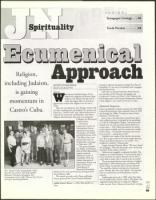
Our "Jewish Cuba" group flanks Adela
Dworin (in center), who held together
Havana's Patronato Synagogue and
Community Center after Havana lost 95 per-
cent of its Jewish population.
lir
hen former President Jimmy Carter
talked with religious and human rights
leaders on his historic five-day visit to
Cuba that began May 12, he had an
opportunity to learn that religion is on the rise in
Cuba.
That was my experience, too, during a recent week
in Cuba, traveling with my husband, Ed, and our son
David on a "Jewish Cuba" trip. I learned that Jews in
Cuba do not encounter anti-Semitism. And where
religious discrimination does exist, it encompasses
Catholics and Protestants
as well as Jews.
The Jewish
Community Center of
Metropolitan Detroit
sponsored our journey.
The leaders, Dr. Robert
and Myrtle Everett of St.
Clair Shores, have con-
ducted more than 40
United States exchanges
to Cuba since 1997.
Our group included
Dr. Sidney and Sharlene
Beck of West Bloomfield,
Sophie Averbuch
(Sharlene's mom) of
Southfield, Herb and
Audrey Saperstein of
Huntington Woods and
Julian and Frannie
Greenebaum of
Bloomfield Township.
David was the only out-of-towner, joining us from
Santa Monica, Calif
We teamed up nicely with a Peace and Justice
Group sponsored by Central United Methodist
Judith Doner Berne is a West Bloomfield resi-
dent.
Church in Detroit; the group included Fern Katz of
Southfield. On our tour, we attended both synagogue
and church services.
And what we learned both from Adela Dworin,
vice president of the Patronato Synagogue and
Community Center, and Dora E. Arce Valentin, the
first female pastor of the Luyano Presbyterian Church,
is that religion is very much on the rise in Cuba.
Historical Perspective
Cuba was declared an atheist country soon after Fidel
Castro's Revolutionary Army claimed victory in 1959
and through the 1980s. "It wasn't an issue of anti-
Semitism," Dworin said.
Jews, in fact, may have been treated better than
other religious groups. As detailed in the guidebook
on Cuba by Christopher P Baker, "Jewish parochial
schools were the only parochial schools allowed to
remain open ... The Cuban government has always
made matzah available and even authorized a kosher-
butcher shop ... The Jewish community also has its
own cemetery ... dating from 1910."
Catholics were targets of the harshest discrimina-
tion. But, to gain access to the most sought-after pro-
fessions and job promotions, it was simple: "You
couldn't be a believer," Dworin said.
Largely through Dworin's efforts, "We never closed
the synagogue. Only the old people came. Seven men
and three Torahs made a minyan."
Valentin also struggled to maintain her faith. The
daughter of a retired minister, "I had to declare that I
was a Christian in school. Because of my faith, I
wasn't able to study what I wanted at the university."
The government became more tolerant of religion
beginning in 1990, following the unraveling of the
Soviet Union. For the first time, Dworin reported,
"You could be a believer and join the Communist
parry." Shortly after, the word "atheist" was removed
from its constitution and Cuba became a secular
country.
Further gains occurred in 1998, when Pope John
Paul II visited Cuba, Valentin told us. The pope's visit
triggered the first televised coverage of a religious
event, she said. Now, Cubans can tune into a worship
•4 '
n
5/17
2002
59