
ek\
•■•
••.v
Jewish And Proud
Smart, beautiful, successful and outspoken, actresses Debra Messing
and Natalie Portman are role models for a new generation.
State Of `Grace'
Debra Messing plays TV's first fully realized Jewish female character.
NAOMI PFEFFERMAN
Jewish Journal of Greater Los Angeles
-
D
ebra Messing shrieked when she heard
she's been cast as Woody Allen's sexy girl-
friend in his new romantic romp,
Hollywood Ending.
"I was in my car, and I al-most caused an acci-
dent," gushes the spunky, green-eyed redhead, best
known as the kooky Jewish gal pal to a gay lawyer
on NBC's Will 6- Grace.
"I come from a Jewish family from New York, so
Woody Allen is almost mythological to me. To star
in one of his movies — I was over the moon."
Messing, who'll accompany Allen to France to
open the Cannes Film Festival next week, plays Lori,
a ditzy tart of an actress dating a washed-up director
(Allen) with one last shot at success. Never mind
that the pairing is, well, ironic: Allen's known for
depicting not-so-nice Jewish women (think the nag-
ging mom from New York Stories) while Messing's
overturned every Jewish female stereotype on TV
Forget pathetic Melissa from thirtysomething and
obnoxious Vicki from Suddenly Susan. The fictional
Grace Adler is a hip, gorgeous, lovably klutzy interi-
or designer with way cool clothes and an unabashed-
ly Jewish sensibility
The character spouts Yiddishisms, reminisces
about Camp Ramah, confesses eating a burger on
Yom Kippur and describes her excitement at being
profiled in the Jewish Forward. When Grace breaks
up with her latest inappropriate beau, she chants,
"Baruch Atah Adonai, I'm gonna die alone."
You could call her the anti-Seinfeld: "I remember
thinking Jerry's friend Elaine was Jewish, then learn-
ing she wasn't," said the Emmy-nominated Messing,
33, whose series has just been picked up for three
more seasons.
"Then I thought, Seinfeld's friend George must be
Jewish, but his last name was 'Costanza.' It's like
the sensibility was Jewish but the characters weren't.
Which is why I encouraged the Will d' Grace writers
to include more Jewish references for my character.
5/10
2002
104
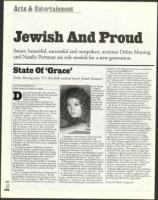
Debra Messing:
"I thought it
would be great if
Grace were open
and unapologetic
about being
Jewish, i fher
Jewishness were
just a fact, the
way it's a fact
that Will is gay"
"I thought it would be great if Grace were open
and unapologetic about being Jewish; if her
Jewishness were just a fact, the way it's a fact that
Will is gay. I thought it would be neat and an inside
joke for my family if we could have smart jokes that
revealed Grace's Jewishness while at the same time
making her endearing to the audience."
Will 6- Grace co-creator Max Mutchnick, concurs:
"Grace doesn't fall into any of those categories that
have stereotyped Jewish women," he says. "She's
strong, she's pretty and she's a proud Jewish woman."
If Messing projects a certain vulnerability as Grace, it's
because she's had some practice. "I never felt beautiful
growing up," confides the 5-foot-8-inch actress, who
was born in Brooklyn but raised in rural Rhode Island.
"I didn't think my big hair was attractive. It took
me a long time to come to terms with my looks."
It didn't help that Messing — the daughter of a
jewelry executive active in the Rhode Island Jewish
Federation — was one of only a few Jews at school.
When she was in the third grade, a boy pushed her and
called her a "kike" (around the same time, a swastika was
painted on her grandfather's car).
"I felt the desire to lie and say I was sick on Yom
Kippur because kids got mad and thought it was
unfair I got the Jewish holidays off and Christmas,
too," Messing recalls. "I did feel different being Jewish.
I felt like an outcast throughout elementary school."
She escaped into the Jewish milieu of Woody Allen's
films, which were de rigueur in her childhood home.
Messing also nursed a wicked crush on actor Dustin
Hoffman, became bat mitzvah at a Reform temple
and trekked to Brooklyn to visit her Jewish relatives.
During one such visit, her mother, Sandy, a onetime
professional singer, took her to see Annie on Broadway.
The then-7-year-old Messing leaped out of her seat
and declared, "I'm going to be Annie one day."
By the age of 16, she was playing the role in a
high school production, though her parents insisted
she attend college before drama school.
So Messing was off to Brandeis University, where she
says the heavily Jewish population proved "shocking, but
ultimately, a relief It was amazing to not feel ashamed,
to not have to make excuses for my holidays and to meet
people who'd had similar family experiences."
After graduating summa cum laude from Brandeis,
Messing earned a master's degree in theater from New
York University and became the quintessential struggling
actress — until her father revealed he'd invested her bat
mitzvah money and parlayed it into a cool $30,000.
The funds helped sustain her until she began
landing roles such as a scheming sister on NYPD
Blue and Jerry's elusive ideal girlfriend on Seinfeld.
In 1995, Messing snagged the lead in the Fox
series Ned and Stacey, though she bombed her initial
audition. "They said I was too wholesome," she
recalls, with a groan. "They wanted a neurotic Jew
from New York, and I said, 'Hello, I'm right here.'"
If Stacey was Jewish in name only, Grace Adler is
anything but. While Will 6- Grace broke ground in
1998 as one of the first network series to feature an
appealing gay main character, it was a first for
another reason. As the Forward put it, "There [has-
n't] been a more positive role model for Jewish
women on television in the past 50 years."
Messing, oddly, expresses surprise when told about
the Jewish community accolades. "No one's articulat-
ed that to me, but I consider it a huge honor and a
privilege," she says. "I had hoped Grace would be to
Jewish people what Will is to gay people."
STATE OF 'GRACE' on page 106
Scanned image of the page. Keyboard directions: use + to zoom in, - to zoom out, arrow keys to pan inside the viewer.
May 10, 2002 - Image 116
- Resource type:
- Text
- Publication:
- The Detroit Jewish News, 2002-05-10
Disclaimer: Computer generated plain text may have errors. Read more about this.