

V()
o mmafille/,
-)f
kyyrouRcl a
az
nth la
,_171;zia/
among them Detroit Symphony Orchestra concertmaster Gordon Staples,
Boston Symphony concertmaster Joseph Silverstein and violinists Annie
and Ida Kavafian. His music students also have gone on to receive
national and international acclaim, among them pianist David Syme;
Paul Schonfield, who headed the composition department at the
University of Toledo, and conductor Kurt Saffir.
In its heyday, the orchestra had 50 members, some amateurs and many
professional musicians. Thanks to the wide acclaim the symphony
received,.Mr. Chajes had no trouble finding professionals locally and
from out of town who wanted to be part of the CSO. Paul Paray, Detroit
Symphony Orchestra conductor from 1952 to 1963, appeared as a guest
conductor with the CSO.
dRice
nt h
ik ti2c000
r312-oleia
„2,;,‘
(
e2(//,
Staff, members and the community braved the July heat to build the
Weinberg playground.
As the saying goes, it takes a village to raise a child, but it takes a com-
munity and JCC staff to build a playground. It's also helpful to have a
generous grant from the Harry and Jeanette Weinberg Foundation. Past
President Linda Lee and Todd Sachse chaired the project: a new play-
ground for the JPM Building. More than 300 volunteers turned out on
July 3-4, 1994, some with little or no building experience, others with
More, but all dedicated to providing a safe and wonder-fill place for chil-
dren and families to gather.
Children were asked to draw what they imagined would make a nice play-
ground, and off the pictures went to the designers who came to the JPM
Building to view the site. When the final pieces were delivered, the main-
tenance staff prepared them for installation, and then young and old, from
all levels of Jewish observance came to help out by serving food, working
on assembling the pieces and just lending a hand wherever needed. The
maintenance staff was so devoted that after their role doing the hard
labor, they stayed on working alongside the volunteers. According to
Linda Lee, "it was a true community effort."
Manny, Natalie and Jeffrey Charach wanted to find a way to honor the
memory of their daughter and sister Janice, an artist. They did it at the
JCC. In 1990, with Janice's husband Stuart looking on, the Charachs
broke ground for what became the Janice Charach Epstein Gallery.
Opened in 1991, the two-story gallery, acclaimed by the Detroit Free
Press as one of the metropolitan area's leading art galleries, is an impor-
tant venue for Jewish art and artists. The gallery : hosts seven shows a
year, filling the multi-level space with an ever-changing visual experi-
ence, ranging from contemporary art to exhibitions . of religious signifi-
cance and relevance to Jewish history and culture. • It also provides edu-
cational experiences for children. •
The Janice Charach Epstein Gallery showcases art in a variety of media:
glass, photography, architecture, painting, jewelry; fiber, ceramics and
more. It also has held shows featuring the works of the late Janice
Charach Epstein.
Although-its mission is to highlight Jewish art and artists, the gallery has
drawn audiences from many religious and ethnic groups in the communi-
ty.
The Center Symphony
Orchestra makes its
debut in 1940 under the
baton of composer,
pianist and conductor
Julius Chajes at the
Aaron DeRoy
Memorial Building.
From its first concert in 1940 and for the next 45 years, Julius Chajes led
the JCC's world-class Center Symphony Orchestra. When he came to
Detroit, Mr. Chajes was charged with organizing an orchestra, a music
school and choir at the JCC. The Polish-born composer, pianist and con-
ductor created an orchestra that produced countless classical music stars,
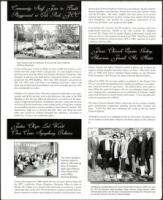
Attending the groundbreaking for the Janice Charach Epstein Gallery in 1990 were. from
left: JCC Past President Hugh Greenberg, Manny Charach, Natalie Charach, Jeffrey
Charach, Stuart Epstein, the late Janice Charach Epstein's husband, JCC President Linda
Lee and JCC Executive Director Dr. Morton Plotnick.