

Detroit rabbis and Baptist ministers travel
to Africa and Israel together and discover
an interfaith dialogue and connection.
SHARON LUCKERMAN
Staff Writer
A
BSA
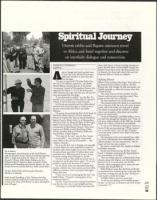
Top to bottom:
An impromptu memorial service at the site of Moment
C e, the Jerusalem site of a March 9 suicide bombing that
ki led 11 people and injured 54. Shown are: The Rev.
Kenneth J. Flowers, Rabbi Maria Feldman, the Revs.
Nicholas Hood III, Benjamin Baker and Robert Dulin,
Rabbis Arnold Sleutelberg and Jonathan Berkun, the Revs.
Ronald Turner and Darryl Robinson, Rabbi David Nelson.
The Rev. Robert Dulin and tour guide Menachem
Wertheim at Massada.
Rabbi Arnold Sleutelberg of Shir Tikvah and the Rev.
Nicholas Hood III ofPlymouth United Church of Christ
in front of the "Door of No Return" on Goree Island off the
coast of Senegal
trip to Senegal and Israel touched roots
in ways that truly allowed Detroit-area
rabbis and ministers to share their dis-
tinct heritages.
"I've gone to Israel with Christians before, but
this was a very different experience," says Rabbi
Marla Feldman, assistant director of the Jewish
Community Council of Metropolitan Detroit, who
organized the March 11-21 trip. By sharing each
other's historic and tragic sites, she says, the trip was
more personalized for the clergy.
"It was absolutely incredible," says the Rev. Dr.
Ronald Turner, minister of Peace Baptist Church in
Detroit. It was his first trip to both countries.
Six Detroit-area ministers and four rabbis shared
historical and cultural heritages to reinforce ties in
the two communities back home, says Rabbi
Feldman.
The group also included the Revs. Nick Hood of
Plymouth United Church of Christ, Kenneth J.
Flowers of Greater New Mount Moriah Missionary
Baptist Church, Robert Dulin Jr. of Metropolitan
Church of God, Dr. Benjamin Baker of New Light
Baptist Church and Dr. Daryle W Robinson of
Community of Faith Baptist Church. Their coun-
terparts were Rabbis Arnold Sleutelberg of Sliir
Tikvah, Jonathan Berkun of Shaarey Zedek and
David Nelson of Beth Shalom.
"The value of the trip," says the Rev. Turner,
"is inestimable. I was enamored, mesmerized
when taken to the old city of Jerusalem ... Yad
Vashem, Massada."
But it was his first visit to Senegal, and especially
to Goree Island, the main embarkation point for
the slave trade, that brought him to tears. Here was
the point where more than 22 million slaves were
processed over a 300-year period, he says. "It was
the most moving thing to happen in my life."
The Rev. Flowers, who made his second visit to
the island to see the slave house, agrees. "It was very
painful to stand in the doorway of no return ..."
On the island, slaves were separated from their
families, children from their parents, and sent off to
different continents, never to see each other again.
Many died there.
.
"There was a lot of embracing [at the site]," says
Rabbi Nelson. "I learned a missing piece of our
[American] history."
The Rev. Turner found that visiting Goree Island
and then the holy sites in Israel enlightened him.
"Listening to our Jewish brothers and sister talk
about their history, I found a kinship through our
paths, the Holocaust and the Middle Passage [the
Atlantic Ocean slave route]. We found union and
we learned a lot about each other's faith and how
important faith is to both our religions."
Infusing Humor
What's it like traveling with clergy? "Every place we
go everyone had to preach a sermon," the Rev.
Flowers says with a laugh. He adds that humor was
helpful, especially to relieve the tension when they
arrived in Israel.
The streets were much less crowded, says Rev.
Flowers, who has been to Israel four times. Their
group was the only tour at Masada.
Yet, their experience was no less powerful.
The ministers joined the rabbis in an impromptu
visit to Moment Cafe, the scene of a recent terrorist
attack, where they broke into song and lit candles.
The rabbis accompanied the ministers to biblical
sites in east Jerusalem, where Jesus was crucified,
and to his empty tomb.
It was eye-opening," says Rabbi Nelson, to see
the Old City through the ministers' eyes." They vis-
ited many religious leaders of the Old City, he adds,
which was a lesson in hope and reconciliation.
A visit to the Ethiopian absorption center in
Yemin Orde was ey,e-opening. "What jumped
out at me this time," says the Rev. Flowers,
"was that these students were filled with hope
and promise."
His experience took a more personal turn when
an 18-year old Ethiopian Jew befriended him. He
calls the student "my new adopted son," who he
hopes will visit him next summer.
But there's a small hitch: The student is Shabbat
and kosher observant.
By the end of their journey, the Rev. Turner
found "a healthier appreciation for humankind in
our commonality, in our faith."
There are already plans for a black-Jewish clergy
alliance, along with religious and cultural programs
between the two communities, says the Rev.
Flowers, whose congregation has a seven-year rela-
tionship with Temple Beth El.
Rabbi Feldman notes that the black and Jewish
communities have worked together in the past. But,
since they no longer live side by side, "we have to
work harder to build the bridges."
To Rabbi Nelson, this was a good start.
"In all my years dealing with interfaith groups,
he says, "on this trip we reached a new level of com-
munication." ❑
,,
eIN
4/12
2002
55