

The Big Story
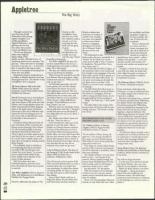
Through a series of pic-
tures featuring Ariella
Eichenbaum (the photog-
rapher's daughter) and
Ariella's grandfather,
Sigfried Halbreich, a little
girl learns for the first
time about the numbers
on her grandfather's arm.
The two are doing the
dishes when Sigfried
begins telling of the
attacks on Jews, of family he lost, of
Auschwitz where he was a prisoner. The
girl says, "There were tears in Grandpa's
eyes and in my eyes, too ... It must hurt
him to remember the time he spent
there and to remember all the people he
knew who were killed."
Restrained, eloquent, breathtaking in
its ability to illustrate both the most pro-
found grief and love, The Number on My
Grandfather's Arm is exquisite.
My Secret Camera: Life in the Lodz
Ghetto (2000), photos by Mendal
Grossman, text by Frank Dabba Smith.
Published by Harcourt.
Mendal Grossman was an extraordinary
human being. Risking his own life, he
took secret photos of life inside the Lodz
Ghetto, one of many ghettos where the
Nazis imprisoned Jews before shipping
them to the death camps. (Grossman
had access to film and a darkroom only
because his job was taking pictures of
Jews to be used on identification cards;
he died after a forced march in
-
Germany).
Grossman's photos illustrate both the
pain and beauty of life, evinced by his
famous picture showing a boy of about
13, who himself probably is starving,
sharing his food with his little sister.
There is agony (a mother speaks across a
wire fence to her son, about 6, who like-
ly is on his way to a death camp), and
hope (Jews in the ghetto making matzah
before Pesach).
The publishers chose to include an
accompanying text that is not always
successful ("We must be brave and
remain free in our hearts," by contem-
porary author Frank Dabba Smith,
seems awfully trite in the face of the
power of these pictures.)
Still, if you have never seen
Grossman's photos, and even if you
have, this book will never lose its power
to astonish.
One Yellow Daffodil (1995) by David A.
Adler, with illustrations by Lloyd Bloom.
Published by Voyager Books.
0IN
4/5
2002
60
David A. Adler (also the author of The
Number on My
Grandfather's Arm,
above) is one of the
best children's authors
around, so it's not
surprising that this
book isn't just good,
it's great.
In this case, too,
the illustrations are
actually up to par
with the copy. They're
beautiful and haunting.
One Yellow Daffodil is the story of a
survivor named Morris who lives in a
small apartment and works in a flower
shop. He is often lonely.
One day, two children come into the
store to buy flowers for Shabbat.
They have just $2 and ask for any left-
over flowers. Morris gives them a huge,
lovely bunch and says, "When you buy
old, you get more."
As Chanukah approaches, the chil-
dren's parents, Mr. and Mrs. Becker,
invite Morris for dinner and to join
them lighting the menorah. The next
day, Morris takes out his own menorah,
packed away for so many years, and
remembers when he was in Auschwitz.
There, he saw a yellow daffodil and
thought, "If the daffodil can survive
here, maybe I can, too."
When he returns to the Becker home,
Morris tells them of his life. "I thought I
would find some of my old friends in
the village [after the war], but I didn't. I
had no one."
Mrs. Becker takes Morris' hand and
tells him, "Now you have us."
In his introduction, Adler says of his
decision to write the book: "Morris
Kaplan is a fictional character inspired
by many of the Holocaust survivors I
interviewed while researching previous
books. Many survivors told me that after
the war they returned to their villages, as
Morris did, hoping to find a relative or
friend who had survived. Many told me,
too, that after the war they felt an
emptiness that would not go away"
I Am A Holocaust Torah: The Story of
the Saving of 1,564 Torahs Stolen by the
Nazis (2000) by Rabbi Alex. J.
Goldman. Published by Gefen.
One of the most curious aspects of the
Nazis was their determination to create a
museum about the very people they
were murdering. SO rather than destroy
everything Jewish, the Nazis, at times,
set aside such items as Sifrei Torah for
later display.
Some of these Torah scrolls sat in
Prague for almost 20 years before they
were discovered, and then saved by a
British art dealer who
took them to London. A
number were unusable,
but many were repaired
and have since found
homes in synagogues
throughout the world. I
Am a Holocaust Torah is
the story of one such
Torah.
The illustrations in this
book are fair; the text is wonderful. It is
"written" by the Torah, but it never
comes across as silly or trite. ("I used to
be handsome. No more! Now I have
scars, burns, tears.")
The Torah tells of its life in Prague, of
the excitement when it was written and
first brought to the synagogue. Then the
Nazis came, and the Torah is placed in a
dark closet with other Sifrei Torah. "At
one point one evening we all cried. Do
you know what it is to hear 1,564
Torahs cry at once? It was a symphony
of weeping."
The Sefer Torah that tells its story in
this book eventually is saved and finds a
new home in a synagogue. Here the
rabbi is young and clean shaven, but he
lovingly holds the Torah and kisses it.
"Inside," the Torah says, "I feel myself
.....................
The rabbi looks at the woman (who
has given him the Torah scroll), his eyes
tearing, and says, "The Torah is crying
tears of joy."
RECOMMENDED FOR OLDER
READERS (AGES 12-18)
The Children of Izieu: A Human
Tragedy (1984) by Serge Klarsfeld.
Published by Harry N. Abrams.
The 44 children of Izieu, France, all
aged 4-15, were among a handful of
Jews taken to private facilities during
World War II, where Jewish philanthro-
pists paid for their care.
Then Nagi war criminal Klaus Barbie
learned of their existence and promptly
had all 44 deported to Auschwitz, where
they were murdered.
The Children of Izieu is not the easiest
book to read — not because of the
material, which is painful enough, but
because Serge Klarsfeld (famous for his
Nazi hunting work), for all his good
intentions, simply is not a writer.
But the photos. Oh, the photos.
With the exception of one little girl,
of whom not even a picture remains,
readers come to intimately know each of
these 44 children.
There is the charming Egon-Heinrich
Gamiel, an only child, who was 9 when
he was killed, and Alice-
Jacqueline Luzgart in
her fancy sandals. She
was 10 when she was
murdered.
There are family pho-
tos, letters and docu-
ments, newspaper arti-
cles, all of which tell us
about each child and
remind us, as well we
should know, that it wasn't 1 million
children who perished — it was one,
and then another and another and
another and another and another and
another.
Though it is these 44 lives that stay
most with the reader, the book ends
with a fight (it's great) as we learn of
how surviving members worked to
bring Barbie to justice.
The Holocaust Heroes (1988) by David
K. Fremon. Published by Enslow.
If you only know a little about the
Holocaust, it is easy to understand how
you might imagine that everyone was a
victim or a murderer.
But there were heroes, too — not just
the famous ones like Raoul Wallenberg,
but Sophie Scholl, who helped create
the resistance group the White Rose
(and was subsequently executed by the
Nazis when she was just 22); Sempo
Sugihara, a Japanese diplomat who
defied his government and issued 2,000
visas to Polish Jews, saving their lives;
and Janusz Korczak, who was offered
the chance to live, but instead went to
his death in a gas chamber because he
could not bear to be parted from the
orphans for whom he was the sole
guardian.
The Holocaust Heroes certainly is not a
complete text on Holocaust heroes, but
it's a good start. Consider this an intro-
duction, then encourage children to
read more about the figures who
intrigue them most.
Young Moshe's Diaiy: The Spiritual
Torment of a Jewish Boy in Nazi Europe
(1985) by Moshe Flinker. Published by
B'nai B'rith.
You will not forget this book.
It is the story of an observant Jewish
boy, Moshe Flinker, who was a teen
when he was murdered in Auschwitz.
Before his death, Moshe wrote down
his thoughts — about persecution,
about God, about suffering. For
unknown reasons, this book hasn't
received as much attention as it deserves.
It will challenge you, and your teens, to
think. ❑