

Searching For A Cease-Fire
No Time Like Now
In the face of violence, Americans still are making aliyah to Israel.
S taff photo by H arry Ki rsbaum
HARRY KI RS BAUM
StaffWriter
I
t was not a snap decision. Efrat
Ludomirsky has been thinking
about the move since high
school.
Now 21, the Israeli-born dual citi-
zen student who graduates from the
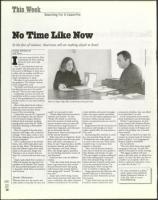
University of Michigan in April sits at
a table with her mother and fills out
the first of many forms to make
aliyah, immigration to Israel.
She plans to move sometime after
she graduates. The Mideast violence
hasn't changed her mind.
"My family and friends aren't worried,
but they just want me to be careful,"
she said, "They've been expecting this."
Ludomirsky was born in Israel and
moved here with her parents when she
was 4. Her grandparents live in Israel
and her cousin is in the Israel Defense
Forces.
She's a little afraid of the violence
there, but said she's never traveled in
Palestinian areas and she's always
aware of her surroundings.
Ludomirsky was one of 11 potential
aim (new emigres) who met March
12 with Maurice Singer, Midwest
shaliach aliyah (emissary handling
immigration) at the Max M. Fisher
Federation Building in Bloomfield
Township.
She's not typical of the aim from
America, said Singer, who is based in
Chicago. "Once upon a time, it was
50 percent religious Jews, now it's 90
percent Orthodox."
Of 5.7 million Jews in the United
States, only 1,400 make aliyah each
year, he said. About 130 Americans
from the Midwest region have made
aliyah in the past year, Singer said.
'America is not a country that you
leave. It's a country that you aim to go
to.
Singer made aliyah from London in
1968, and became the executive vice
president of the British Olim Society.
He also provided absorption services
to Australia, South Africa, Scandinavia
and Germany.
Similar Motivation
Wherever Jews live, the reasons they
make aliyah are basically the same and
3/22
2002
16
NAtubiug*
-
Maurice Singer helps Efrat Ludomirsky with paperwork.
usually very personal, he said.
"People make aliyah because they're
idealistic and Zionists," he said.
"People who decide to come here
know the situation in Israel and the
current situation won't put them off.
There has been a large increase of
aliyah from Argentina, and when peo-
ple are distressed, like the
Argentineans, they're not being put off
by the security situation."
Right now, Jews in Argentina, South
Africa and France have the most prob-
lems, and Israel is reaching out to
them, he said. 'Argentina has a terrible
economic situation, and France has
anti-Semitism, and South African
Jews, who fought against apartheid,
are now finding themselves victims of
anti-Semitism."
American Jews come for different
reasons.
"They also make aliyah because they
want to get away from their in-laws,
because business hasn't been going
well, because their marital relations
aren't going well," he said. "To make a
new start."
Singer said a whole string of assis-
tance awaits American olim when they
arrive, including a free ulpan (intensive
Hebrew immersion) for six months;
rental subsidies and special mortgages
when they apply; special concessions
to buy cars and import appliances and
furniture without paying custom
duties; and special income tax rates for
three years.
Organizations like the Association of
Americans and Canadians in Israel
make a special effort for Americans to
find work.
Announcing their intention is usual-
ly a very personal thing, he said.
"Professionals who make aliyah tend
to work to the very end. Their clients
wouldn't want to read about their
decision in the paper.
"Also, with the security situation,
they want to break the news gently to
their families and friends," he said.
"You can imagine a mother reading of
her child making aliyah in the press.
It's a very personal thing. It's also a
shame, because if people would stand
up in the community and say 'I'm
making aliyah, who's coming with
me?' it would be a rallying call."
Singer appreciates the help from the
Jewish Federation of Metropolitan
Detroit and other federations around
the country.
"I don't think they fear that there
would be massive aliyah from their
community, therefore, they can afford
to be benevolent," he said.
Local communities worry instead
about assimilation and intermarriage.
Of the 11 appointments, six had
serious intents, said Shoshana Becker,
Federation shlicha. Becker said she is
in constant contact with Singer, and
said he will probably visit in another
three months.
Singer was on hand for an open dis-
cussion on current issues of moving to
Israel on March 11 at Congregation
Shaarey Zedek in Southfield.
No one showed.
"You never know how many people
are going to show up," he said. He's
talked to 60 people at similar meetings.
"My biggest problem with Jews
today is that they don't see aliyah as an
option. To reject the idea, you have to
consider it as an option. I don't see
Israel as a place for other Jews, I see it
as a place for all Jews." ❑
For those interested in making
aliyah, please contact Shoshana
Becker, Federation's Shlicha, at
(248) 203-1462 or e-mail:
becker@jfmd.org