

ma \
Searching For A Cease-Fire
Dim Prospects
Internal Israeli, Palestinian constraints cloud hopes for a meaningful cease-fire.
Ends And Means
LESLIE SUSSER
Jewish Telegraphic Agency
Jerusalem
n early March, as Israeli tanks
rumbled into Palestinian
refugee camps and cities, Israeli
Prime Minister Ariel Sharon
held a secret meeting with
Mohammed Rashid, one of
Palestinian leader Yasser Arafat's clos-
est confidants.
Sharon was doing what he
said he never would: talking
political solutions under
fire.
Rashid was doing what many
Palestinians say he never should have:
listening to the Israeli prime minis-
ter's proposals as the Israel Defense
Forces tightened their hold on the
West Bank and Gaza Strip.
But the very fact that the two men
got together under those circumstances
suggests that after 18 brutal months of
confrontation, the two sides may at last
be ready to do business.
But can they? The reason Sharon
called the meeting was to dispel
Palestinian allegations that he has no
peace plan. He wanted to convince
the Palestinian leadership through
Rashid that there is a political light at
the end of the tunnel and that there-
fore it would be worth their while to
call off their armed intifada (upris-
ing).
But what he put on the table did
not go nearly far enough for the
Palestinians. He proposed a 7-year
interim agreement, with Israel hold-
ing on to Jerusalem and the Jordan
Valley.
Although the Palestinians would
get a mini-state, the plan would leave
Israel in control of two buffer zones,
one along the 1967 borders and a
second along the Jordan River.
The Palestinians would have terri-
torial contiguity in the rest of the
West Bank, but their mini-state
would be surrounded by Israeli-held
territory on all sides.
Thank you, said Rashid. But no
thank you.
I
The meeting, which took place two
weeks before U.S. envoy Anthony
Zinni arrived on the scene deter-
mined to negotiate an Israeli-
Palestinian cease-fire, gives a good
idea of his chances of success.
The fact that the meeting took
place suggests Zinni may well get a
cease-fire; the political chasm it
revealed suggests that it won't last.
And that is not the only
reason why a cease-fire, if
achieved, may not hold.
The American mediators,
the Palestinians and the
Israelis all face virtually insurmount-
able problems.
For the Americans, it's a question
of getting an extremely delicate car-
rot-and-stick balancing act right. The
margin for error is tiny.
For example, to get the Palestinians
to join a political process, the
Americans need to assure them that
there are political gains to be had. So
President George W. Bush and
Secretary of State Colin Powell speak
openly and often about a vision of
Palestine and Israel coexisting in
peace and security.
They need to show "even-handed-
ness," so they publicly pressure Israel
to withdraw from Palestinian territo-
ry.
The message to the Palestinians is
supposed to be that moderation will
be rewarded, and that they can get
from the Americans what they cannot
achieve through violence.
But when the balance is just slight-
ly off, the message the Palestinians
actually get is that violence pays, that
the more they use terror, the greater
ANALYSIS
Leslie Susser is the diplomatic corre-
spondent for the Jerusalem Report.
3/22
2002
14
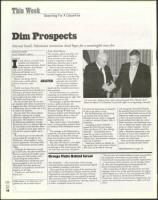
U.S. envoy Gen. Anthony Zinni, right, meets with Israeli Prime Minister Ariel
Sharon on March 14 in Jerusalem, as part of his effort to try negotiating a cease-fire.
the price the Americans are prepared
to pay to get them to stop.
For the Palestinians, just carrying
out the first bits of the Tenet-
Mitchell formula, which is supposed
to lead to a renewal of peace talks, is
anathema.
According to Tenet-Mitchell —
named for CIA Director George
Tenet and former U.S. Sen. George
Mitchell — immediately after a
cease-fire en route to political dia-
logue, the Palestinians must arrest
wanted men, decommission weapons
and stop incitement.
Palestinian leaders are already say-
ing openly that in the present climate
they may not be able to come up
Groups Unite Behind Israel
New York/JTA — After several days of fine tuning,
American Jewish organizations have unanimously agreed
on a solidarity statement with Israel.
But to get there, the final version of the statement by
the Conference of Presidents of Major American Jewish
Organizations expressed support for the State of Israel,
rather than its government, as was originally proposed.
The statement, titled "We Stand With Israel," was slated
to appear in full-page advertisements Thursday, March 21,
in major newspapers across the country.
with the goods. Even Jibril Rajoub,
the powerful- head of preventive secu --
rity on the West Bank and one of the
Palestinian leaders most outspokenly
in favor of accommodation with
Israel, declared that after the recent
Israeli incursion into Palestinian terri-
tory no Palestinian leader could order
arrests or collect weapons. Even if
Arafat wanted to make a cease-fire
stick, a debatable proposition to say
the least, it is not clear whether he
still has the clout on the ground to
restrain the armed men.
Never mind the rejectionist organi-
zations, the fundamentalist Hamas
DIM PROSPECTS on page 18
The ad is part of a broad solidarity initiative launched by
the Conference of Presidents in partnership with the
United Jewish Communities and its member organizations.
A cornerstone of the initiative is set for Sunday, March
24, when pro-Israel gatherings are being planned for
dozens of communities around the country.
After several days of debate and discussion over the
language, all but one of the umbrella group's 52 organi-
zations signed on to the ad. The only group that didn't
sign was the American Jewish Joint Distribution
Committee, which, as a humanitarian organization, has
a policy that precludes participation in public political
action.