

Exploring Roots
*444.avioOka V
'
SHELLI LIEBMAN DORFMAN
Staff Writer
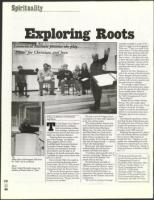
Top:
Arthur Voisin ofFarmington Hills directs
the "Pilate" cast in a rehearsal
Above:
George Croll of Northville rehearses the
character of Pontius Pilate in "Piktte."
inT
3/15
2002
60
he Last Supper was a Passover
meal, Passover and Easter
both commemorate a release
from bondage, and Jews and
Christians have more to share than most
realize, say ecumenical educators.
"Learning about one anotheris all a
part of that sharing," says Barbara
Yuhas, program director of the
Southfield-based Ecumenical Institute
for Jewish-Christian Studies. "Many
Christians are interested in learning
about Passover and the seder so we
thought in the Jewish community, there
is probably the same interest about what
goes on in church."
And so the play Pilate was created as
a one-act fictional performance about
Pontius Pilate, the 26 C.E. fifth procura-
tor of Judea, defending,his actions con-
cerning Jesus before the Roman Senate.
"He-was the Roman governor respon-
sible for issuing the death sentence," says
David Blewett, executive director of the
Ecumenical Institute. "He gave the order
for Jesus to be crucified."
The play is part of bringing histori-
cal perspective to what really happened
at the time of Jesus' death.
"The whole problem between Jews
and Christians arises from the miscon-
ception that the Jews killed Jesus,"
Blewett says. "In reality, the Romans
and Pilate killed Jesus. Early writers
feared for their lives if blame for the
death of Jesus was placed on the
Roman people. So they blamed a group
who were no longer around — a group
of Jews who had perished."
Blewett says, with better historical
understanding, the truth has been
revealed and needs to be shared.
"Crucifixion wasn't even the style of
execution of the Jews," Blewett says. "It
was the style of the Romans. The
Jewish style was stoning."
The performance is actually an
adaptation of a teaching tool written in
1979 by the late Rev. James R. Lyons,
founder and longtime executive direc-
tor of the Ecumenical Institute, an
organization that presents educational
programs for the Christian and Jewish
communities.
"He used it in a variety of settings
and often included it as part of the
classes he taught at local synagogues,"
Yuhas says. "There is so much in the
movies and on TV that many people
think they know all about other reli-
gions. This is for those who realize
there is more — for those who want
to learn that Lent is about more than
giving up chocolate," she says of the
40 days of penance, prayer and soul-
searching observed by Christians
before Easter.
Based on the New Testament, as
well as the writings of Jewish historian
Flavius Josephus and other contem-
porary writings, the 30-minute pres-
entation will end with a question and
the opportunity for dialogue.
"It is actually a reader's theater,"
Yuhas says of the performance, adapt-
ed for the stage by the play's director,
former teacher Arthur Voisin of
Farmington Hills and presented by
the North Congregational Church
"Poverty Players."
Temple Kol Ami Rabbi Norman
Roman, who often taught classes
together with Rev. Lyons, says, "In his
writing, as in his life, Jim Lyons
taught us to look for non-traditional
answers to our questions about Jews,
Christians, Jesus and our common
roots."
Describing the significance of Jews
attending the play, Rabbi Roman says,
"In hearing the voice of Pontius Pilate,
we gain new perspective into the story
of what may have taken place in
Jerusalem some 2,000 years ago."
Following the presentation, a discus-
sion will be led by Blewett and Rabbi
Ernst Conrad, rabbi emeritus of
Temple Kol Arai. "Together, we will
explain how understanding the truth
should not be looked upon as a threat
to Christians," Blewett says. "Based on
reality and history, it should be a libera-
tion." ❑
.
The Ecumenical Institute for
Jewish-Christian Studies and North
Congregational Church of
Farmington Hills will present Pilate
6:30 p.m., Sunday March 17, at
North Congregational Church,
36520 W. 12 Mile Road,
Farmington Hills. No charge, but
donations will be accepted to bene-
fit the Ecumenical Institute. For
information, call (248) 557 - 4522.