

ed I write a musical," recalls Lippa, who devel-
oped a friendship with Seller in high school as
they both participated in the choir and did
school plays.
"I thought it was a great idea and we collabo-
rated on something called Our Heroic Man, a
compilation of 'Jack and the Beanstalk' tales.
At U-M, Lippa played the Jimmy Stewart role
in a musical version of Its A Wonderful Life at
the Power Center, and was musical director for
Anything Goes and Gypsy at the Ann Arbor Civic
Theatre. He wrote a musical version of "Puss
and Boots" for the company's Young People's
Theater and a show called The Adding Machine
for the U-M drama department.
After earning a degree in 1987, Lippa moved
to New York and landed a job teaching music to
5th- to 8th-graders. He left teaching after four
years and began playing piano for auditions and
performing in various pit orchestras. He played
at Carnegie Hall and numerous cabaret venues
throughout New York City as well.
"Around that time Jeffrey was awarded a
$10,000 commission and we put on a couple of
shows in a Manhattan shul," Lippa recalls. One
of the shows was a musical called A Pound of
Feathers, an adaptation of five Yiddish tales,
which Lippa wrote with Tom Greenwald.
Another effort with Greenwald, John Jen,
about a brother and sister who'd grown up in
an abusive environment, first earned him
national acclaim.
Continuing to make a name for himself,
Lippa wrote three new songs for the Broadway
revival of You're a Good Man, Charlie Brown,
which enjoyed a successful run at Detroit's
Fisher Theatre. He produced the cast recording
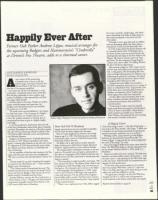
Andrew Lippa: Reaping the rewards of nearly two decades of hard work. and earned a Gramniy nomination.
Happily Ever After
Farmer Oak Parker Andrew Lippa, musical arranger for
the upcoming Rodgers and Hammerstein's "Cinderella"
at Detroit's Fox Theatre, adds to a charmed career.
ALICE BURDICK SCHWEIGER
Special to the Jewish News
A
new version of the enchanting
Cinderella story is about to hit the
Detroit stage. Coming to Detroit's Fox
Theatre March 5-10, this new adapta-
tion has a 21st-century sensibility.
Sure, there are still the evil stepsisters, a cruel
stepmother, a handsome prince and a lavish ball.
But the fairy godmother is more modern, and
teaches Cinderella to take responsibility and find
the magic within herself.
And then there is the music. Thanks to Andrew
Lippa, musical arranger and supervisor, the
Rodgers and Hammerstein lyrics and melodies
.
have taken on a new life.
"We made some cuts and additions," says Lippa,
an Oak Park native. "Out of respect for Rodgers
and Hammerstein, we wouldn't add any new
music [by another composer or lyricist], but we
reconceived the show to give it a slightly height-
ened edge.
In the Fox production, Eartha Kitt takes the role
of the Fairy, Godmother, Jessica Rush plays Cinderella
and Paolo Montalban (no relation to Ricardo) reprises
the role of Prince Charming, which he played in the
1997 Disney/ABC television movie starring Brandy
and Whitney Houston.
Rodgers and Hammerstein's Cinderella debuted on
television in 1957. Written expressly for the small
screen, it starring Julie Andrews in the tide role. A later
TV adaptation in 1965 featured Jewish actors Lesley
Ann Warren and Stuart Damon as Cinderella and
Prince Charming:
For the rendition of the fairy tale coming to the Fox,
Lippa took the score and wrote new arrangements.
"We took a cue from the televised Disney version," he
says.
"Disney souped it up, and in keeping the integrity,
we wanted to do what Disney did — make the piece
slightly more contemporary
"[The Disney version] interpolated the song The
Sweetest Sounds' from the musical No Strings, [with]
music and lyrics by Rodgers. That turned out to be a
perfect song for Cinderella and the Prince.
Another addition, sung by the Fairy Godmother, is
"There's Music in You," a Rodgers and Hammerstein
composition originally sung by Mary Martin in the
1953 movie Main Street to Broadway.
A Magical Career
"
From Oak Park To Broadway
Lippa's personal story may not resemble Cinderella's,
but his career has been magical just the same.
Born in Leeds, England, he moved to the United
States at age 3 in 1967. His British parents, Ronald
and Naomi Lippa, moved to Oak Park because they
had family living in the area.
His father was in sales and his mother opened a
ladies clothing store called Naomi Lippa's Advanced
Fashions. Lippa's parents are now retired to Florida.
The young Andrew developed an interest in the arts
early on. He studied voice and piano, participated in
the choir at Congregation B'nai Moshe (where he cele-
brated his bar mitzvah), performed in school plays and
sang in a quartet.
"I did everything I could musically," says Lippa. "My
first musical role was in The Pajama Game, when I was
a sophomore at Oak Park High, and I also had one of
the leads in The Fantasticks and in Down in the Valley."
Following high school graduation in 1983, Lippa
went to the University of Michigan and majored in
voice and education. On the advice of his longtime
friend Jeffrey Seller, another Oak Park native and pro-
ducer of the Tony Award-winning Rent, Lippa expand-
ed his musical horizons.
"When I was a sophomore [at U-M], Jeffrey suggest-
"One of the songs I wrote — `My New Philosophy' —
was sung at the Tony Awards," says Lippa. "I didn't win
a Grammy, but just being nominated and getting the
special nomination treatment was very exciting."
Working in film, Lippa teamed up with Stephen
SchWartz on the animated DreamWorks film The
Prince of Egypt. "I sang and did the vocal arrangements
for some of the songs," he notes.
One of the biggest thrills of his career came when his
show The Wild Party, based on the Jazz Age poem writ-
ten by Joseph Moncure March in 1926, made it to
•
Broadway.
Lippa turned the verse into a musical. The bad news,
however, was that another version of the poem — with
the same name — was opening on the New York stage
at the same time. Unfortunately, the competition put a
damper on both productions.
"At the time, when anyone asked me if I minded
there was another Wild Party, I said no," Lippa says.
"But it was fairly alarming, and I think they got in each
other's way and both suffered as a result.
"The good news, though, was that The Wild Party
changed my life in a creative way, and garnered so
much attention in the theater . community that people
HAPPILY EVER AFTER on page 62
2002