
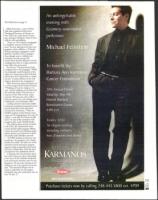

An unforgettable
NOT ENOUGH
on page 21
Rabbi Futterman, a native of New
York and a graduate of the Jewish
Theological Seminary of America in
New York City, made aliyah 16 years
ago, settling in Ashkelon, where he lives
with his wife and children.
"There are 150 Orthodox synagogues
in Ashkelon and two Conservative
ones," he says, referring to his own con-
gregation and its offshoot, a 70-family
Russian-speaking congregation, estab-
lished by members of his synagogue.
Even though most in Ashkelon are
Orthodox, he still sees the 350
Conservative families affiliated with the
congregations there as a large representa-
tion within the community.
Yet, he says, "No government body
recognizes me or my synagogue." While
his credentials would bring him all the
rights of a Conservative rabbi if he had
remained in the United States, in Israel,
he says, "I cannot officiate at the wed-
dings or funerals of my congregants."
Rabbi Futterman hopes the option of
a civil marriage will be made for Israelis.
"Weddings in Israel are religious," he
says. "Jewish weddings can be held only
by Orthodox rabbis. Now Jews go to
Cyprus or New York or Paris, to get
married. We hope next, there will be
both the option of a civil wedding and a
wedding by a non-Orthodox rabbi."
Looking toward to the future, Rabbi
Futterman anticipates the growth of rab-
binical leadership within the Israeli
Conservative movement. "There are
30,000 members of the Masorti move-
ment and 50 congregations, but only 20
rabbis — and only six of them are full
time," he says of the movement with
programs that reach 100,000 Israelis.
The rabbi has been actively involved
with TALI, the Conservative move-
ment's Jewish studies program offered
within the Israeli non-Orthodox public
school system as an alternative to both
the secular and Orthodox curricula.
"If 20,000 students in Israel are now
studying in this program, we've clearly
broken the mold," the rabbi says of the
pluralistic Jewish education program
approved and recognized by the Israeli
Ministry of Education. TALI has been
incorporated into Ashkelon's schools.
In keeping with this pluralistic spirit,
the rabbi maintains a close relationship
with many of the Orthodox leadership
and community members near his con-
gregation. He says issues relating to the
ruling are not to be argued over person-
ally. "This should be fought over in
court or politically, but not against
Orthodox Jews who understand who we
are," he says. ❑
evening with
Grammy-nominated
performer
Michael Fems
20th Annual Dinner
Saturday Ma) 4th
Detroit Marriott
Renaissance Center
Tickets: %250
An elegant evening
including cocktails,
hors d'ouevres and dinner
Title Sponsor:
Dow Autom
Purchase tickets now by calling 248-443-5800 ext. 4709
3/1
2002
23