

Narrow Ruling, Broad Impact
"Who is a Jew?" controversy in Israel could affect links with American Jews.
DOUGLAS M. BLOOMFIELD
Special to the Jewish News
Washington, D.C.
he Israeli High Court decision
last week permitting non-
Orthodox conversions could
help heal a major rift between
American Jewry and Israel — or it could
lead to a dangerous split.
The ruling itself was a narrow one,
simply allowing Israelis who undergo
Reform and Conservative conversions be
identified as Jews on the national identi-
fication cards, but the symbolic impor-
tance of the decision is enormous for an
American Jewish community deeply con-
cerned about the lack of religious plural-
ism in Israel. It could mark an end to
what many see as the second-class status
of non-Orthodox Jews in Israel, said
leaders of the Reform and Conservative
movements.
On the other side, leaders of religious
parties in Israel are threatening to bring
down the government unless the Knesset
overturns the ruling. That could have a
devastating impact on the Jewish com-
munity's ties to Israel, especially in the
areas of philanthropic giving, political
activism and travel.
Foreign non-Orthodox converts have
T
Related editorial: page 31
been recognized by Israel as Jews since
1986. Those converted in Israel by
Conservative and Reform rabbis were
given the same status, by a 9-2 Court
ruling last week ordering the Interior
Ministry to register them as Jews for pur-
poses of national identity. That is the
lowest of three classifications of Jews.
While largely symbolic, it is important in
such daily endeavors as getting a job,
joining the army, gaining school admis-
sion and receiving insurance benefits.
The Law of Return bestows citizenship
on any immigrant who has at least
one Jewish grandparent. The
highest classification are people
deemed Jewish according to
Halachah (Jewish law), meaning their
mothers are Jewish or they underwent
Orthodox conversions.
The Orthodox establishment says it
does not challenge the Jewishness of
Conservative and Reform Jews born to
Jewish mothers or who had Orthodox
conversions. But it is also true that they
don't accept the legitimacy of non-
Orthodox movements and refuse to per-
mit non-Orthodox rabbis to officiate at
weddings, divorce, burials and other reli-
gious events.
Rabbi Jerome Epstein, executive vice
president of the United Synagogue of
Conservative Judaism, sees the decision
as a "stepping stone" to full equality.
"The fact that these conversions were
Not Enough
NARROW RULING on page 22
Conservative rabbi in Israel sees Knesset ruling
as first step to recognition of non-Orthodox.
SHELLI LIEBMAN DORFMAN
Stag Writer
A
not recognized for so long has been a
problem of major proportion in causing
some disaffection with Israel and Israeli
society" he said. "Our congregants say,
`If Israel doesn't think my rabbi and I are
legitimate enough, why should they want
and expect my support?'"
On the other side, Ashkenazi Chief
Rabbi Yisrael Lau said the Court has no
authority to make such decisions and
told Israeli Reform and Conservative
converts, "You remain in your goyish-
),
ness.
Interior Minister Eli Yishai, who
must enforce the ruling, indi-
cated he plans to ignore it. He
said he answers to a higher
authority — Rabbi Ovadia Yosef, the
spiritual leader of his party, Shas, not the
Court. Yishai, political leader of Shas, the
powerful ultra-Orthodox Sephardi party,
called the decision "scandalous" and
"likely to wreak disaster on the Jewish
people," and he immediately offered leg-
islation to overrule the Court.
While about 90 per cent of affiliated
Jews in the United States belong to
Conservative and Reform synagogues,
only a tiny faction — about 40,000 —
do so in Israel.
A battle in Knesset over pluralism, let
alone invalidating the High Court ruling,
would "risk significantly alienating large
numbers of American Jews, even though
it does not impact directly on them,"
Rabbi Saperstein said.
Rabbi Epstein said repeal would
"require American Jewry to mobilize and
apply extreme pressure." Such a con-
frontation could weaken the already frag-
ile bonds between the non-Orthodox
movements and Israel, he added.
In the past when Knesset confronted
Orthodox pressure to enact "who is a
Jew" legislation, top American Jewish
leaders flew to Israel to lobby.
Missions are important, but money
talks louder. During recent "who is a
Jew" fights, American philanthropic
organizations like the federations and
United Jewish Appeal (now United
Jewish Communities), non-Orthodox
movements, and political groups such as
the American Israel Public Affairs
Committee rushed their big money peo-
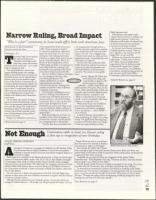
'though his Conservative synagogue in Ashkelon has 280 families, Rabbi
Matt Futterman has no religious authority in Israel. He can't perform
weddings or funerals because the Jewish state doesn't recognize Reform or
Conservative clergy.
Rabbi Futterman, president of the Rabbinical Assembly of Israel, the Israeli organ-
ization of Conservative rabbis, made a Feb. 25-27 visit to Adat Shalom Synagogue
in Farmington Hills, while on sabbatical from Netzach Kehillat Israel synagogue,
where he serves as spiritual leader. The rabbi holds the synagogue position previously
held by Rabbi Philip Spectre, former executive director of the Masorti movement,
the Conservative movement in Israel and brother of Rabbi Efry Spectre, rabbi emer-
itus of Adat Shalom.
He took time out to discuss the implications of the Feb. 20 Israeli High Court
decision to allow those with non-Orthodox conversions to register with the Ministry
of Interior as Jewish citizens.
Although fiercely opposed by some Orthodox groups, the new law doesn't say
enough for Rabbi Futterman. "Minimally, this will give people self-respect," he says.
"People will see we exist as a movement,
but if we want to be married in Israel by
Rabbi Futterman at Adat Shalom.
a Conservative, rabbi it is still illegal."
Even though the rabbi's wife is Israeli,
their marriage is legal in Israel only because Detroit native Rabbi Joel Roth, rosh
yeshiva (head of the yeshiva) of the Conservative Yeshiva of Jerusalem, performed the
ceremony in New York, not Israel.
"Logically, the next step should be the recognition of the rabbis," Rabbi
Futterman says. "If the Supreme Court says, 'These are real Jews,' then they should
also be ready to say, 'These are real rabbis.'"
Overall, though, Rabbi Futterman is highly encouraged by the ruling. "In a coun-
try where they say Conservative Jews won't play, we've proven they will play."
To those who say conversion to Judaism must follow an Orthodox path, Rabbi
Futterman says "No one has a monopoly on interpreting God's will. In Conservative
Jewry, we do not_convert for the sake of conversion. We convert you if you study."
He says, "We hope this ruling will be the beginning of offering recognition that is
missing from the lives of Conservative Israelis."
.
NOT ENOUGH on page 23
3/1
2002
21