

Arts & Entertainment
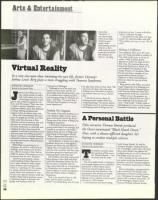
Scenes from
ndrome," a
new play starring
-8' Joshua Lewis Berg:
"Syndrome gives
people a better
understanding of what
Thurettes is, but I
really wanted to make
a great piece of theater
that everyone can
relate to," says Berg.
U
7.1
410
3
Virtual Reality
In a new one-man show imitating his own life, former Detroiter
Joshua Lewis Berg plays a man struggling with Tourette Syndrome.
SUZANNE CHESSLER
Special to the Jewish News
.1
oshua Lewis Berg may not
have asked anyone to walk a
mile in his shoes, but he has
invited large numbers of peo-
ple to step inside his psyche for one
hour and 40 minutes. That's the time
it takes to present Syndrome, a one-
performer theater piece that dramatiz-
es Berg's lifelong problems and
inspires others to address their own.
Berg, who commissioned the piece
that was staged Jan.23-Feb. 9 in New
York under the direction of Rob
Urbinati, served as producer and took
the part of a young man battling
Tourette Syndrome, an inherited, neu-
rological disorder characterized by
repeated, involuntary movements (tics)
and associated with differing psycho-
logical conditions, including obsessive-
compulsive behavior, bipolar personal-
ity traits and attention deficit/hyperac-
tivity disorder.
While Berg was growing up in
Michigan, he tried to understand his
sniffling, facial tremors and sensitivi-
ties. After he moved to New York to
fulfill his dream of becoming an actor,
he learned that he was a Touretter.
"Syndrome gives people a better
understanding of what Tourette's is,
but I really wanted to make a great
piece of theater that everyone can
relate to," says Berg, 31. His interest
in acting surfaced while he was in
grade school and continued in com-
munity and regional theaters while the
Berkley High School graduate earned
a bachelor's degree in Japanese lan-
guage and literature from the
2/22
2002
86
University of Michigan.
"Although a lot of the piece was
based on stories from my life, the
playwright, Kirk Wood Bromley, took
it to another level, making up parts
and changing things for dramatic pur-
pose," says Berg. "I'm proud that it
still had that foundation in my per-
sonal experiences."
the play three times in New York. "He
was more of a loner than the other
children, but I first knew he had act-
ing abilities when he was in a Purim
play.
"I did ask his doctor about his
blinking and his teacher about his
misplacing things. The doctor said he
would grow out of it, and the teacher
said keeping track of things was not
important to him. I wrote it all off as
a phase a kid goes through.
"I remember the day [Josh was diag-
nosed]. He called his father and said,
`The problem isn't you; it's me.' We all
cried."
Making A Difference
That diagnosis came just a few years
ago, after Berg had added a number of
New York productions to his list of
credits, which includes Sweeny
Agonistes at Todo Con Nada in New
York City, The Sunshine Boys at the
Elmwood Playhouse in Nyack,. N.y,
and Suddenly Last Summer at the
Reality Theater in Columbus, Ohio.
He also has been a member of two
improvisation theater troupes —
Slipshod in Ohio and Durdom in
Moscow, where he was one of the
founders.
Berg and his wife, Tisha, an actress-
singer, happened to be listening to a
documentary about a baseball player
with Tourette Syndrome when they
independently made the connection.
"When we saw the program, we
immediately believed that was what I
have, although I don't scream and
curse," Berg recalls. "I didn't want to
self diagnose so I went to the Tourette
Syndrome Association, and they sent
Making The Diagnosis
The course of the play develops as its
only character, Egon Covert, antici-
pates meeting his parents for dinner.
Eating was at the center of Berg's psy-
chological symptoms.
"I developed a hypersensitivity to
eating noises when I was younger and
listened to my dad eat very loudly,"
explains Berg, the son of Micki and
David Berg of Huntington Woods.
"When I approached him about my
[annoyance], he pooh-poohed it.
"In his defense, it doesn't seem like a
problem, but to me, it was gigantic
because my father was not acknowl-
edging what was bothering me. I still
can't eat with my father and have anxi-
ety about going into restaurants and -
hearing people smack their lips."
The problems that Berg experienced
before going to New York were kept
within his immediate family. His tics
did not seem to interfere with his
stage career that built on acting studies
at Interlochen Arts Academy and a
master's degree in media management
from the Audrey Cohen College in
Manhattan.
"Josh is the second of our six chil-
dren, and he always excelled in
school," says Micki Berg, who has seen
A Personal Battle
Film executive Thomas Sherak produced
the Oscar-nominated "Black Hawk Down."
Now, with a disease-afflicted daughter, he's
hoping to combat multiple sclerosis.
SUZANNE CHESSLER
Special to the Jewish News
1wo battles currently claim
the attention of film execu-
tive Thomas Sherak — one
11111 on-screen and the other
off-screen.
The most public battle is making its
way through theaters in his company's
production of Black Hawk Down,
which just earned Academy Award
nominations for best direction, cine-
matography, film editing and sound.
The movie recounts the very real
fighting of U.S. soldiers trying to quell
civil war in 1993 Somalia.
A more personal and heartrending
battle brings Sherak, 56, and his
youngest daughter, Melissa Resnick,
29, to Michigan, where they will speak
about their family's war against her
multiple sclerosis, or MS, a disease she
has fought since she was 15.
MS, a disorder of the central nerv-
ous system involving decreased nerve
function, can show varying symptoms
from movement impairments to blind-
ness.
Dad and daughter, accompanied by
other members of the family, some
belonging to Detroit's Jewish commu-
nity, will address the annual Women
Against MS Luncheon hosted Feb. 28
by the Michigan Chapter of the
National Multiple Sclerosis Society