

„
title, 20 Jewish prison-
ers in a Nazi-occupied
concentration camp
carried out a carefully
planned uprising,
killing their German
captors and bringing
about the end of the
exterminations, num-
bered in the hundreds
of thousands, at the
Sobibor death camp.
Yehuda Lerner was
one of those men.
:-.,...
gives a complicated smile as he recalls the most
graphic aspects of the rebellion.
But because of the interview's pace — and because
Lanzmann ends the documentary abruptly, leaving
Lerner's own story unfinished — we never have a sat-
isfying portrait of either the Sobibor uprising or of
the resourceful man who helped carry it out. ❑
•
Director Claude
Lanzmann
Sobibor will be screened 7:30 p.m. Monday,
Feb. 11, at the Detroit Film Theatre at the
Detroit Institute of Arts: $6. (313) 833-3237.
An Extraordinary Life
In 1979, while filming Shoah, Lanzmann inter-
viewed Lerner. The filmmaker believed the account
of the Sobibor uprising was particularly important
because it dispels two assumptions about the
Holocaust: that the Jews were unaware of the exter-
mination camps and that they put up no resistance.
In Sobibor, Lanzmann juxtaposes the footage of
his interview with Lerner with long, meditative
shots of the Polish landscape, train tracks, stations
and sites of the former camps as they appear today.
Just 16 at the time that he was first sent to the
camps, Lerner had already escaped — according to
his own account — from eight different camps in
six months.
When he was transported to Sobibor, a Polish
worker on the rails attempted to warn the Jewish
prisoners that Sobibor was an extermination camp
where they would be burned. Lerner spoke Polish
only well enough to barely understand the message,
but he did not believe it.
When he arrived at the camp, however, he realized
the truth of the unheeded warning.
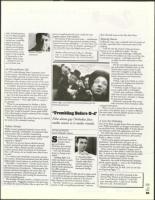
Mark, right, was kicked out of several yeshivot for his
homosexual practices.
`Trembling Before G-d'
Film about gay Orthodox Jews
makes waves as it makes rounds.
Tedious Format
While Lerner's gripping firsthand account of the
Sobibor uprising is remarkable, the approach" taken
by Lanzmann here is, frankly, exasperating.
The format of the interview seems simple enough:
Lanzmann asks a question in French, Lerner
responds in Hebrew.
However, we are not shown subtitles during
Lerner's animated and often lengthy responses.
Only later, when a female assistant translates
Lerner's answers back into French for Lanzmann
who is off camera, do we finally learn what Lerner
has said.
It's a tedious and completely unnecessary process
that creates a frustrating remoteness from the subject.
Additionally, Lerner's pauses are artificial and forced.
One feels — even knows — he has much more to
say, but is continually interrupted by the slow and
awkward process of translation. Unfortunately, this
process continues throughout the entire film, dis-
rupting the narrative, undermining the effect of
Lerner's recollections, and ruining the momentum
of this compelling story.
The footage of Lerner reveals a complex and inter-
esting persona. Ruggedly handsome and charming,
he relates the story of Sobibor like an epic hero. He
Elvis Mitchell wrote in the New York Times.
Enjoying Success
DuBowski, who is gay, is pleased with the success of
his film, especially since it was seven years in the
making.
"I call this the Mt. Everest of documentaries
because it was so difficult to make," he says.
Aside from the financial challenges, DuBowski
had to convince his subjects to come out of the clos-
et and speak on camera — although several still
wouldn't let their real names or faces
be used.
•
But he eventually persuaded several
gay and lesbian Orthodox Jews, in the
United States and in Israel, to talk
about their struggles to merge their
sexual identities with their desires for
Jewish observance and community.
Among them are:
• Mark, a gay man kicked out of sev-
eral yeshivot in England and Israel for
his homosexual practices;
• A lesbian couple in Miami who
met at a girls yeshiva in Brooklyn;
• David, who confronts a Chasidic
rabbi who 20 years before recommend-
ed that David see a therapist to change
his homosexual leanings.
DuBowski intersperses their stories
with comments from Orthodox rabbis
and psychotherapists.
"When you put a human face on what has until
now been a very abstract issue, it creates a dilemma.
But that's what I feel the halachic process is about,"
he says, referring to Jewish law.
A Love For Orthodoxy
Part of the film's strength derives from its compas-
sion. While sympathetic to the gays and lesbians who
are the film's focus, Trembling Before G d also depicts
the Orthodox world with admiration, even love.
The rabbi who meets with David is shown strug-
gling between his love for David as a Jew and his
desire to adhere to Torah.
"There's a great passion and a great truth in
Orthodoxy," says DuBowski, who grew up in a
Conservative Jewish home in Brooklyn and has stud-
ied Chumash for two years with a gay Orthodox rabbi.
"Every community is capable of change, and if I
didn't believe so, I don't think I could have done the
film. To think that the Orthodox community, unlike
other communities, isn't capable of change is to
demonize and dehumanize" them, he says.
Meanwhile, the world of homosexual Orthodox
Jewish support groups — such as the OrthoDykes
— is growing, DuBowski says.
As the word gets out, he said, "you can see that
world getting bigger." ❑
-
PETER EPHROSS
Jewish Telegraphic Agency
andi Simcha
DuBowski's docu-
mentary about
gay and lesbian
Orthodox Jews already
has opened some eyes.
Now the filmmaker
hopes to change some
minds.
Trembling Before G ch
-
evtr,a0
In "Trembling Before
G-," David confronts a
Chasidic rabbi who'd
recommended he see a
therapist to change his
homosexual leanings.
which was shown to much
acclaim last year at the
Berlin and Sundance film
festivals, broke opening day
box office records at
Manhattan's Film Forum
when it opened last fall. The film also drew a large crowd
here in Detroit during a one-day showing in November.
It will be screened this weekend at the Detroit
Film Theatre at the Detroit Institute of Arts.
The film "latches on to a provocative subject and
invests it with a compelling tenderness," reviewer
Trembling Before G d will be screened at the
Detroit Film Theatre at the Detroit Institute of
Arts 7 and 9:30 p.m. Friday; 4, 7 and 9:30
p.m. Saturday; and 1, 4 and 7 p.m. Sunday,
Feb. 8-10. $6. (313) 833-3237.
-
2/8
2002
63