

AMENO‘ AWIP,P4PfP
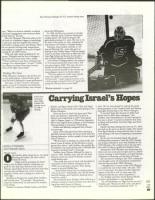
Sara DeCosta backstops the U.S. women's hockey team.
Tending Her Goal
While Weinstein is looking to take his first turn
on the medal podium, women's hockey goalie
Sara DeCosta is looking for a repeat performance.
DeCosta, a 5-foot, 10-inch, 130-pound
goalie, is one of 14 members returning from
the 1998 U.S. women's hockey team compet-
ing in.the 2002 games.
In 1998, the first year women's ice hockey
was an Olympic sport, DeCosta shared goal-
tending duties with Sarah Tueting for the
gold-medal-winning U.S. team. She was in net
for three of her team's six wins, including the
only shutout of Canada in Canada's history.
DeCosta, whose mother is Jewish, is a 24-
year-old Warwick, RI., native who grew up
playing in boys' hockey leagues. DeCosta earned
a spot on the boys varsity team at Warwick's Toll
Gate High School and became the first girl to
play in Rhode Island's top scholastic division.
A Providence College graduate, she posted a
17-9-3 record and led the nation with a .943
save percentage in 2000. That year, she was a
finalist for the Patty Kazmaier Memorial
Award, presented annually to the nation's top
intercollegiate women's ice hockey player.
"They say goalies are a little crazy and dif-
ferent, but goalie is a unique position,"
DeCosta said. "I mean I guess you have to be
a little strange to stand in front of a puck that's
going 90 miles per hour at your head."
WINTER OLYMPICS
Israeli short-
track .speed
skater. Olga
Danilov, 28,
practices on an
ice rink in
Metulla.
JESSICA STEINBERG
Jewish Telegraphic Agency
Metulla, Israel
lga Danilov glides along the ice, one hand
brushing the surface, the other tucked
behind her back.
Thigh muscles pumping, she skates
along a trail of rubber markers, using them as a
guide for her daily laps. Between runs, Israel's
Olympic speed skater throws on her blue-and-white
warmup suit and skates over to her 3-year-old
daughter, Nicole, who is sitting on a stool at the
rink's edge.
Speaking in Russian, her coach, Boris Drabkin,
calls out her time: "9.2 seconds." She grimaces,
straps her helmet back on and returns for another
series of laps.
Danilov, ice dancers Natalia Gudina and Alexei
0
AP
ture. "When we travel as a family, we always
visit local congregations and museums about
Jewish history," she said.
After the Olympics, Weinstein plans to fin-
ish work on a bachelor's degree in psychology
at Harvard. And he's hopeful that someone
will build a training center near Boston where
he can practice for long-track competitions
and prepare to compete in that part of speed
skating for the 2006 Games.
With only eight teams qualifying for the
games, Weinstein said the law of averages is
good that he'll come home with a medal.
"There's nothing we can do in training to get
stronger. It's a mental game," he said. "I think
our chances are better than most, because
three of the eight teams medal."
on page 56
Israel's Hopes
Beletski, and figure skaters Galit Chait and Sergei
Sakhnovsky are the Israeli team participating in the
Winter Olympics.
Chait was born in Israel, but grew up in New
Jersey and Delaware. Saknovsky was born in
Moscow and made aliyah in 1995. They placed
14th in Nagano, Japan, in 1998 and an impressive
fifth in the original dance program at the European
Championships in Lasusanne, Switzerland.
Gudina and Beletsky emigrated from Ukraine
two years ago.
Many of the Olympians have been training at
Metulla's Canada Center, the home of the Israel Ice
Skating Federation, within eyesight of snow-capped
Mount Hermon.
"We Jews have to develop our cultural side, and
sports is part of culture. It's the life that we immi-
grants know about," said Drabkin, who pushed for
the Olympic-size speed skating rink in Metulla after
moving to northern Israel 11 years ago.
Danilov, from Ukraine, followed her sister to
Israel in 1994. Drabkin came with his wife from
Moscow, where he trained the Russian national
speed-skating team.
They made their way to Israel with hundreds of
thousands of other Russian immigrants in the
1990s, not expecting to continue their skating
careers in the and Middle East.
"I had finished school and was thinking about
what to do next," said Danilov, 28. "All my friends
had left. Ukraine, and I had been thinking about
Israel for a while."
She had heard about Drabkin while still living in
Ukraine, and got in touch with him soon after arriv-
ing at her sister's home in Netanya.
Drabkin had been living in Israel for several
years. He was instrumental in creating the speed-
skating program at the Canada Center and helping
Israel gain membership in the Winter Olympics.
"It was hard back then because we didn't have
skaters and we didn't have experience," said
Drabkin, who cleaned floors in Tel Aviv during his
first year in Israel. "I started to build the first roots,
working with local kids. And then Olga came from
the Ukraine."
Danilov has been skating since she was 3'/2, when
she took up the sport on doctor's orders. She moved
from figure skating to long-track and then to short-
track skating in her teens, competing in internation-
al events.
By the time she finished school, she started
thinking about moving to Israel. By 1995, Danilov
was living in Metulla to train with Drabkin for the
1998 Olympics. She needed to be in the top 20 in
the world in order to qualify, but finished 22nd.
Missing the 1998 Olympics was devastating, but
there were soon some joys to make up for it, includ-
ing her marriage to Alex Danilov, an Israeli Olympic
competitor in shooting, and the birth of Nicole.
She returned to training in late 1999, making her
way through a series of international competitions
and moving toward the 2002 Olympics.
"I thought that if I wasn't in the 1998 Olympics
it would be the end of the world," she said. "This
year it's important, but there are other important
aspects of my life as well. In some ways, the
Olympics feels like any other competition."
For Drabkin and other Israeli skating officials,
Danilov's participation is very significant.
"It's a lot of pressure on Olga, but she can do it,"
Drabkin said. "She knows what to do, and that's a
result of her extremely professional work."
❑
M
2/8
2002
55