

`I Am Sam'
Writer/director tackles the story
of a mentally handicapped father.
NAOMI PFEFFERMAN
Jewish Journal of Greater Los Angeles
117
1 hen filmmaker Jessie Nelson was
growing up in North Hollywood in
the 1950s, she was frightened of the
mentally handicapped.
"I had the fear a lot of children have when they
are not exposed to people with disabilities," says
Nelson, whose wrenching new film, I Am Sam,
tells of a developmentally disabled father (Sean
Penn) struggling to keep custody of his daughter.
Nelson remembers her Jewish communist par-
ents toting her to Watts for civil rights marches
and to similar protests at city hall.
"Every Passover, the toast was that Jews, as an
oppressed people, must stand up for others who
are oppressed," she recalls. "My parents were
always rooting for the underdog, and welcomed
all marginalized people into our home."
Those people included friends with autistic or
developmentally disabled children, and Nelson's
fear eventually dissipated. "I learned to play with
kids who were 10 years older than me but at my
age level," she says. "I got to know them as
human beings."
Nelson remembered the lesson when, just after
her daughter was born seven years ago, her writ-
ing partner mentioned a story she'd heard about
mentally handicapped parents.
Rather than raising her eyebrows, the new mom
immediately felt a kinship with the characters in
`Charlotte Gray'
A portrait of wartime courage.
MICHAEL ELKIN
The Jewish Exponent
I
n Charlotte Gray, opening today exclusively at
the Birmingham 8, the lead character is an
Englishwoman (Cate Blanchett) who risks her
life while spying for the French Resistance.
Hers is not a selfless sacrifice for the greater good
but a selfish sell-out for her own needs — a ploy for
finding the whereabouts of her lover, an RAF pilot
shot down over France by the Germans.
Yet, Gray's undercover work does uncover a
cache of humanism. She ends up harboring two
Jewish youngsters from the Nazis.
"I continue to marvel at women's ability to lead
men," says screenwriter Jeremy Brock (Mrs.
Brown) of why "women make the best spies."
"They have a capacity for subterfuge that they
the story. "I
thought that was an
amazing metaphor
for how every par-
ent feels," says
Nelson, whose tran-
scendent 1994
directorial debut,
Corrina, Corrina,
tells of a Jewish
widower, his daugh-
ter and their black
housekeeper.
"I think that all
parents — whether
disabled or not —
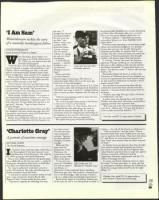
"I Am Sam" has more than
can feel over-
30 Beatles references.
whelmed and con-
fused."
Nelson and Sam
co-writer Kristine
Johnson began envisioning a film about an
embattled single father who is at the same age
level as his 7-year-old daughter.
As research, they spent six months at L.A. Goal,
a center for adults with developmental disabilities.
"We didn't just want to observe," explains Nelson,
who co-wrote the films Stepmom and The Story of
Us.
"Only by participating could we learn the true
stories of people's lives."
The writers brought those stories to the fiction-
al characters of Sam and his friends.
Like many of the L.A. Goal clients, Sam is an
avid Beatles fan who talks about the band to
describe his journey through life. In a pivotal
courtroom scene, he compares his relationship to
his daughter to the way Paul McCartney and John
Lennon needed each other as songwriters.
His tightly knit group of friends (including
have had to learn"
over the years exist-
ing in patriarchal
societies. "Spying is
not about physical
strength; it is about
courage."
While the film
deals with the
dimensions of the
Holocaust, the
screenwriter wasn't
about to copy other
films of the genre.
"I was very con-
scious of Schindler's Billy Crudup and Cate
List and its impact," Blanchett in "Charlotte Gray"
says Brock, in
admiration of the acclaimed Steven Spielberg
Holocaust epic. But "this is about a woman's jour-
ney to self-knowledge. I did not want it hitch a
ride on a subject that was beyond improvement."
Brock proves adept at storytelling. Indeed, part
of the story he tells is one infrequently invoked in
developmentally disabled actors Joseph Rosenberg
and Brad Allan Silverman, who were recruited
from L.A.-area group homes) cheers him on.
As Nelson explains: "They share an extreme
camaraderie because our [non-disabled] world
rejects them."
If Nelson keeps returning to stories about single
fathers and motherless daughters, it is perhaps
because she was once one herself. During the
traumatic period after her mother died in a car
accident, the then 3-year-old Jessie was raised by a
succession of black housekeepers who brought
comfort with lessons about God and heaven.
In Corrina, Corrina, she based the character
played by Whoopi Goldberg on a housekeeper
who was, in fact, elderly at the time she entered
the Nelson household. "I hoped she'd marry my
father," the director recalls. "I had no idea she was
black or 70."
Eventually Nelson left home to study at the
University of California Santa Cruz, dropped out
to join an experimental New York theater compa-
ny and moved to Hollywood to become a movie
actress around 1980.
She switched to screenwriting when she dis-
cerned that actors have little control over their
material — but soon found that writers fared lit-
tle better.
"Violent, sexy, edgy films get made a lot faster
in Hollywood," she says.
A major coup was signing Penn and Michelle
Pfeiffer, who plays Rita, the brittle, marshmallow-
popping attorney who represents Sam.
"She turns out to be a far more disabled parent
than he is," Nelson says. "It's just that she has a
more socially sanctioned disability."
❑
I Am Sam, rated PG-13, opens today in Detroit.
movies — the role of the French as collaborators.
"I did my research," says the writer. "France
betrayed itself; there were 75,000 of its own Jews-
sent to death by the French. They don't talk about
it," says Brock. In some noxious instances, he
says, "some went beyond what the Nazis required
of them."
As did the heroes go beyond what they thought
they could humanly and humanely do. Gray is
but a fictive stand-in for the fierce fighters who
risked freedom and their lives to wage war against
Nazism as members of Britain's Special
Operations Executive organization and the U.S.
Office of Strategic Services.
In a way, says Brock, Charlotte Gray is a hero
for today. "In these post-Sept. 11 times, she has
an even greater relevance because she is flawed yet
finds the courage within herself to do the right
thing." ❑
Charlotte Gray, rated PG-13, opens today at
select theaters. Check your local listings.
>."*..
1/25
2002
59