

left at coffee shop and store
doorways for locals to read.
In 1996 the paper launched its
Web site, and today - an estimated
500,000-1 million people read
each issue, giving the Onion cult
status.
"The paper started as a parody
of the tabloids, like the National
Enquirer, running stories about Elvis, outer space and
outrageous kinds of things," says Siegel. "Then over
the years it became more sober and, in doing so, I
think it became funnier.
"We narrowed our focus to parodying real current
events rather than crazy stories. At first we didn't even
make political commentary, we just stayed neutral,
and now we make statements that come down on the
right or left."
Robert Siegel:
"I may be one of
those 'temple twice
a year' guys, but
my religion is a
big part of who
I am."
Post 9-11
The biggest challenge by far that Siegel and his staff
have had to face was how to approach humor in the
aftermath of Sept. 11.
While the late night TV shows — like The Late
Show with David Letterman, The Tonight Show and
weren't back for a couple of weeks,
The Daily Show
the Onion had to put out its weekly paper shortly after
the attacks. Nothing seemed funny.
"Immediately after 9-11, people didn't feel safe to
joke about many things — or even joke at all," says
Siegel. "It was a difficult time to be in the news paro-
dy business. Comedy entertainment-we shows had
reruns, but we didn't have that luxury.
"We couldn't go back to anything that happened
before, like Gary Condit, because nobody cared about
those things any more. But we said to ourselves,
`There is nothing disrespectful about laughter,' and
there were lots of things to say."
The response after the first issue following the attack
was overwhelming, Siegel says. The first clay lured
399,791 visitors to the Onion's Web site. For the first
few weeks, traffic on the site doubled.
The first issue back was headlined "Holy F
S—: Attack on America." Trying to be compassion-
ate, yet determined to go forward, the paper featured
such articles as: "God Angrily Clarifies 'Don't Kill'
Rule," "Hijackers Surprised To Find Selves In Hell"
and "Not Knowing What Else To Do, Woman Bakes
American-Flag Cake."
"Everyone was thankful that we broke the ice and
gave them the first opportunity to laugh," says Siegel.
"Our readers thought we did a public service of sorts."
—
,1ataays;titti4AST
A V:
,.
Photo by Darrell Taunt
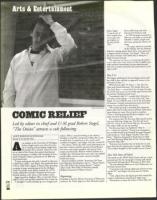
COMIC RELIEF
Led by editor in chief and U-M grad Robert Siegel,
"The Onion" attracts a cult following.
ALICE BURDICK SCHWEIGER
Special to the Jewish News
A
4114
1/25
2002
50
s a student at the University of Michigan,
Robert Siegel wasn't sure where his inter-
est in writing and journalism might lead.
He needn't have worried. Today he is edi-
tor in chief of the Onion, the nation's best-known
satirical newspaper, a weekly with hundreds of thou-
sands of regular readers, primarily on its Web site,
www o ni on. com .
"I knew writing was the path I wanted to take, but
I didn't have a plan," says Siegel, who graduated from
U-M in 1993 with a degree in history after spending
a couple of years covering sports for the Michigan
Daily. He briefly wrote sketch comedy for a U-M
troupe called the Comedy Company and even per-
formed standup a few times at the student union.
Siegel moved to Madison, Wis., to join the Onion
staff in 1995, and quickly worked his way to the top.
"I thought I would probably go into straight jour-
nalism. When I started working at the Onion, I
thought it would be a temporary hobby. But it was
so much fun, it turned out to be a career and I
couldn't be happier," says Siegel, who just turned 30.
The Onion, which also offers mail subscriptions to
the print version, parodies anyone and anything in
the news, and comes complete with sports, horo-
scopes and editorials. Written without bylines in a
straight, dry, Associated Press news style, the oddball
stories reflect current events, national scandals,
health and more._
Recent headlines include: "American Life Turns
Into Bad Jerry Bruckheimer Movie," "Parent Mad 6-
Year-Old Didn't Like Peanuts Special," "Aspirin
Taken Daily With Fifth Of Bourbon Greatly
Reduces Awareness Of Heart Attacks."
Beginnings
Founded in the late '80s by University of Wisconsin
students, the Onion began as a free alternative paper
New York State Of Mind
The attack on the World Trade Center took on a more
personal note for the newspaper's writing staff, which
had recently relocated from Wisconsin to New York.
The new editorial offices are in the Chelsea area, not
far from Ground Zero.
"I was home and a friend called and told me to turn
on the TV," says Siegel, who lives near his Chelsea
office.
"I live a block from the big hospital that treated the
victims. Ambulances were going all night long."
The decision to move the writers to New York City