

Editorials are posted and archived on JN Online:
www.detroitjewishnews.corn
The Trouble With Oil
merica is badly in need of a thorough re-
evaluation of its relationship with Saudi
Arabia, but we are singularly ill-suited to
carry out the reappraisal. The core issue
is determining America's long-term best interest in
the Arab kingdom that is the birthplace of Islam
and the home of its holiest sites.
For decades, we have wanted one thing — oil
— above all others and, for its sake, have turned a
blind eye to the country's failures, both domestic
and international. As Sept. 11 made clear, if we
continue to ignore those problems, it will be at
our peril.
The current debate seems to be over the future
of the 5,000 or so U.S. servicemen and
civilian employees who have been sta-
tioned in Saudi Arabia since the end of
the Gulf War a decade ago. Osama bin
Laden and many militant clerics say it is impious
to have foreign troops on Saudi soil, and call them
a signal of a U.S. intent to impose its Western cul-
ture on the Muslim world. At the same rime, a
growing chorus of U.S. protest has arisen about
the Saudi insistence that troops adhere to Muslim
practices, particularly in the clothing of female
soldiers.
But the U.S. bases in Saudi Arabia proved very
useful in waging the bombing campaign against
the Taliban and Al Qaida in Afghanistan. And
even a mild suggestion last week that the Saudis
might prefer us out sent Secretary of State Colin
Powell and other administration figures into a
heated defense of the American presence in
Riyadh.
The actual problem is much deeper than who is
stationed at Prince Sultan Air Base.
The Saudi ruling fam-
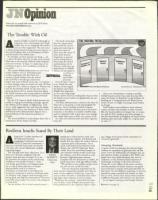
VARYING PA
ilies have perpetuated
their power by encour-
aging and exporting an
ultra strict form of
Islam (one that many of
them don't practice
themselves in private)
and by doing little to
discourage the clerical
condemnation of the
Western world. But our
dependence on Middle
Eastern oil has made us
unwilling to
challenge
such Saudi
practices.
Over the last 15 years
or so, North Sea and
Alaskan oil has tipped
the balance away from
Middle East dependen-
cy, but every long-range
forecast shows America needing the resources that
the Saudis control unless we significantly cut our
consumption.
The Bush administration, raised on the ethos of
Texas oil, is not going to work meaningfully for
such cuts. And a narrowly divided Congress,
which faces mid-term elections and an uncertain
economy, is not about to consider sensible steps
such as a dramatic hike in gas taxes, even though
that would help wean us from our overuse of oil.
So, what can American Jews and their organiza-
tions do?
THS
EDIT MAL
•
Given our commitment to seeing a sensible
Middle Eastern policy that could one day offer
peace for Israel, we should be in the forefront of
pushing for a Congressional and White House
review of how we might encourage Saudi Arabia
to change.
Saudi leaders must embrace a more tolerant
version of Islam and its place in their national
life; the Saudi model is no longer chic or roman-
tic, and the U.S. needs to give that message to
the Ibn Saud family of Kingdom of Saudi Arabia.
Ending some arms sales might be a logical place
to start.
Resilient Israelis Stand By Their Land
long with 13 other members of
people go to school and to work, ride
the National Christian
busses and get together with friends and
Leadership Conference for Israel
family. But just under the surface, there is
(NCLCI) executive committee, I
a genuine spirit of frustration, not so
have just returned from Israel, my fourth
much with Israeli Prime Minister Ariel
visit since the current Palestinian intifada
Sharon, but with PA Chairman Yasser
(uprising) began.
Arafat. Even the most liberal people we
The trip had three basic objectives: 1) to
met doubted whether Arafat could stop
show our Christian solidarity with the
the violence, even if he wanted to, and
D AVID
people, land and state of Israel; 2) to see
become a legitimate peace partner.
BLE WETT
for ourselves the impact of the continuing
Coupled with this frustration in Arafat, we
Comm unity
intifada on the people of Israel — Jews
heard many Jews of all ages affirm loudly,
Vie UJS
and Arabs, government and religious lead-
"We are here to stay; Arafat and the terror-
ers as well as those who have no leader-
ists will not run us off this land."
ship portfolio; and 3) to listen to
The one thing that impressed me the
Christians in Israel and in the Palestinian
most was how appreciative Israelis were that we
Authority territories in order to challenge those
came. As the organizer of the trip, I was con-
we disagree with, support and encourage those
scious of how everyone I contacted about meet-
doing good and help the thousands of Christians,
ings began their response to me by saying,
especially those under PA control, who desperate-
"Thank you for coming," and ended the same
ly need help.
way. At first, I only thought that people were
On the surface, life in Israel seemed normal —
being polite; but as the responses began to pile
A
up, I began to be aware of the consistency of
everyone's gratitude.
Sweeping Gratitude
I cannot recall one meeting that did not begin
without an expression of gratitude that we had
come. From the kibbutzniks of Mishgav Am, on
the Lebanon border, to people at Bet Hefer, the
Israeli town just inside the green line next to
Tulkarem, to the Technion-Israel Institute of
Technology in Haifa, to the three Christian
Patriarchs, to the offices of the prime minister
and the president of Israel, everyone was quick
and consistent to express their gratitude that we
had come. On two different occasions, as our bus
passed bus stops crowded with Israelis on their
way to work, several of us noticed that everyone
brok, into big grins and waved in our direction.
As we began a meeting at the Foreign Ministry
BLEWETT on page 23
1/25
2002
21