

W WW :;.1'
any
s kia.4,,.
•
Hear
Sr Song
The Shabbat of strong women.
ELIZABETH APPLEBAUM
AppleTree Editor
N
ext Shabbat, Jan. 26, traditionally
is designated Shabbat Shira,
Sabbath of Song. This is because
the sedrah, the weekly Torah por-
tion — Beshalach (Exodus 13:17-17:16) —
contains the song the Jews sang after they
crossed the Sea of Reeds ("Red Sea") on their
way out of slavery in Egypt.
Moreover, the haftorah that accompanies
the sedrah contains the victory song of
Deborah, Jewish prophet and judge, in her
.
defeat of the enemy Canaanites.
In addition to the spirit of song that arches
over this Shabbat, the other salient theme is
that of bold, assertive Jewish women leading
their people to greatness.
The first instance is that of Miriam, older
sister of Moses and Aaron. The Torah tells us
in Exodus 15:1-19 that, after the Jewish peo-
ple crossed the sea and saw how God drowned
the mighty Egyptian army, they and Moses
spontaneously broke into a lengthy song of
praise. Immediately afterward, Miriam led the
Jewish women in a song of their own, accom-
panied by drums and dancing.
In Sotah 11B, the Talmud teaches that it
was because of the righteousness of the
women that the Jews were redeemed from
Egypt.
Taking up this point, the Mechilta (a sec-
ond-century midrash on Exodus) explains that
the women sang to drums because they had
such faith in God's promise to deliver the
Jews from slavery that they had prepared the
drums while still in Egypt — in anticipation
of just such an occasion.
In an era when women were expected to
remain in the background and do as they were
told by men, Miriam spontaneously led the
women, exhorting them to raise their voices
and sing their own hymn of praise. While the
Torah records the words of
the song led by Moses,
there's no set of lyrics given
for the women's song. But,
if we heed the words of the
Talmud, they might have
included something like,
"We never had a doubt."
As with every sedrah, the
rabbis chose a haftorah
because of the similarity of
themes between the por-
tions of Torah and
prophets. In this specific
case, both readings con-
tains songs of assertive
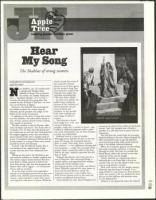
Debowlis song of triumph.
women.
The haftorah is drawn
from Judges 4:4 - 5:31, and
concerns Deborah,
encounter the third of this week's strong Jewish
prophet, judge and "a mother in Israel," who
women, Yael. Her husband was a Kenite, a
resided or rendered judgment under a palm
member of a tribe that lived in peace with the
tree north of Jerusalem, not far from the pres-
Canaanites.
ent-day city of Ramallah.
Yael told Sisera he could elude the pursuing
Deborah lived in a time of trouble.
Barak by hiding in her tent. Sisera accepted her
Although Joshua had led the Jews to the con-
offer and ducked under a rug. He asked for
quest of Canaan, the Canaanites had not
water and she gave him milk, which induced
given in easily. Their king, Yavin, with his
sleep in the already exhausted deserter.
iron chariots — a war implement the Jews did
When the Canaanite general was fast asleep,
not yet possess — under the command of his
Yael took a hammer and drove a tent peg
general, Sisera, turned the table on the Jews
through his head. She then ran outside and
and for 20 years "mightily oppressed the chil-
found Barak, whom she invited to see what
dren of Israel."
remained of the man he sought.
Deborah decided the time had come for a
Clearly, Yael felt no compunction about
war of liberation. She summoned Barak, a
betraying the trust Sisera had in her as an
capable soldier, and appointed him military
putative ally, nor was she afraid to kill a man,
commander of the Israelite army.
even in so gruesome a manner.
Accompanying him to the north, near Mount
With total victory over her people's enemy,
Tabor, Deborah exploited the rainy season in
Deborah sang her song of triumph. It is a
Israel and directed Barak to attack the
song of faith in God, praise for those Israelite
Canaanite army near a rain-swollen river.
tribes that joined in the war, disdain for those
With Yavin's chariots stuck in the mud, the
that sat on the sidelines and sarcastic scorn
Israelites annihilated Sisera's forces.
for the defeated foe.
Sisera himself ran away; then he happened to
Deborah is not squeamish about the violence
1/18
2002
•
• •:.
na
\t wal k
57