

This Week
News Digest
Taking Fire
A shrinking group ofArab recruits into the IDF are in a no-win situation.
GIL SEDAN
Jewish Telegraphic Agency
Hai a
eath has been a guest in too many Israeli
and Palestinian homes during the past 16
months, the heavy toll of the Palestinian
intifada (uprising). But it is not often that
Arab soldiers die serving in the Israel Defense Forces.
The four soldiers killed last week near Kibbutz
Kerem Shalom near the southeastern border of the
Gaza Strip served in the Desert Patrol Unit, a special
unit that in recent years has been in charge of securi-
ty patrols along the Gaza Strip.
Most of the soldiers in the Desert Patrol Unit are
Bedouin, members of nomadic tribes who, through
centuries of desert wandering, have acquired special
pathfinding skills.
Since its early days, the IDF has recruited Bedouin
pathfinders. The unit also includes Christian and
non-Bedouin Arabs.
Two and a half years ago, then-Defense Minister
Moshe Arens set a target of enlisting 800 Bedouin
soldiers this year.
However, the intifada, the Israeli Arab riots in
October 2000 which led to the deaths of 13 Arab
citizens at the hands of Israeli police, and ongoing
discrimination against Arabs and Bedouin in Israel
have cut that number considerably. It now is doubt-
ful that even 200 Bedouin will volunteer for the
IDF this year.
In addition, increasingly radicalized Arab legisla-
tors and propaganda efforts backed by the
Palestinian Authority are further eroding Arab citi-
zens' allegiance to Israel.
One major force working against Arab enlistment
is Israel's Islamic Movement. The radical group
reportedly raised more than $30,000 during
Ramadan for scholarships for Bedouin students.
Thus, when a Bedouin youth must choose between
1/18
2002
18
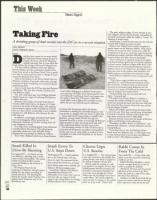
Israeli soldiers belonging to a Bedouin border patrol
unit stand near the bodies of two Hamas gunmen who
were killed after attacking an Israeli army outpost near
the southern Gaza Strip. The gunmen killed three
Israeli soldiers and an officer and wounded two more
before they were shot dead during the infiltration.
studying with all expenses paid by the Islamic
Movement or enlisting for potentially dangerous mili-
tary service at a meager salary, the choice is rather clear.
Arens, head of the Knesset lobby on behalf of the
Bedouin, recently raised $30,000 through the
Abraham Fund for a project to encourage 20 Bedouin
high schoolers to enlist, promising them help with
their studies both before and after army service.
The decreasing number of Arab volunteers also is
a function of the general atmosphere among Israel's
Arabs. Last year, an Arab soldier, a resident of Acre,
was killed in a clash with Hezbollah on the border
with Lebanon.
The qadi, religious judge, of Acre refused to pro-
vide religious services for his funeral, and leaders of
the Arab community called the soldier a "traitor" for
enlisting in Israel's army.
Arab society in Israel has become even less tolerant
of Arab IDF soldiers in recent months.
Reserve Gen. Rafael Vardi recently completed a
special report on the Bedouin soldiers. Vardi report-
ed they are scorned in their community, suffer dis-
crimination in the army, enjoy few opportunities for
professional mobility and face difficulties in finding
security-linked jobs after they are discharged.
That is only part of a general situation of neglect
and discrimination against the non-Jewish segments
in Israeli society. Bedouin villages suffer from a lack
of land reserves and housing development projects,
Bedouin towns in the Negev have the highest unem-
ployment rates in the country, and education and
health projects are far below the national average.
Some Bedouin settlements lack running water and
electricity.
"Only when a tragic incident occurs do they
remember us," says Mohammad Sawayyid of Bar-
Ilan University, a Bedouin from northern Israel.
Sawayyid is convinced young Bedouins join the
army not as a means of livelihood but because they
want to integrate into Israeli society.
"Unfortunately, they do not enjoy full civil
rights," Sawayyid said.
The attack near Kerem Shalom is unlikely to
increase the number of Bedouin recruits. Young
Arabs have learned the hard way that once they join
the army they face criticism from their own society
and the danger of death.
Before the intifada, patrols along the Gaza border
used to be easy. Now they remind many of the dead-
ly patrols in southern Lebanon before Israel with-
drew from its security zone in May 2000.
Bedouin activists worry that the deaths of the four
soldiers could further erode enlistments.
"Nowadays, in effect, there's no enlistment," says
Salameh Abu Ghanem, a veteran enlistment activist
among Bedouin.
"In another year or two, the Bedouin Desert
Patrol won't be a Bedouin unit, or will simply cease
to exist, because there won't be any more Bedouin
ready to serve," Abu Ghanem predicts. P1
Israeli Killed In
Drive-By Shooting
Israeli Envoy To
U.S. Steps Down
Clinton Urges
U.S. Resolve
Rabbi Comes In
From The Cold
Jerusalem/JTA — An Israeli woman
was killed in a shooting near a settle-
ment outside of Jerusalem. The attack,
which wounded another woman,
occurred Tuesday at the entrance to
Givat Ze'ev.
The Popular Front for the
Liberation.of Palestine claimed respon-
sibility for the attack, according to
Israeli television. The shooting fol-
lowed the murder earlier Tuesday of an
elderly Israeli-American man in the
Bethlehem area.
Washington/JTA — Israel's ambassa-
dor to the United States will step
down in April. No successor has yet
been named for David Ivry, as Israeli
party leaders argue over a suitable can-
didate to fill the prestigious post.
Israel Prime Minister Ariel Sharon
reportedly favors former U.N.
Ambassador Dore Gold, who is seen as
someone who can improve Israel's
image in the United States, but Foreign
Minister Shimon Peres is opposed.
Los Angeles/JTA — The United States
must stay involved in the Middle East
peace process, even when it appears to
be failing, President Clinton said.
Clinton made his remarks to a sell-
out crowd in Los Angeles of more than
6,000 listeners Monday evening at the
kickoff of a University of Judaism lec-
ture series. Even though the United
States may risk its prestige in an unsuc-
cessful effort, "We will be judged by
what we tried. It is better to try and fail
than not to try at all," Clinton said.
New York/JTA — A New York rabbi
failed to set the record for remaining
inside an ice hut.
Rabbi Abraham Abraham, a senior
citizen, emerged from his ice but in
order to prepare for Shabbat.
Abraham's 54 hours and 54 minutes
fell short of the record set by Wim
Hof, who lived in a tube of ice cubes
for more than 60 hours.
Abraham was fully dressed and did not
come into contact with the ice, but said
the temperature inside his but hovered