

C ommu nity
Cover Story
:;;;;;W: ,
Celebrations
FOR EVERYONE
O
O
President, past presidents and
executive directors look to past
and future as 75th anniversary
activities continue.
,
SHARON LUCKERMAN
Staff Writer
L
,
inda Lee of West BlOomfield remembers
swimming and roller skating at the old
Dexter-Davison JCC and "doing cof-
fees" to raise money to build the Jimmy Prentis
Morris Building in Oak Park.
Little did she imagine then that she would be
president of the Center (1990-92) and lead it
through the first "truly continental Maccabi
Games" when a record 15,000 people came to
the opening event at the Palace of Auburn Hills
in 1990. "It was spectacular," she says.
She and another past president, Douglas
Bloom of Birmingham (1994-96), now serve as
co-chairs of the JCC's yearlong 75th anniver-
sary celebration.
"We have to stay tuned to the times," says
Lee, pointing out how the indoor tennis courts .
at the West Bloomfield JCC were torn down
for an in-line hockey rink. Seven-hundred new
families joined since that change, according to
David Sorkin, JCC executive director.
"We try to stay on the cutting edge of com-
munity needs," Lee says.
Current JCC President Sharon Hart agrees.
"Once the JCC served as a neighborhood cen-
ter as at the Meyers and Curtis building," she
says.
She remembers when kids biked and walked
to the Center, and when she was president of a
teenage social club that had bake sales and
watched guys play basketball.
"But now, Jews are dispersed;" she says.
"They have to drive, so you don't just drop in
[at Maple-Drake] to swim. There's a new
emphasis at this Center on informal Jewish
education."
CELEBRATIONS on page 28
Linda Lee
1/4
2002
26
Douglas Bloom Sharon Hart
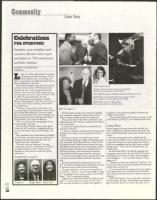
Clockwise from top left:
Northwest Activities Center director Larry Edwards
with JCC executive director David Sorkin.
Pianist jeHaas plays at Northwest Activities Center open house.-
Melba Winer started the first JCC theater group in 1953.
Here she shown in a later photo by Irene Bayer.
Melba Winer and Irwin Shaw, former
JCC executive director, at the open house.
JCC from page 25
The front lobby and the north wing of the building
were completely remodeled: A grant from the Ford
Motor Company helped renovate the auditorium.
"This was the heart of the Jewish community," said
Lillian Bernstein, 85, of Detroit, speaking of the Meyers
and Curtis Center.
An early JCC member, Bernstein remembered the
precursors to the JCC.
"I will never forget the -experience of receiving my first
diphtheria shot at age 5 and crying all the way home,"
she said.
Back then, the center of Jewish Detroit was the
Hannah Schloss Building on High and Hastings streets,
later named the Detroit Jewish Institute. There, Jewish
immigrants learned English, received medical care, got
help finding employment, met in social groups and par-
ticipated in sports. Though not yet called the JCC, it
was built as the first center of activities for Detroit's
United Jewish Charities and the Jewish community.
"It was the mother lode for many agencies that would
later form the Jewish Welfare Federation," Bernstein
said.
She later joined the first building identified as the
JCC in Detroit (at Woodward and Holbrook), eventual-
ly named the Aaron DeRoy Memorial Building.
The sense of history is not lost on the occupants of
the NWAC. "We have a sense of responsibility to a lega-
cy," said Maggie Porter, current secretary of the NWAC
board. "This is a wonderful building."
Peggy Grand of West Bloomfield was thrilled to see it
again. "I've come back to my roots," she said. "It's so
nice to see the old and -new members here together. I
would love to see more joint programs [between the
NWAC and the JCC]."
"That's exactly what the JCC hopes to continue," said
Andy Roisman of the JCC, who coordinated the event.
Living His tory
Several people at the open house older than 80, like
Shaw and Bernstein, reminisced about the Center and
how it affected the Jewish community and their person-
al lives.
Bernstein commented on the multiple roles the
Center served at different times. At first, she said, it was
a place for immigrants, a meeting place for everyone,
unlike the synagogues then that were based on ethnic -
backgrounds — "there was the Hungarian shul, the
Russian shul."
But after World War II, Jewish life expanded, and
synagogues moved north, she said. The JCC became a
meeting place for all Jews no matter what synagogue
they belonged to — or if one didn't belong to a syna-
gogue at all.
"Religious activities were weakening," said Shaw, "but
the one place that still provided programs that attracted
modern Jews was the JCC.
"So many people had the opportunity to get together
here, opportunities they wouldn't have had anywhere
else [with the divisions between the different streams of
Judaism]."
Melba Winer agreed. "It was a place for everybody to
do their thing," she said. "The Jewish Parents Institute
got its home at the JCC in the late '40s, early '50s. It