

ELIZABETH APPLEBAUM
4,ft•
v(..0
• •
•
,
"
:•Z;,#-: ?'"r
5 l
AppleTree Editor
IV
hether you'll be with
a parry of pals, trip-
ping the light fantas-
tic and bringing out
the champagne — or just hoping
you'll make it to 9 p.m. (young chil-
dren can do that to you), the secular
new year is just around the corner.
Much of the world is making reso-
lutions. But what does a new secular
year mean for us as Jews?
It may mean nothing. After all,
our new year, Rosh Hashanah, start-
ed several months ago.
b Or, , we can
choose to make it something special.
\XTe can choose to make it a time
when we decide to think in a new
way about our Jewish lives. Maybe
this will be the year we actually give
10 percent of our income to
tzedakah, as is the•mitzvah (com-
mandment); or maybe this will be
the year we start to learn something
we've never learn eebefore, or even
imagined we could learn.
Below are 12 ideas, one for each
month, that can help you get started.
z
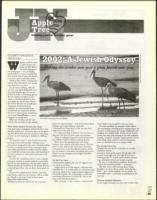
Are storks mentioned in the Bible?
What About Judaism Interests You Most?
One great aspect of Judaism and Jewish life is that
there's so much of it. Of course, that can be daunt-
ing. But don't think }rou have to know everything
at once, or ever. Learning in Judaism is a lifelong
project.
The Rarnbam said, 'A man should never stop
learning, even on his last day." Perhaps you've
always been intrigued by the story of Joseph and his
brothers, or maybe you've been wanting to learn
more about Jewish life in medieval times. Maybe
you would like ro hear more about the founding of
the State of Israel, or what makes cod kosher and
shark treif.
If you're still wondering where to start, consider
your own interests in secular subjects or your hob-
bies. If you love gardening, why not take a look at
flowers and fauna mentioned in the Torah? If you're
a devoted sports fan, why , not learn about sports in
Israel?
Once you've pinpointed an interest, visit your
local library, check out the Internet, talk to a rabbi
or a friend, or pick up a book to learn more.
Room For Improvement.
Whether he wants to admit it or not, everyone
knows his shortcomings — and everyone has them.
Perhaps you've been hearing words like
"Chumash"and Torah all your life, but you don't
really know what they are.
Or maybe you hate to admit it, but you have no
idea how the State of Israel came into existence.
There is nothing wrong with not knowing; there
is a problem with not doing anything about it.
Write down five questions you have about
Judaism, then resolve to find the answers. The best
place to start, and it won't cause you a moment's
embarrassment, is the EncydopediaJudaica, which
has the answer to just about everything and can be
found in most synagogue and temple, and often
public, libraries.
To Tell The Truth.
Unfortunately, Judaism has a lot of "experts" who
are expert at nothing.
Imagine how we would regard a politician who
identified the U.S. Constitution as a document that
advocates support for a single national religion and
limited free speech. Yet, inexplicably, we allow for
astonishing distortions in Jewish life. Now is the
time to do something about it.
Take a concept — any concept — and research.
You're likely to be amazed by what you learn.
Consider tzedakah, for example. Some believe •
this encompasses everything from supporting an art
museum to helping pay for a huge wedding for the
daughter of a leading rabbi. These may be worthy
causes, but they have nothing to do with tzedakah.
Instead, "tzedakah" (literally, "righteousness") means
only aiding those unable to care for themselves,
such as a disabled man or an orphan child.
Do A Little Every Day.
Imagine that you decide to become an a world-
champion runner —
tomorrow. Sure, you're a good 30 (all right, 40)
pounds overweight and your idea of exercise is
walking to the TV to pick up the remote; becom-
ing a champion runner just sounds so good.
So, too, is it ridiculous to suddenly decide you
need to do everything Jewish — tomorrow.
The best way to start learning about living
Jewishly is to do it a bit at a time. Each day, do a
little — give a little tzedakah, say one prayer, eat
one kosher meal — and then try adding more the
next day.
Discover Judaism's Mysteries.
.
As you begin learning, you may want to start with
12/28
2001
69