

INSIDE:
Community
Calendar
34
Mazel
Toy!
36
.44 4 digia:
making
The Grade
AJE speaker stands up for every student's right to learn.
DIANA LIEBERMAN
Copy Editor
W
hat did you learn in school today,
honey?" "Nothing."
According to Nancy Weber, your child
may very well be telling you the truth.
Every student comes to school with a different amount
of prior knowledge, a different learning style and a dif-
ferent rate of learning. And, if teachers merely aim for
the norm in these three areas, they may be successfully
reaching only one-third of the class.
"The notion is that one-third of a given class are not
yet ready to learn, one-third are ripe and ready to learn,
and one-third already know the material or learn twice
as fast," Weber said.
As guest speaker for the Agency for Jewish
Education's fifth annual Day School Conference,
Weber explained the methods and advantages of differ-
entiated teaching — how to teach students of varied
abilities in the same classroom so that the greatest
number of them will actually leave school for the day
having learned something.
The event, which took place Nov. 29 at Yeshivat
Akiva, is designed for teachers and administrators from
Akiva, Bais Menachim Academy, Darchei Torah, Hillel
Day School of Metropolitan Detroit and Yeshiva Beth
Yehudah. It is presented each year by the Agency for
Jewish Education and its Opening the Doors special
education department.
Weber explained that equality in education does not
mean that every child is equal in background or ability.
Instead, it means that everyone has an equal right to
have his or her needs met in the classroom.
"Every child has a right to high self-esteem, to learn
something new every day and to be in a full-time
learning environment," she said.
Weber emphasized that she doesn't believe learning
has to be fun. But it does have to be interesting.
Here are a few of her specific suggestions to teachers
for meeting the needs of the entire spectrum of learn-
ers:
• Pre-test to rind out who already knows the material.
Have other meaningful materials for those who pass
the pre-test, but base their grade on the classroom cur-
riculum. "Otherwise, it's like I do a great job of clean-
ing the basement, so, as a reward, I get to clean the
garage," she said.
• Form cooperative groups to accommodate those who
are social learners — who need to bounce ideas off of
others instead of sit-
ting in a corner by
themselves. But
make sure the
groups are formed of
students with abili-
ties that are not
overly dissimilar.
And never give a
group grade. It will
only penalize the
faster learner.
• Instead of calling
just those students
whose raise their
hands, have them
write their names on
index cards. Shuffle
and choose a differ-
ent card for each
question. Students
who know they
won't be called on
unless they raise
their hands have less incentive to pay attention.
"To the extent that students participate, they
learn," she said. But, if someone doesn't know the
answer, don't leave them hanging — tell them in a
nonjudgmental way.
Weber practiced these techniques and others on
teachers in the audience, leaving most eager to go
back to their classroom and start following her
advice.
"I thought she was great. She gave good, con-
crete examples," said Shani Meer, a teacher with
P'tach, a private special education service that pro-
vides resource rooms at Orthodox day schools. "A
lot of times, speakers give advice that's not practi-
cal enough to implement. This time, they was a
lot I cam use."
Debbie Migdal teaches in the Opening the
Doors program at Yeshivah Beth Yehudah and is
also a reacher at Congregation Shir Tikvah's sup-
plementary school.
"Nancy's ideas were very pertinent for regular
and special education — for everyone," Migdal
said. Li
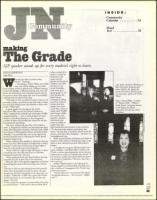
Left: Rabbi Avraham Weinberg of
Bais Menachim Academy and
Anita Naftaly, the Agency for
Jewish Education's director of spe-
cial education, speak with Nancy
Weber.
Below: Nancy Weber, co-author
of "Teacher Talk — What It
Really Means" and guest lecturer
at the Agency for Jewish
Education's annual day school
conference.
12/28
2001
29