

BARBARA LEWIS
Special to the Jewish News
O
n her first night at summer
camp, Linda Foster burst into
tears — but not because she
was homesick.
"The other girls were crying
because they were upset about being
away from home, so I started crying
too," said Foster, a West Bloomfield
mother of three.
Camp turned out to be "the best
experience of my life," she said. "On
the last day, when the buses pulled in to
take us home, then I cried for real."
Warm memories of outdoor activi-
ties, camaraderie and personal growth
inspire today's parents to send their own
children to camp.
1 lived for camp," said Liz Schubiner
of Bloomfield Hills, who
grew up in Manhattan
and attended camps
in New
Hampshire and
Maine. 1 loved
being away
from home
on my own.
I loved the
sports, the
singing, the
campfires ... I
probably did-
n't like the
food, but there
wasnt anything
else about camp
I didn't like."
As soon as her
daughters, Andrea,
14, and Julie, 11,
were old enough,
Schubiner made sure
they had similar expe,
riences. The girls have been to Camp
Tamarack and Camp Tanuga in
Michigan and now go to Camp
Chateaugay in upstate New York.
Summer camps started in the early
1900s as a way for city youngsters to get
out into the country. Even today, when
getting away from crowded, hot city
streets is no longer an issue in the Jewish
community, overnight camp offers a
unique opportunity for children to go
off on their own, make their own deci-
sions and learn to live with each other,
said Neal Schechter of West Bloomfield,
who ran Camp Walden in Cheboygan
from 1959 to 1995.
"At camp, kids learn new skills, they
learn to socialize. It's a microcosm of
life," he said. "Even if they only go for
one or two weeks, it's an experience
they'll remember as long as they live.
People come up to me now, all grown
up, who I knew at
camp years
ago, and they tell me it was the best
experience of their lives."
Opportunities
Summers at Camp Tamarack gave Linda
Foster many opportunities she wouldn't
otherwise have had. "My parents could-
n't afford to take us on vacations," she
said. "Being outdoors all day, with
friends, was a wonderful escape. The
canoe trips, the hiking trips — there's
no other way I could have had an
adventure like that.
"Camp also allowed you to do things
you couldn't do at home. Within limits
you could be silly, you could be wild."
Foster said she "couldn't wait" for her
own kids to feel ready for camp. Josh,
17, Zachary, 16, and Marni, 8, have
attended Tamarack Camps and Camp
Ramah.
Many Jewish parents feel their cultur-
al identity was strongly influenced by
Jewish camps.
"It wasn't a structured envi-
ronment like school, but we
were learning all the time,
immersed in Yiddishkeit,"
said Mark Goldsmith of
Huntington Woods, who
spent many summers at
Camp Ramah, the summer
camps of the Conservative
movement. "We were sur-
rounded by knowledgeable
people. It was a seamless
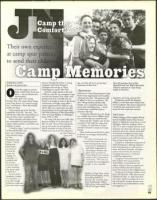
Buddies at Camp Tavor: Aimee
Flood of Grand Rapids, Ariana
Stranndberg-Peshkin of
Evanston, Ill., counselor Elana
Porat of Milwaukee, Hillary
Miller of Ann Arbor and Marni
Falk of Huntington Woods.
Back left: Jonathan Kirik of West
Bloomfield and Dan Wolf of Bloomfield
Hills pose with pals at Camp Young
Judaea in Wisconsin.
experience of living a Jewish life."
Goldsmith wanted his daughter,
Molly, 9, to feel that same warmth and
love for Judaism. She went to Ramah for
a week last year and loved it; she'll
return for four weeks this summer.
Li'? Lessons
Debbie Salinger of Huntington Woods
learned indelible lessons about Zionist
history at Habonim Camp Tavor in west
Michigan, where her daughter Marni
Falk, 13, is now a camper. She has vivid
memories of a three-day, all-camp pe'ula
(activity) where the campers pretended
to be Jewish immigrants trying to get
into Palestine in the 1930s and 1940s,
and the counselors acted as British sol-
diers trying to keep them out.
Camp is an important component of
child development, offering independ-
ence and recreation in a safe environ-
ment, said Renee Deroche, Michigan
section executive - for the American
Camping Association, a voluntary
accrediting organization.
Camps are "kid communities" that
help children learn accountability,
responsibility resourcefulness and
respect, and give them an opportunity
to meet children they don't already
know from school or the neighborhood.
Camps are as vital now as they've ever
been, said Deroche. "After [the terrorist
incidents of] Sept. 11, kids more than
ever need a chance to escape, to be in a
safe and healthy outdoor environment
where they're not bombarded by media
and negativity"
❑
12/21
2001