

Spirituality
Lear11111
How
To
Grieve
Dorfman Chapel opens
non-denominational
bereavement library.
ALAN ABRA•S
Special to the Jewish News
T
he horrific events of Sept.
11 have seared the images
of coping with the loss of
a loved one into our col-
lective psyches.
There always has been a need for
bereavement libraries where families can
find videotapes or books to comfort
them in their loss. With this year's collec-
tive tragedy on his mind, Jonathan
Dorfman of the Dorfman Chapel in
Farmington Hills realized the time was
right to provide this service. He began
the collection earlier this month with 20
books and videotapes and hopes to build
the library through future acquisitions.
"If there is a book that particularly
helped someone, we would really like to
have it here to help others," said
Dorfman, 32, of Birmingham.
He first got the idea of the library
from Dr. John Canine (pronounced
KAH-nine), a Wayne State University
psychologist who taught Dorfman.
Canine, whose private practice oper-
ates under the name of Maximum
Living in Birmingham, runs aftercare
programs for funeral homes as well as
support groups.
Dorfman worked for Canine from
1996 until 2000, running support
groups and providing counseling
"mainly at night, until I had to stop
because it took too much
time away from my wife
and children," he said.
"The need for a bereave-
ment library is exceptionally
high," said Dr. Sandra
Lyness of Bloomfield Hills,
another of Dorfman's former
teachers.
Now retired from WSU, she main-
tains a private practice as a psychologist
and often deals with bereavement issues.
"Because of Sept. 11, we are feeling
mortality more," Dr. Lyness said.
"People certainly do not know as
much about Jewish feelings about death
as they do about holidays. It has always
been easier for Jews to deal with bar
mitzvahs and other festivals of life than
with death. Unless it occurs, death and
thinking about death can be put off
until tomorrow."
Providing Knowledge
Dr. Lyness said that, although thinking
about death and dying is often difficult
for older people, they still need to sort
out their feelings.
"They come in frightened or
depressed," she said. They ask ques-
tions such as 'Is there an afterlife?' You
try to help them become more knowl-
edgeable. One way to overcome feel-
ings of fear of the unknown is to read
about the subject.
And the more you read, Dr. Lyness
said, the more secure you feel. "There is
a need for people to have a greater
understanding. A bereavement library
gives them what Jews have always had
— education," she said.
"We now have the oldest generation
we have ever had. But even older Jewish
people raised here have carried with
them the superstition and folklore of the
ghettos of Europe. And Europe is loaded
with myth, mystique and the fear of
death."
Dorfman said most existing after-
care programs at funeral homes and
support groups require the family
member to go to counseling. "But
with the aid of the bereavement
library, education can be done by
themselves at their own pace."
Open To All
The library is not just limited to use by
the bereaved. "It is there for use by edu-
cators, clergy, therapists and other pro-
fessionals," said Dorfman.
He estimates that 90 percent of the
books are non-denominational.
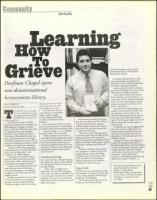
Jonathan Dor an with one of the
bereavement books in the Dorfman
Bereavement Library.
,
Dr. Lyness said any book or video-
tape that provides counseling to the
bereaved on how to deal with the death
of a child is especially invaluable.
Another issue she raised is coming to
grips with the feelings of survivors about
where family members are buried.
"If the older member of the family
lived in Florida and is buried there, as a
result, there can be a feeling of abandon-
ment," she said. "But through reading,
families can realize they also have the
ability to plan for it."
She believes that when dealing with
people at the crisis point of death, view-
ing videotapes, such as those at the
Dorfman Bereavement Library, may be
easier and more helpful than reading
books. That's because people may not be
able to concentrate as easily upon the
printed word.
In addition, Dr. Lyness suggests fami-
lies create an oral or taped history of
family members, especially those who
are older, so the person who may be
dying knows they will continue to live
through memory.
Among the books at the Dorfman
Library are the pioneering works of .
Elisabeth Kubler-Ross, The Jewish Way of
Death and Mourning by Maurice Lamm,
Straight Talk about Death for Teenagers
and Suicide: Prevention, Intervention and
Postvention both by Rabbi Earl
Grollman, and Healing a Teen's Grieving
Heart by Dr. Alan D. Wolfelt.
❑
The bereavement library, locat-
ed at the Dorfman Chapel,
30440 12 Mile Road,
Farmington Hills, is open from
9 a.m.-5 p.m. Monday through
Thursday; it closes by 3 p.m.
on Friday.
\
.\\
\
12/21
2001
47