

Silver Streak
With the largest body of surviving work by a European or American
Jewish silversmith prior to the 19th century, colonial Jewish silversmith
Myer Myers comes to life in book and exhibit.
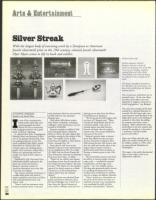
Clockwise from left:
Exhibit organizer David L.
Barquist, associate curator of
American decorative arts at the Kite
University Art Gallery, considers
colonial silvermith Myer *fyers'
Torah finials with intricate decora-
tive details the best examples of his
work.
This bowl, intended to function as
the "slop bowl" of a tea service, is on
loan to the exhibit from the Detroit
Institute of Arts.
This circumcision shield bears the sil-
versmith's name. 'At the time Myers
was alive, silver objects were very
important in religious ceremonies in
Jewish congregations," says Barquist.
SUZANNE CHESSLER
Special to the Jewish News
I
n one of his commentaries,
Maimonides stated that corn-
missioning gold and silver
objects for use in connection
with synagogue services was a good
deed, worthy of a blessing.
In colonial New York, Congregation
Shearith Israel was fortunate to have
one of the greatest silversmiths of the
era crafting works for its use. The
newly published Myer Myers: Jewish
Silversmith in Colonial New York
includes many eye-catching photo-
graphs of his creations, along with a
history of a pioneering artist and
insight into early Jewish culture in
America.
Published by Yale University Press
($60 hardcover/$35 softcover), the
book was written by David L.
Barquist, associate curator of
American decorative arts at the Yale
University Art Gallery.
The volume combines the beauty of
a coffee-table book with hard-to-
obtain material on the history of New
York colonial Jewish history and
Myers' work.
"Myers' work has enormous value
because American silver is rare and
12/7
2001
86
early American silver has not survived
terribly well over the centuries,"
Barquist says.
Only about 400 objects remain
from Myers' workshop, including a
coffeepot, which last January was auc-
tioned for $100,000.
Barquist curated an exhibit of 104
silver and gold objects created by
Myers as well as 50 other objects that
provide a setting for the artistry of the
time. The exhibit will be at Yale
University Art Gallery in New Haven,
Conn., through Dec. 30.
From there it will move to the
Skirball Cultural Center and Museum
in Los Angeles from Feb. 19 to May
26, 2002, and the Henry Francis du
Pont Winterthur Museum in Delaware
from June 20 to Sept. 13, 2002.
"Pieces for the exhibit were chosen
according to how they fit into the sto-
ries being told about Myers," the cura-
tor says. "The objects are not represen-
tative of his shop's output as a whole.
The focus is on the extraordinary
objects rather than the ordinary
objects."
Exhibit pieces were obtained from
public and private collectors, and a
few have Michigan ties. A bowl is on
loan from the Detroit Institute of
Arts, while a coffeepot stand and cov-
ered jug are on loan from the Henry
Ford Museum in Dearborn.
"We borrowed all of the Judaica that
we know of," Barquist says. "These
include the Torah finials and the cir-
cumcision shield. I also tried to
include objects that had histories
because we knew who the original
owners were. The owners themselves
were part of the story."
Barquist's project seeks to demon-
strate that Myers was the most pro-
ductive silversmith working in New
York during the late 18th century and
that his ritual and secular silver is the
largest body of extant work by a
Jewish silversmith from anywhere in
Europe or America prior to the 19th
century.
The silversmith's renown came from
his ability to execute quality custom--
order work — candlesticks, pierced
breadbaskets, covered jugs, cruet
stands — for very wealthy patrons.
His shop also generated steady income
by satisfying the demand for more
modest forms of hollowware and flat-
ware for a larger, less affluent clientele.
"Myers' success as a silversmith was
the result of his talents not only as a
craftsman but also as an entrepreneur
who marshaled the skills of other
craftsmen and specialists," Barquist
The only extant example of this form
marked by a Colonial American sil-
versmith, this dish ring is also a per-
sonal statement made by Myers at the
height of his career as the leading sil-
versmith in New York. By striking
his surname mark twice, writes
Barquist, "Myers claimed this excep-
tional object as his own creation and
asserted his equality, as a Jew and as
a 'mechanic,' with the wealthy
patrons of his labor"
Myers most likely made this soup
ladle with wooden handle for one of
his children, Judith, in 1784, when
she married Jacob Mordechai of
Philadelphia.
This teapot is the earliest documented
object to bear Myers' mark as an
independent craftsman.