
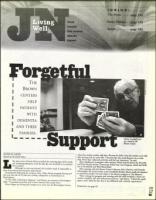
THE
BROWN
CENTERS
HELP
PATIENTS
WITH
DEMENTIA
L
RONELLE GRIER
Special to the Jewish News
ike many sons, Dennis Morse avoided the warning signs of his moth-
er's increasing dementia until the day she was involved in an automo-
bile accident.
Although no one was injured, the incident made it impossible to
deny how serious her situation had become.
Immediately following the accident, Mrs. Lillian Morse stopped driving and
also quit her job of 25 years as a jewelry salesperson at Greenstone's in
Birmingham.
"It was really a blessing in disguise," said Morse, an attorney in Farmington
Hills. "It opened everyone's eyes to how extensive her needs were."
Morse began by hiring daily caregivers to come into his Birmingham home,
where his mother resides with him. Because he didn't want his mother to be idle
after having such an active life, "I became like the social director on a cruise
ship. Every day, I planned activities and laid out itineraries," he said_
After deciding to investigate other options, Morse learned about the Dorothy
and Peter Brown Jewish Community Adult Day Care Program, which has facili-
ties in Southfield and West Bloomfield.
After meeting with the Brown Center's director, Peter Ostrow, and Dorothy
Schmittdiel, the social worker at the Southfield facility, Morse made the decision
to enroll his mother. He now refers to the Brown program as "his lifesaver."
"After visiting the program and meeting with the staff members, I knew my
mother would be safe and well-protected there," said Morse. "I liked the social
aspect, and I liked the fact that it was affiliated with a Jewish organization."
FORGETFUL on page 96
IN
11/30
2001
Scanned image of the page. Keyboard directions: use + to zoom in, - to zoom out, arrow keys to pan inside the viewer.
November 30, 2001 - Image 131
- Resource type:
- Text
- Publication:
- The Detroit Jewish News, 2001-11-30
Disclaimer: Computer generated plain text may have errors. Read more about this.