

REr
Running For. Rachel
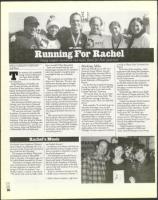
Young couple's marathon run raises funds for Rett syndrome.
SHELLI LIEBMAN DORFMAN
StaffWriter
T
he memory of a remarkable
young woman helped moti-
vate Tracy Roth and Jeff
Aronoff, to run their first-
ever marathon.
Rachel Kopelman of Franklin was
only 20 years old when she died last
December of Rett syndrome, a neuro-
logical, developmental disorder. A few
months later, Roth and Aronoff con-
tacted Rachel's parents, Jeff and Sandra
Kopelrnan, with the idea of running a
marathon in her honor.
Roth has known Rachel's sister, Lisa
Fenberg, since their days at Tamarack
Camps 16 years ago. Aronoff is a close
friend of Lisa's husband Aaron Fenberg.
"We were just overcome," says Jeff
Kopelman. In return, he and his wife
promised to be there to see the two run
in the Oct. 7 LaSalle Bank Chicago
Marathon. They were joined by friends
and family, including the Fenbergs, who
came from Portland, Ore., and the run-
ners' parents, Susan and Richard Roth
of Bloomfield Hills and Sheila and
Mery Aronoff of West Bloomfield.
Roth and Aronoff, both4125, had
already begun training for the marathon
when they decided it would be more
meaningful if they ran in Rachel's
honor.
"Rett syndrome was something very
close to us," Roth says. "It's not a very
well-known disorder and we thought
raising money would help raise aware-
ness."
First described by Dr. Andreas Rett in
Austria in 1966, Rett syndrome is a
genetic disorder seen almost exclusively
in females. It affects approximately one
in every 10,000 to 15,000 live female
births, causing a loss of communication
skills, including interference of eye gaze
and speech disorders as well as motor
control disturbances. It was Dr. Rett
who diagnosed Rachel when she was
age 7.
After contacting the International
Rett Syndrome Association (IRSA) in
Maryland, Roth and Aronoff began to
seek donations. The Fenbergs gave the
pair a copy of their July 2001 wedding
list to contact the Kopelman's family
and friends, whom Roth says "were
extremely generous."
Rachel's Music
The Rachel Lynn Kopelman Children's
Music Library was dedicated Nov. 9 in
the name of the 20-year-old who died of
Rett syndrome last December.
The program was held at Wing Lake
Development Center in Bloomfield
Hills, a school for 150 students ages 3 to
26, which Rachel attended for 18 years.
"The library was begun with the pur-
chase of instruments and boom boxes
for each classroom, so teachers could
bring in CDs for the students," says
Heather Moore, a teacher at the school.
"We started with music by Raffi, which
was Rachel's favorite."
In addition to the library, the fund, set
up by Rachel's parents, brought in dona-
tions to purchase a wheelchair swing for
the school's playground.
The dedication was attended by stu-
dents and staff of the school as well as
friends and family of Rachel's parents,
Jeff and Sandra Kopelman of Franklin.
The Kopelmans each spoke at the dedi-
cation as did staff members of the center
who knew Rachel.
Those in attendance listened to CDs
of Raffi music in memory of Rachel. ❑
— Shelli Liebman Dorfman, staff writer
11/23
2001
36
Marking Miles
Roth and Aronoff met in 1991 on a
Tamarack Camps Western trip and
began dating three years ago while in
Israel on Project Otzma, a 10-month
fellowship program sponsored by the
Jewish Federation of Metropolitan
Detroit.
For the first four months of training,
the pair ran together. "At times Jeff and
I would get up at 5 a.m. and run the
Orchard Lake trail," Roth says.
"If it rained, Tracy ran on our tread-
mill," says her mom Susan Roth. "She
and Jeff went running in the heat —
some days in pain. They were definitely
driven."
Roth concedes, "It was hard to get up
that early, (but) after a run you feel
good about yourself the rest of the day."
In August, their training split into
separate courses. Roth moved from
Bloomfield Hills to Chicago to study
integrated marketing communications
at Northwestern University. Aronoff,
who grew up in West Bloomfield, now
lives in Ann Arbor where he is studying
public policy at the University of
Michigan. He also commutes to Detroit
to study at Wayne State University Law
School.
By the day of the marathon, which
happened to fall during Rett Syndrome
Awareness Month, the two were well
trained and both were able to complete
the 26.2 mile course.
Rachel's father sees the awareness and
the $5,500 raised for Rett syndrome
research as a continuation of his daugh-
ter's legacy to make the lives she
touched better.
At Rachel's Jan. 2001 funeral, Rabbi
Paul Yedwab- of Temple Israel said, "She
was unable to speak, but boy could she
communicate."
Despite her disorder, Rachel inspired
others through her determination,,
including being called to the Torah as a
bat mitzvah in her wheelchair. "Rachel
taught us everything we needed to
know about life," her father says.
While there is no cure for Rett syn-
drome, an Oct. 1999 discovery of a •
genetic mutation found in up to 75 per-
cent of those affected brings hope,
according to IRSA.
"Rachel Kopelman's family was
incredibly supportive of IRSA and
many, many friends gave in her loving