

Arts Entertainment
Jewish Book Fair
Love In The Ashes
In "The Oasis," author tells the true story of his in-laws' courtship in Dachau.
GLENDA WINDERS
Copley News Service
A
sk most married couples where they met,
and they'll probably answer at school, at
work or at the home of friends. But ask
Mirek and Blanka Friedman and they'll
answer, "Dachau."
The pair, who now live in Beverly Hills, Calif,
met in 1944. Blanka, then 19, had been deported
from her home in Czechoslovakia to Auschwitz and
then transferred as part of a work crew to camp
Muhldorf, also known as Dachau 3b.
Mirek, 23, whose fake identification papers hid
the fact that he was Jewish, had been imprisoned
because of his political activities with the Czech
underground.
"It was 'Romeo and Juliet' behind barbed wire,
and then some," said their son-in-law, Petru
Popescu, who has re-created their experience in a
memoir titled The Oasis (St. Martin's Press;
$24.95). Popsecu speaks at the Jewish Book Fair on
Sunday, Nov. 18.
Writing The Memoir
"1 had heard the story in bits and pieces, and I had
T
,
2001
84
a haunting desire to hear the rest," Popescu said in
an interview. "It seemed like a good story that
should not be lost in oblivion."
Popescu said he had been "pestering" his in-laws
for 15 years to tell him the details of their early rela-
tionship, but they had resisted going back over the
painful memories. What changed their minds was
returning to Germany for a memorial event.
Their daughter Iris — Petru's wife — advised
them not to go.
"Why give these people the satisfaction?" she
asked her parents.
But, during their pilgrimage, they took part in
the dedication of a sculpture made of scrap iron
left over from the camp, and watched as a group of
young Germans whose parents and grandparents
had been responsible for their suffering planted a
"Tree of Remembrance."
When they got home, the Friedmans said to
their son-in-law, "OK, let's do it."
Popescu spent some 70 hours taping interviews
with the Friedmans; then he traveled to Prague,
Munich, eastern Czechoslovakia and finally
Dachau to visit their past. With the help of
Holocaust historians, he researched the events they
had related and studied the psychology of death
camp survivors.
In some ways, the story wrote itself; in others,
Popescu found the task daunting.
The characters needed no creation because they
were themselves," he said. "The challenge was to get
inside and reconstruct a voice they could recognize and
to decide how to tell the story to an audience of today.
"I also thought it was incredibly valuable to cap-
ture in the book the fact that humanity will be there
almost to the end. It's not as if people did not lose
their spirit — many did — but, almost to the end,
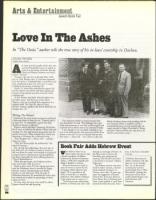
Blanka Friedman beams with joy along with her
new husband, Mirek, in uniform, and two
unidentified friends, just five minutes after the
couple married in Prague. Described as "Romeo
and Juliet" behind barbed wire, they met at the
Dachau concentration camp.
Book Fair Adds Hebrew Event
hen Shimon Peres was in
France earlier this year, he read
a French translation of Address
Unknown by Kathrine Kressmann
Taylor, a 1938 book originally pub-
lished in English in America.
When he returned to Israel in
June, he wrote an article for the
newspaper Yediot Aharonot that
began: "If it is possible to say
about a book that it is absolute
perfection, then Address Unknown
is the nearest one to come to it."
The book portrays relationship
between a German and a Jew, told
W
through an exchange of letters. As
the Nazis came to power, the
friendship grew progressively
strained, until the Jew's last letter
to his friend is returned, "Address
Unknown."
The Hebrew version was trans-
lated by Asher Tarmon, a former
Israeli shaliach (emissary) to
Detroit, more than 10 years ago,
upon the suggestion of former
Detroit JCC Executive Director
Irwin Shaw. But no Hebrew pub-
lisher would publish it until Peres
praised the book this year. Since
then, it has been a bestseller
in Israel.
A Hebrew discussion of
Address Unknown will take
place at 4 p.m. Sunday,
Nov. 18, at the Jewish
Community Center's
Jewish Book Fair in West
Bloomfield. Leading the
discussion will be local
author Rachel Kapen and
local librarian Julie
Solomon.